
Explore the fascinating world of polaron formation in quantum theory, delving into its interactions, effects, and implications in material science.
Polaron Formation: Understanding the Quantum Landscape
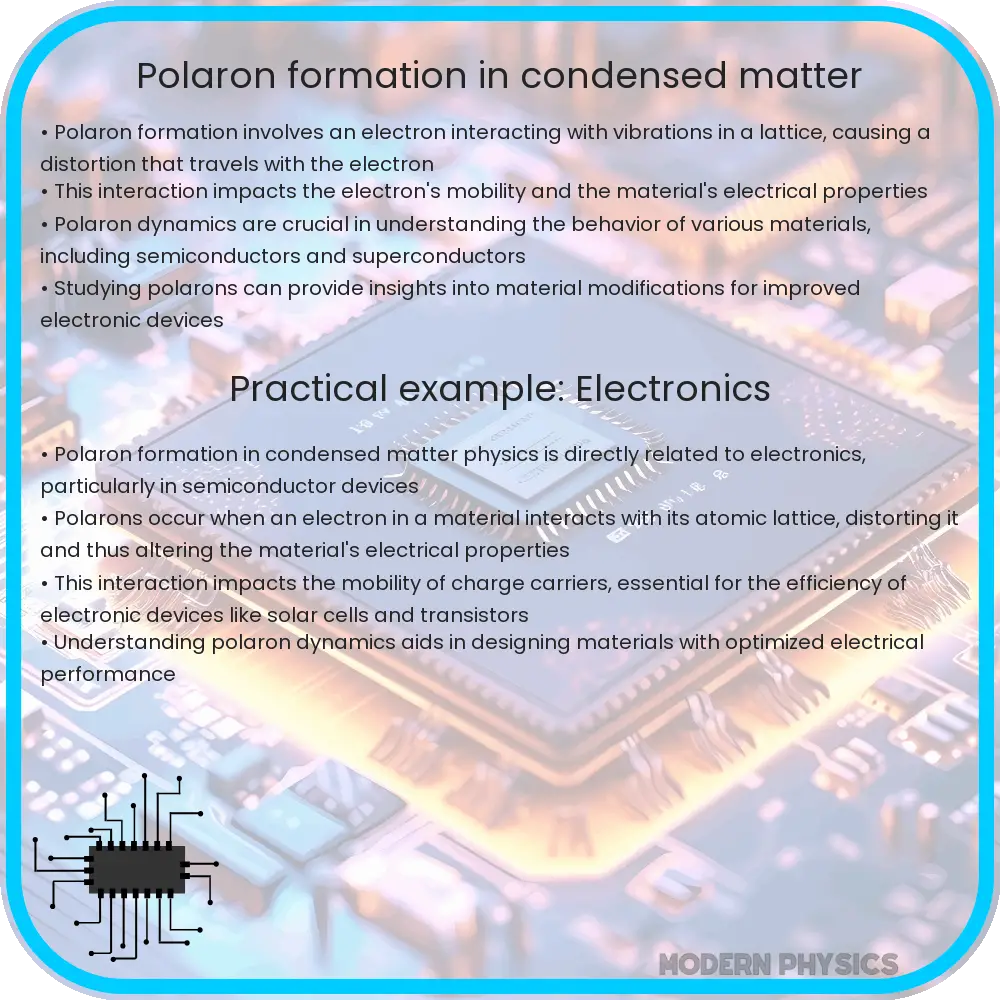
The concept of a polaron plays a pivotal role in the realm of condensed matter physics, particularly in the study of semiconductor physics and the intriguing world of quantum theory. Polaron formation is a phenomenon that occurs when an electron in a crystal lattice interacts with its surrounding lattice vibrations, leading to a unique quasiparticle. This interaction significantly influences the electron’s properties, like its mass and mobility, which are crucial in understanding various materials’ electronic properties.
At its core, polaron theory delves into the complexities of electron-phonon interaction. Phonons, the quanta of lattice vibrations, interact with an electron, causing a distortion in the lattice. This distortion, in turn, affects the electron’s behavior, effectively dressing it with phonon cloud. The electron carrying this cloud, now referred to as a polaron, exhibits altered characteristics compared to a free electron.
The formation of polarons can be approached from two distinct perspectives: large polarons and small polarons. Large polarons occur when the electron-phonon coupling is relatively weak, leading to a broad extension of the lattice distortion over many unit cells. In contrast, strong electron-phonon coupling results in small polarons, where the lattice distortion is confined to a few unit cells.
Quantum Theory and Polaron Dynamics
Quantum mechanics plays a critical role in understanding polaron dynamics. The quantum theory of polarons involves solving the Schrödinger equation, incorporating the interaction between electrons and phonons. This interaction is often modeled using the Frohlich Hamiltonian for large polarons or the Holstein Hamiltonian for small polarons.
One of the fascinating effects of polaron formation is the mass enhancement of the electron. When an electron becomes a polaron, its effective mass increases due to the additional phonon cloud it carries. This increased mass affects the electron’s mobility, which is a key factor in determining the electrical conductivity of materials.
In the context of semiconductor physics, polaron effects are particularly important. They influence the charge transport properties in organic semiconductors and other materials where electron-phonon interactions are significant. Understanding these interactions is crucial for developing new materials with desirable electronic properties.
Moreover, polaron formation has implications beyond semiconductor physics. It plays a role in high-temperature superconductivity, where the interaction between electrons and lattice vibrations is a subject of ongoing research. Polarons are also relevant in the study of biological systems, where they can influence the transport of charges in biological molecules.
In conclusion, polaron formation is a key concept in condensed matter physics, offering insights into the quantum behaviors of electrons in materials. By exploring the interplay between electrons and lattice vibrations, researchers can better understand and manipulate the electronic properties of various materials.
Interactions and Effects in Polaron Formation
The study of polaron formation extends into exploring how different types of interactions affect polaron characteristics. These interactions can be electromagnetic, strong, or weak forces, each playing a distinct role in the behavior of polarons. For example, in organic semiconductors, the electromagnetic interaction between the electron and the lattice vibrations leads to significant changes in the material’s optical properties.
Another critical aspect of polaron research is the effect of external factors like temperature and pressure. Temperature variations can alter the electron-phonon coupling strength, thereby impacting polaron formation and mobility. High temperatures, for instance, can increase phonon activity, which may enhance the polaron effect. Similarly, applying external pressure can change the lattice structure, affecting the electron-phonon interaction dynamics.
Furthermore, polaron theory has significant implications in the field of nanotechnology. In nanostructured materials, the confined dimensions can lead to unique electron-phonon interactions, creating different polaron effects compared to bulk materials. This understanding is pivotal in designing nanoscale devices, where controlling the electronic properties is essential.
Quantum Theoretical Models and Computational Approaches
To comprehend polaron dynamics in depth, various quantum theoretical models and computational methods are employed. These models aim to accurately describe the interactions and predict polaron effects in different materials. Advanced computational techniques, such as density functional theory (DFT) and Monte Carlo simulations, are crucial in these studies, providing insights that are often challenging to obtain experimentally.
One of the notable successes of these models is in the prediction and explanation of high-temperature superconductivity phenomena. The role of polarons in facilitating electron pairing in high-temperature superconductors is a subject of intense research, with theoretical models offering valuable predictions and explanations.
Conclusion: The Broader Impact of Polaron Research
In summary, the study of polaron formation is a cornerstone of modern condensed matter physics and quantum theory. It provides a fundamental understanding of how electrons interact with their environment in a crystalline lattice, leading to profound effects on the material’s properties. The research in this field has far-reaching implications, from advancing semiconductor technology to unraveling the mysteries of high-temperature superconductivity.
As the field continues to evolve, the insights gained from polaron theory are expected to play a crucial role in the development of new materials and technologies. With the ongoing advancements in computational methods and experimental techniques, our understanding of polarons is set to deepen, potentially leading to breakthroughs in various domains of physics and material science.
Therefore, polaron formation remains a vibrant and significant area of study, holding the key to unlocking new possibilities in the quantum world and beyond.