
Explore the intriguing world of pnictide superconductors, their high-Tc properties, theoretical frameworks, applications, and the future of superconductivity.
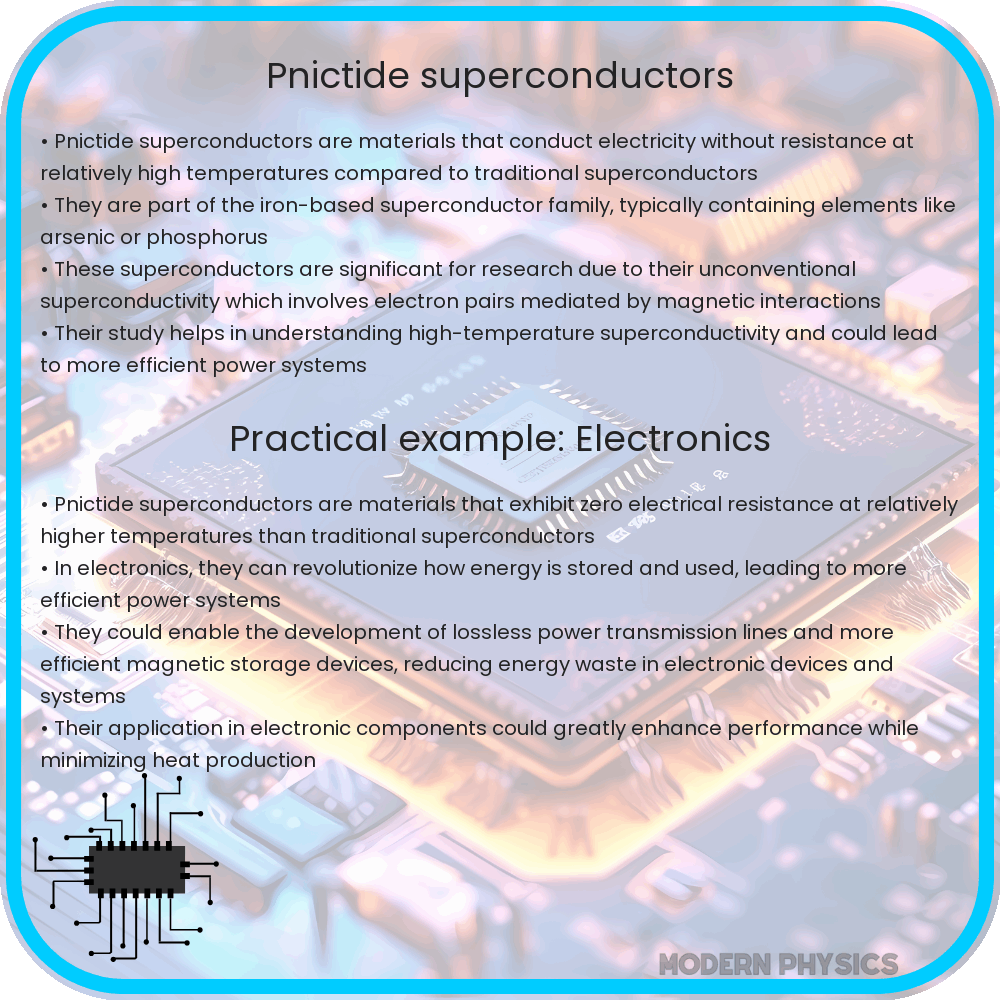
Pnictide Superconductors: Unveiling High-Tc Phenomena
Superconductivity represents one of the most fascinating states of matter, providing zero resistance to electrical current and the expulsion of magnetic fields. Among the various types of superconductors, pnictide superconductors stand out due to their high transition temperatures (High-Tc) and unique electronic properties. These materials are based on the chemical elements known as pnictogens (e.g., nitrogen, phosphorus, arsenic, antimony, and bismuth) combined with metals to form compounds such as iron arsenide (FeAs).
The discovery of high-Tc superconductivity in iron-based pnictides (such as LaFeAsO1-xFx) in 2008 marked a significant breakthrough, challenging the conventional understanding of superconducting materials which were primarily focused on copper oxide (cuprate) superconductors. Pnictide superconductors exhibit superconductivity at temperatures much higher than traditional metallic superconductors, though still below the boiling point of liquid nitrogen (-196°C or 77K), making them more feasible for practical applications than conventional superconductors, yet less so than cuprates.
Theoretical Framework and Mechanisms
The theory behind pnictide superconductivity is complex and still under active investigation. Unlike conventional superconductors, which are well described by the BCS (Bardeen-Cooper-Schrieffer) theory where phonons mediate electron pairing, pnictides do not fit neatly into this framework. Instead, it is believed that the superconductivity in pnictides arises from a unique interplay between magnetic fluctuations and the multi-band nature of these materials. This interaction promotes the pairing of electrons into Cooper pairs, albeit through mechanisms that are distinct from those in conventional and cuprate superconductors.
One of the key features of pnictide superconductors is the presence of a layered structure, similar to that of the cuprates, which seems to be a significant factor in achieving high-Tc superconductivity. The layers typically consist of alternating sheets of pnictogen atoms and transition metals, leading to anisotropic electrical properties that are crucial to their superconducting behavior.
Applications and Future Directions
Pnictide superconductors, with their high-Tc properties and distinct material characteristics, offer promising avenues for various technological applications. These include magnetic resonance imaging (MRI), magnetic levitation (maglev) trains, and power transmission. In MRI technology, the use of pnictide superconductors could significantly enhance the efficiency and resolution of imaging, leading to better diagnostic capabilities. Similarly, in transportation, maglev trains powered by superconductors offer faster and more energy-efficient alternatives to conventional trains.
Beyond these, the energy sector stands to benefit greatly from advances in superconducting materials. Pnictide superconductors could revolutionize power grids by reducing transmission losses, thus enabling more sustainable and efficient energy distribution. Additionally, their unique properties are being explored in the field of quantum computing, where superconductors are pivotal in developing qubits, the building blocks of quantum computers.
Challenges and Research Frontiers
Despite the potential, pnictide superconductors face significant challenges. The main hurdle is the necessity for low operational temperatures, which, despite being higher than traditional superconductors, still require costly cooling systems. Moreover, the synthesis and fabrication of pnictide materials involve complex processes that are currently not suitable for large-scale production.
Research in pnictide superconductors is vigorously pursuing not only ways to enhance the critical temperature but also to better understand the underlying mechanisms of superconductivity in these materials. Discoveries in this field could lead to the development of new superconducting materials that operate at even higher temperatures, perhaps even at room temperature, which remains the holy grail of superconductor research.
Conclusion
Pnictide superconductors represent a significant chapter in the ongoing story of superconductivity. Their discovery has opened new paths in the quest for high-Tc materials, challenging existing theories and offering new possibilities for technological applications. While challenges remain in their application and understanding, the research into pnictide superconductors continues to be a vibrant and promising field. As scientists unravel the mysteries of these materials, the future of superconductivity appears more exciting than ever, holding the promise of transforming technology and society in profound ways.