
Explore the innovative world of plasma stealth technology, its advancements, theoretical foundations, and applications in military and civilian sectors for radar invisibility.
Introduction to Plasma Stealth Technology
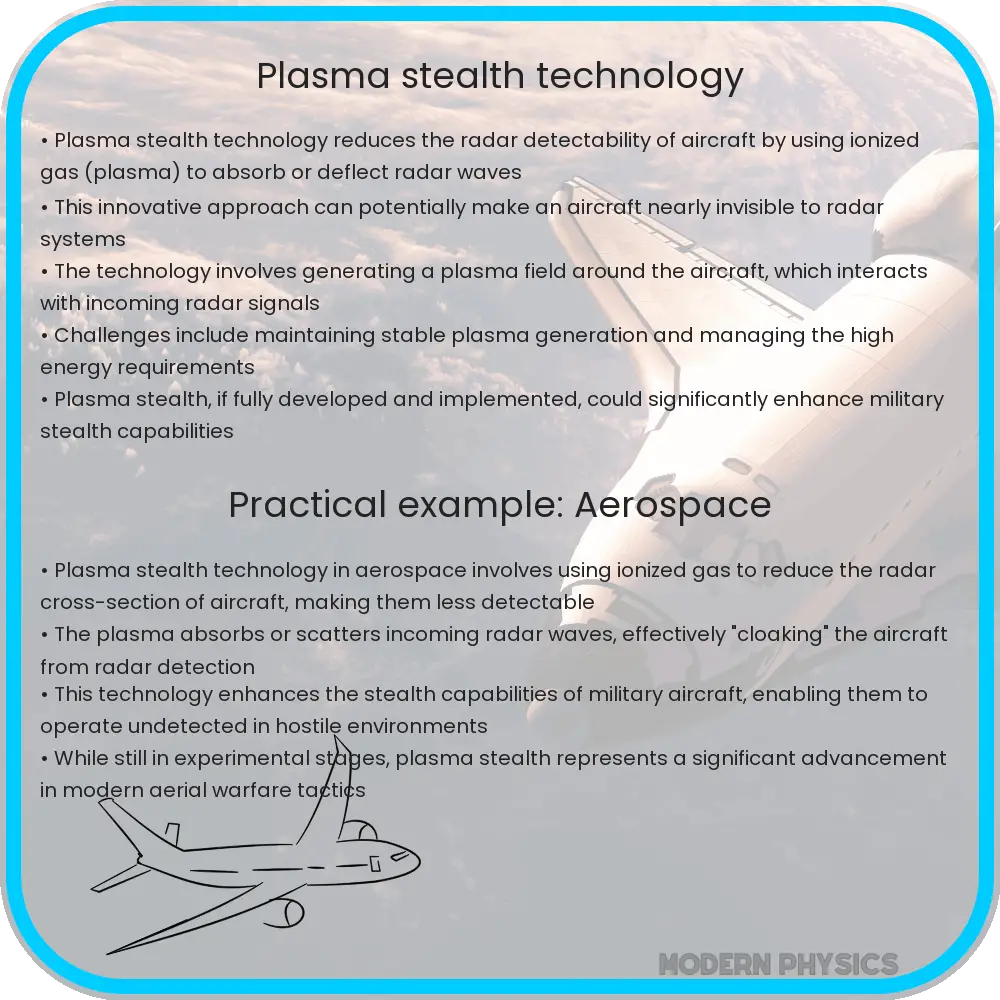
Plasma stealth technology represents a cutting-edge approach in the realm of military stealth capabilities, aiming to reduce the radar cross-section (RCS) of aircraft, making them less detectable by radar systems. This innovative technology employs ionized gas, or plasma, to absorb or scatter incoming radar waves, thereby diminishing the radar signature of the aircraft.
Theoretical Foundations
At its core, plasma stealth technology leverages the electromagnetic properties of plasma. When air or gas is ionized, it becomes plasma, capable of absorbing or deflecting electromagnetic waves, including those used in radar detection. This capability hinges on the plasma frequency, a critical value determined by the density of the ionized particles. For effective stealth, the plasma generated around the aircraft must have a frequency that falls within the range of the radar’s operating frequencies, thereby absorbing or scattering the radar waves and reducing the aircraft’s visibility on radar screens.
Advancements in Plasma Stealth
Recent advancements in plasma stealth technology have focused on improving the efficiency and practicality of plasma generation. Early experiments encountered challenges related to the high energy requirements for sustaining plasma and the difficulty of integrating the technology with aircraft systems. However, breakthroughs in materials science and plasma generation methods have paved the way for more compact and energy-efficient plasma generation systems. These systems are designed to be integrated into the aircraft’s skin or coating, allowing for a more seamless and practical application of plasma stealth technology.
Applications Beyond Military
While primarily developed for military applications, the principles of plasma stealth technology have potential uses in civilian sectors as well. For instance, improving the aerodynamic efficiency of commercial aircraft through plasma manipulation could lead to reduced fuel consumption and faster travel times. Additionally, the technology’s ability to absorb electromagnetic waves has implications for telecommunications, potentially mitigating interference and enhancing signal clarity.
This overview of plasma stealth technology underscores its significance as a revolutionary advancement in stealth capabilities. As research and development continue, the potential applications and improvements of this technology promise to extend far beyond its current military focus, suggesting a broad impact on various sectors of technology and defense.
Challenges and Future Directions
The journey towards fully operational plasma stealth technology is not without its challenges. One of the primary obstacles is the integration of plasma systems with existing aircraft frameworks without compromising performance or safety. Additionally, the technology’s energy demands pose a significant hurdle, requiring innovations in power generation and management to ensure that the plasma can be maintained throughout the duration of a mission. There’s also the issue of environmental effects on plasma stability, including variations in atmospheric conditions, which can affect the efficacy of the stealth capabilities.
Despite these challenges, ongoing research and development efforts are aimed at overcoming these obstacles. Advances in nanotechnology and alternative energy sources present promising avenues for creating more efficient and adaptable plasma stealth systems. Moreover, the exploration of different plasma generation techniques, such as using lasers or microwave energy, offers potential for more versatile and robust stealth solutions.
Conclusion
Plasma stealth technology stands at the forefront of modern stealth capabilities, offering a revolutionary approach to reducing the radar visibility of aircraft. By harnessing the electromagnetic properties of plasma, this technology provides a promising avenue for making aircraft less detectable and potentially transforming the landscape of military and civilian aviation alike. Despite the challenges associated with integrating and sustaining plasma on aircraft, advancements in materials science, energy generation, and plasma manipulation continue to push the boundaries of what’s possible. As researchers address these challenges, the future of plasma stealth technology holds significant promise, not only for enhancing military stealth capabilities but also for applications in civilian sectors that could benefit from reduced electromagnetic interference and improved aerodynamic performance. In essence, plasma stealth technology represents a pivotal step towards a future where the invisibility of aircraft could become a practical reality, marking a new era in stealth and detection avoidance techniques.