
Explore the causes, analysis, and impacts of plasma fluctuations in physics, from auroras to nuclear fusion, and the latest strategies for managing these dynamic phenomena.
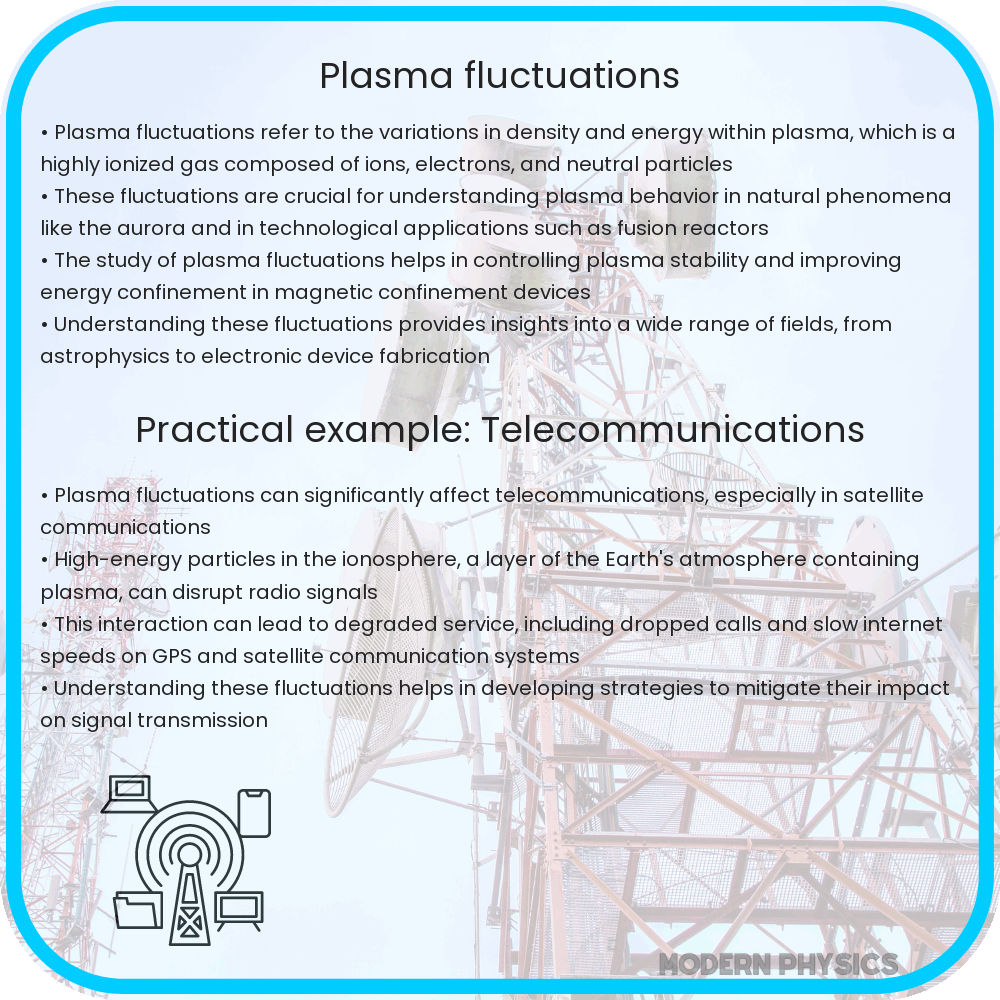
Understanding Plasma Fluctuations: An Overview
Plasma fluctuations play a crucial role in the field of physics, influencing various processes and phenomena in both natural and controlled environments. This article delves into the analysis, causes, and impacts of plasma fluctuations, shedding light on their significance in scientific research and applications.
Analysis of Plasma Fluctuations
The analysis of plasma fluctuations involves the examination of changes in the density, temperature, and magnetic fields within a plasma over time. These fluctuations are often studied through diagnostic techniques such as Langmuir probes, magnetic probes, and laser scattering methods. These tools allow scientists to measure and visualize the dynamic behavior of plasma, providing insights into its complex nature.
Causes of Plasma Fluctuations
Plasma fluctuations can arise from various sources, ranging from external magnetic fields to internal instabilities. Key factors include:
- Magnetic Reconnection: This process occurs when the magnetic field lines in plasma rearrange and realign, releasing a significant amount of energy and causing fluctuations.
- Turbulence: Plasma can exhibit turbulent behavior similar to fluids, with eddies and vortices generating fluctuations in density and temperature.
- Instabilities: Certain conditions can lead to instabilities within plasma, such as the Kelvin-Helmholtz instability or the Rayleigh-Taylor instability, driving fluctuations.
Impacts of Plasma Fluctuations
The impacts of plasma fluctuations are far-reaching, affecting both natural phenomena and technological applications. In space, fluctuations in the Earth’s magnetosphere can influence the behavior of the auroras and pose risks to satellites and space missions. In the realm of controlled nuclear fusion, understanding and managing plasma fluctuations is essential for achieving stable confinement and sustaining fusion reactions. These fluctuations can lead to energy losses, damage to confinement vessels, and challenges in maintaining the necessary conditions for fusion.
Moreover, plasma fluctuations are pivotal in the development of plasma-based technologies, including plasma TVs, semiconductor manufacturing, and medical devices. The ability to control these fluctuations can lead to improvements in efficiency and performance in various applications.
Advancements in Plasma Fluctuation Research
Recent advancements in technology and computational methods have significantly enhanced our understanding and control of plasma fluctuations. High-performance computing has enabled detailed simulations of plasma behavior, providing new insights into the mechanisms behind fluctuations and potential strategies for their control. Additionally, advancements in diagnostic tools have allowed for more precise measurements of plasma parameters, facilitating real-time monitoring and adjustment in experimental setups.
Strategies for Managing Plasma Fluctuations
Effective management of plasma fluctuations is crucial for optimizing the performance and safety of plasma-based systems. Techniques such as magnetic confinement, where strong magnetic fields are used to confine plasma in a defined space, and active feedback systems, which adjust operational parameters in response to detected fluctuations, are among the strategies employed to stabilize plasma. Furthermore, research into alternative confinement methods, such as inertial confinement, offers promising avenues for minimizing the impacts of fluctuations.
Future Directions
Looking forward, the quest to better understand and control plasma fluctuations continues to drive research and development efforts. The integration of machine learning and artificial intelligence into plasma research holds potential for predictive modeling and automated control systems, offering new ways to anticipate and mitigate fluctuations. Additionally, interdisciplinary approaches, combining insights from plasma physics, materials science, and engineering, are expanding the possibilities for innovative solutions to fluctuation-related challenges.
Conclusion
Plasma fluctuations represent a fundamental aspect of plasma behavior, influencing a wide range of natural phenomena and technological applications. From the stunning visuals of auroras to the cutting-edge research in nuclear fusion, the impacts of these fluctuations are pervasive and profound. As our understanding deepens and our tools for analysis and control evolve, the potential to harness plasma more effectively and efficiently expands, promising advancements in various fields including energy, manufacturing, and space exploration. The continued exploration of plasma fluctuations not only enriches our knowledge of the universe but also drives innovation, highlighting the dynamic interplay between scientific discovery and technological progress.