
Explore the science of plant ecophysiology, focusing on how environmental factors influence plant adaptations, growth, and productivity.
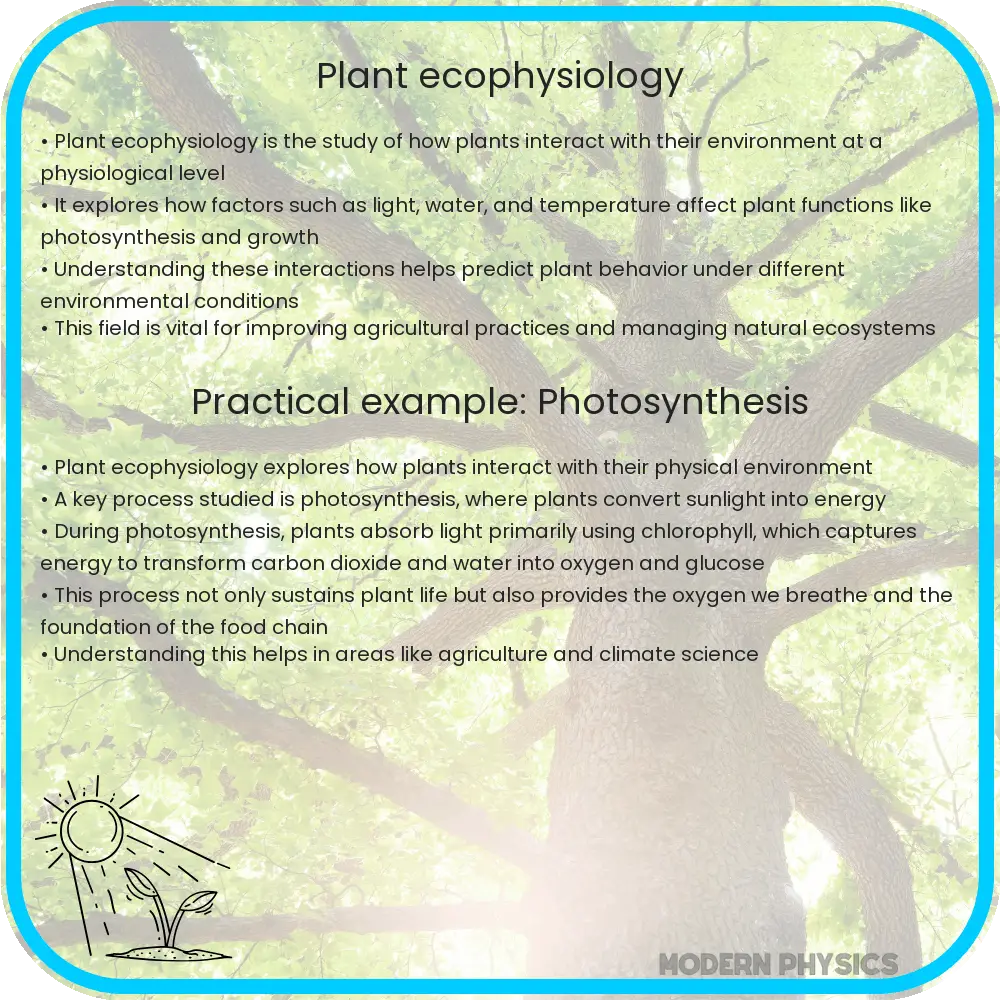
Understanding Plant Ecophysiology: Adaptation, Growth & Yield Factors
Plant ecophysiology is a branch of biology that studies how the environment influences plant physiological processes, and how these, in turn, affect plant growth and productivity. It’s the science of understanding and explaining the complex interactions between plants and their surroundings, focusing on adaptations, growth dynamics, and overall yield factors.
Adaptation Mechanisms in Plants
Plants, unable to move from place to place, have developed intricate adaptation strategies to survive and thrive in various environmental conditions. These adaptations can be broadly categorized into structural, physiological, and behavioral mechanisms.
- Structural Adaptations: These include changes in physical features like leaf size and thickness, root structure, and stem architecture. For instance, cacti have thick, fleshy stems that store water, an essential adaptation for survival in arid environments.
- Physiological Adaptations: These involve modifications in metabolic processes such as photosynthesis, respiration, and transpiration. One well-known physiological adaptation is the C4 photosynthetic pathway, which minimizes water loss while maximizing carbon fixation, beneficial in hot, sunny environments.
- Behavioral Adaptations: Although plants do not exhibit behavior in the traditional sense, they display dynamic responses like heliotropism (sun tracking by sunflowers) and nyctinasty (nighttime leaf folding in legumes), which can be considered behavioral adaptations for optimal light absorption and moisture conservation.
Growth Factors: Light, Water, and Nutrients
Plant growth is significantly influenced by several abiotic factors including light, water, and nutrients, each playing pivotal roles:
- Light: Light is crucial for photosynthesis, the process by which plants convert light energy into chemical energy. The intensity, duration, and quality of light can affect plant morphology and the rate of photosynthesis, altering growth patterns.
- Water: Water is essential for photosynthesis and as a solvent facilitating nutrient transport within the plant. Water availability affects plant turgidity and can influence growth rates through impacts on cellular processes and photosynthetic efficiency.
- Nutrients: Essential nutrients like nitrogen, phosphorus, and potassium support various plant functions, including growth and reproductive success. Nutrient availability can often be a limiting factor in ecological settings, influencing competitive dynamics among plants.
Growth and Yield Optimization in Agricultural Contexts
In agricultural settings, understanding and manipulating these factors can lead to improved crop yields. Practices such as crop rotation, irrigation management, and controlled use of fertilizers are employed to optimize the growth conditions of plants, aiming for both sustainability and efficiency.
Growth models in plant ecophysiology also provide insights into the potential responses of plants under different environmental scenarios. These models integrate data on light absorption, energy allocation, and growth strategies to predict how plants might perform in changing climates, offering valuable information for crop management and agricultural planning.
Environmental Stress and Plant Response
Environmental stressors such as drought, extreme temperatures, and soil salinity pose significant challenges to plant development. Plants respond to these stressors through a series of adaptive mechanisms which may include altering their biochemical pathways, adjusting their physical structure, or even changing their reproductive strategies.
- Drought Resistance: Plants may increase root depth or develop thicker cuticles to reduce water loss. Some species also accumulate solutes that help maintain cell turgidity under water-deficient conditions.
- Temperature Extremes: To cope with cold, plants might produce antifreeze proteins that prevent cell damage. In heat, they might enhance the expression of heat-shock proteins to stabilize cell structures and maintain function.
- Salt Stress: In saline environments, plants might improve their ion regulation abilities or synthesize compatible solutes that help in osmoregulation, maintaining cell viability.
Technological Advances in Plant Ecophysiology
Recent advancements in technology have revolutionized the field of plant ecophysiology, enabling more precise studies and interventions. Technologies such as remote sensing, genomics, and precision agriculture tools have provided new insights into how plants interact with their environment and how we can better manage agricultural practices for optimal plant performance.
- Remote Sensing: Satellite imagery and drone surveillance allow researchers to monitor plant health, moisture levels, and growth patterns over large areas, leading to more informed decision-making in agriculture.
- Genomics: Genetic profiling helps identify plant varieties with desirable traits such as drought tolerance or pest resistance, facilitating the breeding of more robust plant varieties.
- Precision Agriculture: Smart farming technologies ensure that crops receive the exact amount of water, nutrients, and care required, minimizing waste and maximizing growth and yield.
Conclusion
Understanding plant ecophysiology is crucial not only for enhancing agricultural productivity but also for ensuring sustainability in food production. By exploring how plants adapt to their environment and optimizing the factors influencing their growth, we can better safeguard our agricultural resources against future challenges. The continuous integration of new technologies and research findings in plant ecophysiology promises to further enhance our capability to predict and improve plant performance under diverse environmental conditions, paving the way for more resilient agricultural practices worldwide.