
Explore the essential role of physical oceanography in understanding ocean waves, tides, and their impact on climate.
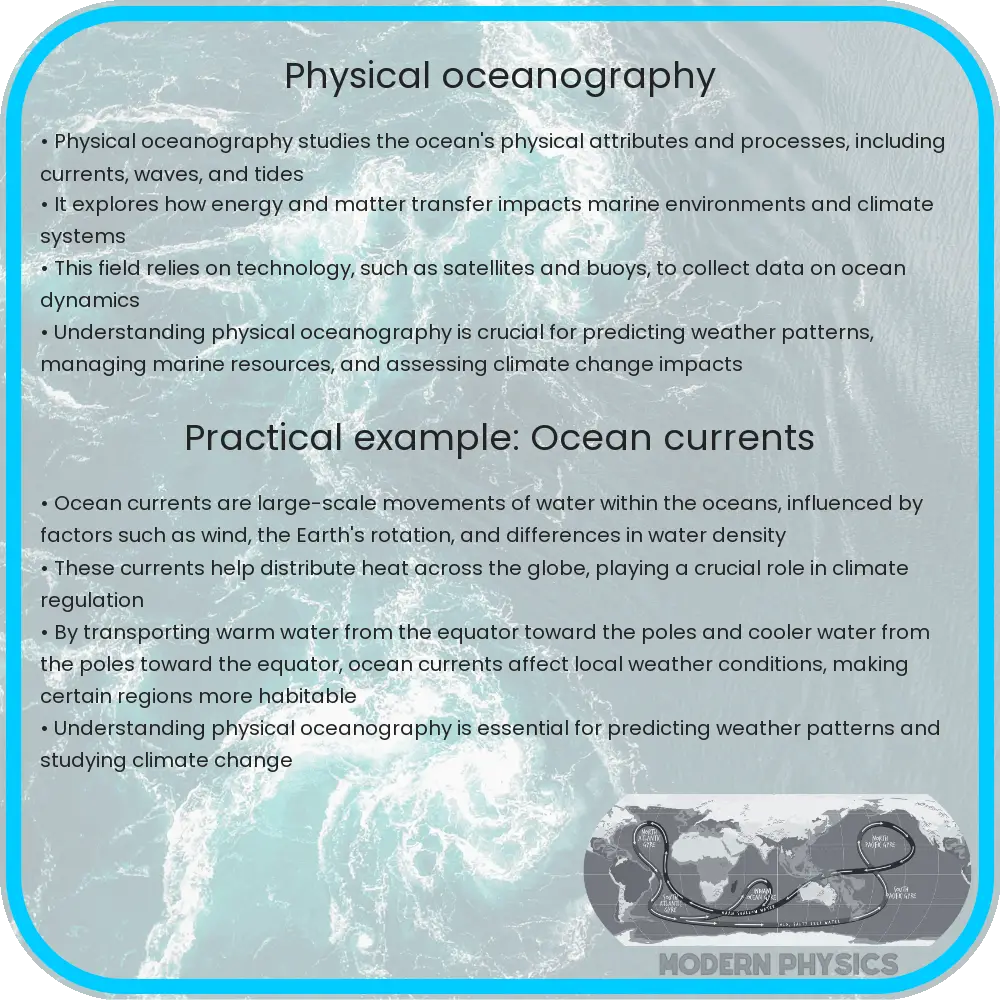
Introduction to Physical Oceanography: Waves, Tides, and Climate Impact
Physical oceanography is a branch of earth science that studies the physical conditions and physical processes within the ocean, especially the motions and physical properties of ocean waters. This discipline plays a crucial role in understanding how ocean phenomena like waves and tides impact our climate, marine life, and coastal environments. This article delves into the fascinating world of ocean dynamics, focusing on waves and tides, and explores their significant impact on the climate.
Understanding Ocean Waves
Ocean waves are primarily caused by the wind blowing over the surface of the sea. The energy transfer from the wind to the water creates undulations that we observe as waves. However, the physics behind wave formation and propagation is guided by both atmospheric conditions (like wind speed, duration, and distance over which the wind blows) and water characteristics (such as water depth and currents).
- Wave Types: Surface waves, the most familiar sight, occur on the interface between air and water. These can be further classified into gravity waves, generated by the gravitational pull of the moon and sun, and capillary waves, which are smaller and influenced by the surface tension of water.
- Wave Characteristics: Key characteristics of waves include wave height (the vertical distance from the trough to the crest), wavelength (the horizontal distance between two consecutive crests or troughs), and wave period (the time it takes for two consecutive crests to pass a fixed point).
Understanding these characteristics helps in predicting the power and behavior of waves, which is essential for marine navigation, coastal management, and in the study of coastal erosion and sediment transport.
The Dynamics of Tides
Tides are another significant aspect of physical oceanography. These are the long-period waves that move through the oceans in response to the forces exerted by the moon and the sun. The gravitational interactions between these celestial bodies and the Earth primarily drive the rhythmic rising and falling of sea levels.
- Types of Tides: The two major types of tides are diurnal tides, with one high tide and one low tide each day, and semidiurnal tides, featuring two high tides and two low tides daily. Mixed tides, showing variation in height between successive high and low waters over a day, also occur in some regions.
- Spring and Neap Tides: Spring tides occur during the new and full moons when the Earth, the moon, and the sun are aligned, producing the highest high tides and the lowest low tides. Neap tides occur during quarter moons and result in the least variation between high and low tides.
The predictability of tide phases and their amplitudes is crucial for coastal activities, fishing, marine life, and maritime operations.
Impact of Waves and Tides on Climate
Waves and tides significantly influence the earth’s climate system. They play a vital role in ocean-atmosphere interaction, which in turn affects weather and climate patterns. For instance, ocean waves are instrumental in air-sea energy exchange and in the mixing of upper ocean waters, which helps regulate the Earth’s climate.
Tides contribute to ocean mixing and circulation patterns, affecting global temperature gradients and climate. Tidal mixing facilitates the upward transport of deep, cold, nutrient-rich waters to the surface, supporting marine ecosystems and influencing biological productivity.
Furthermore, the study of long-term changes in wave and tide patterns assists scientists in understanding and predicting the potential impacts of climate change on coastal areas. Rising sea levels, increased storm intensity, and changes in wave patterns are all climate-related phenomena that are closely linked to the behavior of waves and tides.
Technological Applications and Future Research
The practical applications of understanding ocean dynamics are vast and impact numerous fields. Technologies that harness wave energy for renewable power are growing, using the persistent motion of ocean waves to generate electricity. Moreover, precise tide prediction models aid in optimizing shipping routes, enhancing safety, and avoiding unnecessary fuel consumption. These applications not only provide economic benefits but also contribute to environmental conservation by reducing fossil fuel dependence and promoting sustainable practices.
- Wave Energy Converters: These are machines that convert the kinetic energy from waves into usable electrical power. Different designs, like oscillating water columns or point absorbers, cater to various marine environments.
- Tidal Barrages and Turbines: Similar to hydroelectric dams, these structures are designed to capture the energy from tidal movements. Tidal turbines function much like underwater wind turbines, harnessing the kinetic energy from flowing water.
Continued innovation and research in these technologies are crucial as the demand for renewable energy sources increases with global energy consumption.
Education and Awareness
Enhancing public understanding of physical oceanography can lead to more informed decisions about marine resource use, coastal development, and environmental protection. Educational initiatives and awareness campaigns can help translate complex scientific knowledge into actionable information that can be used by policymakers, environmentalists, and the general public. Teaching the next generation about the importance of the ocean’s role in global ecology is vital for the sustainable future of our planet.
- School and Community Programs: Development of curriculum and interactive learning experiences that focus on ocean sciences.
- Public Engagement: Utilizing media, workshops, and public talks to disseminate information about ocean health and its influence on climate change.
Conclusion
Physical oceanography provides invaluable insights into the complex dynamics of ocean waves and tides, revealing their profound effects on global climate patterns, maritime activities, and biological productivity. By advancing our understanding through continuous research and technological innovation, and promoting widespread education and awareness, we can better anticipate and mitigate the challenges posed by environmental changes. The continued exploration and study of our oceans are not only fascinating but also crucial for building a resilient and sustainable relationship with Earth’s largest and most mysterious ecosystem.