
Explore the Petrov Classification in general relativity, its applications in astrophysics, and its role in understanding the universe’s mysteries.
Understanding the Petrov Classification in General Relativity
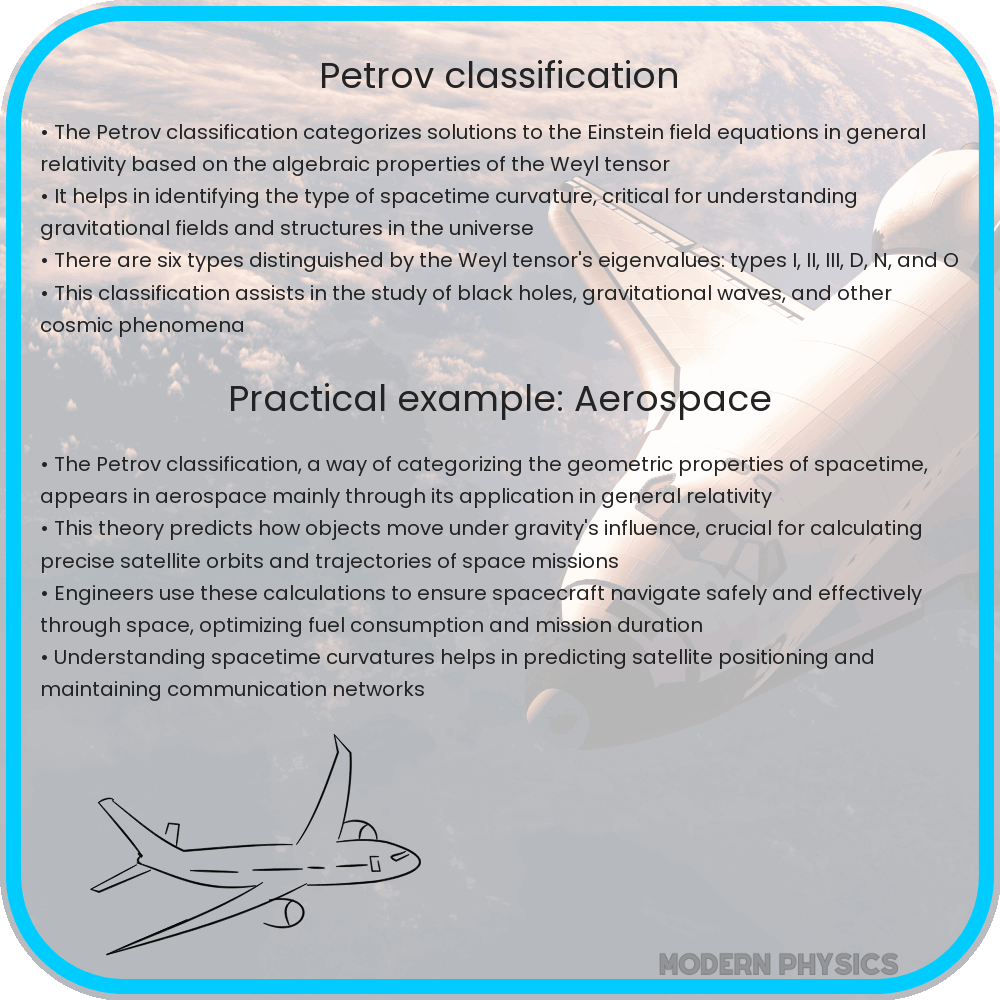
The Petrov Classification is a fascinating and complex aspect of general relativity, a theory formulated by Albert Einstein to describe the gravitational force as a curvature of spacetime. This classification system, developed by Russian physicist A.Z. Petrov in the mid-20th century, is crucial for understanding the intricate properties of spacetime in the vicinity of gravitational fields, especially around black holes and neutron stars.
At the core of the Petrov Classification is the concept of Weyl curvature tensor, a mathematical entity that encodes information about the tidal forces experienced in a gravitational field. Petrov’s work categorizes the Weyl tensor into distinct types based on its algebraic properties. These types are labeled as I, II, III, D, N, and O. Each type corresponds to a different configuration of gravitational fields and has profound implications on the behavior of matter and light in the vicinity of massive celestial bodies.
Applications in Astrophysics and Cosmology
The Petrov Classification has significant applications in astrophysics and cosmology. One of its primary uses is in the study of black holes. The classification helps in identifying the nature of the spacetime curvature around these enigmatic objects. For instance, a rotating (Kerr) black hole is typically associated with Type D in the Petrov classification, which aids in understanding its unique properties like frame dragging.
Another crucial application lies in the study of gravitational waves. These ripples in spacetime, predicted by Einstein and first observed in 2015, can be better understood through the lens of Petrov’s types. Different types of gravitational waves can be associated with different Petrov types, aiding in their categorization and in deciphering the cosmic events that gave rise to them.
Complexity and Challenges
The complexity of the Petrov Classification arises from its deeply mathematical nature. The classification system is rooted in tensor calculus and differential geometry, demanding a high level of mathematical proficiency. Understanding and applying these concepts requires a comprehensive grasp of advanced mathematics and theoretical physics, making it a challenging area of study even for seasoned researchers.
In practical applications, the complexity further increases when dealing with dynamic spacetime scenarios, such as merging black holes or rapidly rotating neutron stars. The constantly changing gravitational fields in these situations require sophisticated computational models to accurately apply the Petrov Classification and predict the behavior of spacetime.
Advancements and Future Directions
The ongoing advancements in technology and computational methods are opening new frontiers in the application of the Petrov Classification. High-performance computing and numerical relativity are enabling more precise simulations of gravitational fields, particularly in extreme conditions. These advancements not only deepen our understanding of general relativity but also pave the way for new discoveries in the cosmos.
Furthermore, the intersection of Petrov Classification with quantum theory presents an intriguing area of research. As scientists strive to unify general relativity with quantum mechanics, the Petrov types could play a pivotal role in deciphering the quantum aspects of gravity, potentially contributing to the development of a theory of quantum gravity.
Implications in Observational Astronomy
In observational astronomy, the Petrov Classification finds its relevance in interpreting data from telescopes and gravitational wave detectors. By classifying the spacetime around celestial phenomena, astronomers can make more accurate predictions about their behavior and characteristics. This is particularly valuable in the study of phenomena like quasars, pulsars, and gamma-ray bursts, where the underlying gravitational fields play a crucial role in their observable features.
The classification also aids in the identification and study of exotic phenomena such as wormholes and singularities. By analyzing the spacetime curvature around these theoretical constructs, scientists can explore the possibilities of their existence and nature, further expanding our understanding of the universe.
Conclusion
The Petrov Classification in general relativity represents a key tool in our quest to understand the universe’s most extreme and enigmatic phenomena. Its applications extend from the study of black holes and gravitational waves to the potential unification of general relativity with quantum mechanics. Despite its complexity, the ongoing advancements in computational power and theoretical physics continue to unlock its potential, offering deeper insights into the fabric of spacetime. As we stand on the brink of new astronomical discoveries and theoretical breakthroughs, the Petrov Classification remains a testament to the intricate beauty and profound mystery of the universe we inhabit.