
Explore the Penrose Process and Quantum Electrodynamics in black holes, uncovering the dynamics of energy extraction and advanced QED implications.
Understanding the Penrose Process in Quantum Electrodynamics
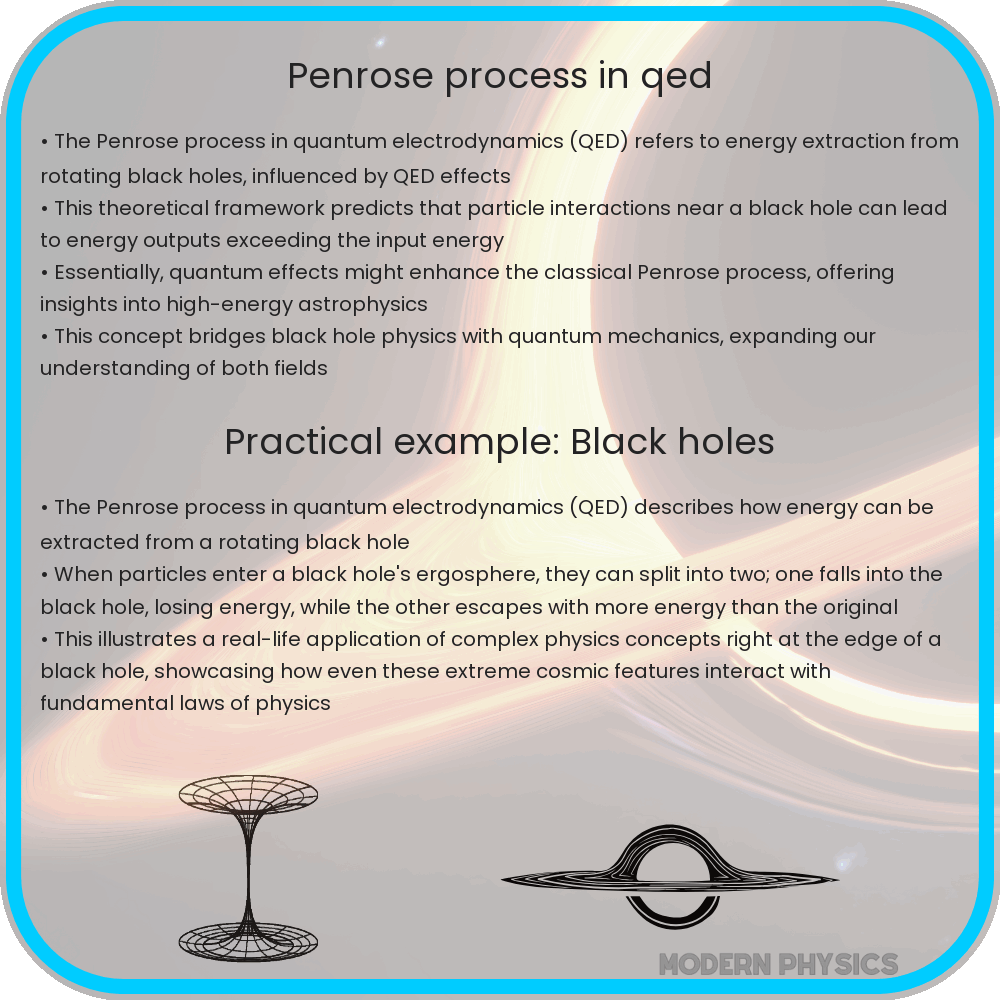
The Penrose Process, a theoretical concept in astrophysics, posits a method for extracting energy from a rotating black hole. This fascinating phenomenon becomes even more intriguing when examined through the lens of Quantum Electrodynamics (QED), the quantum theory that describes how light and matter interact. In this exploration, we delve into the intricate dynamics of energy extraction from black holes, unveiling how QED principles contribute to our understanding of these celestial giants.
The Basics of the Penrose Process
Conceived by Roger Penrose in 1969, the Penrose Process capitalizes on the extraordinary gravitational and rotational forces of a Kerr black hole, a type of black hole that rotates. This process theorizes that energy can be extracted from a black hole’s ergosphere, the region outside the event horizon where space-time is dragged by the black hole’s rotation. Objects within the ergosphere experience a phenomenon known as frame dragging, causing them to move in the direction of the black hole’s spin.
In the Penrose Process, a particle entering the ergosphere could theoretically split into two: one part falling into the black hole and the other escaping to infinity. The key lies in the negative energy states permitted within the ergosphere. When the particle falling into the black hole possesses negative energy relative to an observer at infinity, the escaping particle can have more energy than the original particle, thus effectively extracting energy from the black hole.
QED Dynamics in Black Hole Environments
Quantum Electrodynamics (QED) further enriches our comprehension of these phenomena. QED, the relativistic quantum field theory of electrodynamics, explains how light and matter interact and provides a framework for understanding the behavior of charged particles and photons in extreme environments, like those found near black holes.
Incorporating QED into black hole physics allows for a more nuanced analysis of particle interactions in these high-energy environments. Particularly, QED’s principles help elucidate the behavior of electromagnetic fields around black holes, adding depth to the understanding of phenomena like Hawking radiation and the Penrose Process. By considering QED effects, such as vacuum polarization and particle creation in strong gravitational fields, researchers gain insights into how energy and particles behave under the extreme conditions present near black holes.
Moreover, the application of QED to black hole dynamics also aids in exploring the potential for energy extraction through the Penrose Process. It sheds light on how quantum effects might influence the extraction mechanism and the resulting energy yields. For instance, the interplay between QED processes and the extreme gravitational forces of a black hole could alter the trajectories and energy states of the particles involved in the Penrose Process.
Advanced Implications of QED in Black Hole Energy Extraction
Delving deeper into the quantum realm, QED’s role becomes pivotal in understanding black hole thermodynamics and the fundamental limits of energy extraction. For example, the Unruh effect, a prediction of QED, suggests that an accelerating observer will perceive an apparent radiation field. This effect is analogous to the conditions experienced by particles accelerating in a black hole’s gravitational field. It implies that the vacuum in a black hole’s vicinity is not empty but filled with particle-antiparticle pairs, potentially influencing the dynamics of the Penrose Process.
Furthermore, QED predicts the occurrence of Hawking radiation, a form of black hole evaporation. This phenomenon, although primarily related to black hole thermodynamics, has implications for the Penrose Process. As black holes emit Hawking radiation, they lose mass and angular momentum, factors that could affect the efficiency and feasibility of energy extraction over time. The interplay between Hawking radiation and the Penrose Process highlights the delicate balance of forces and energies in and around black holes.
Challenges and Future Prospects
While the theoretical framework of combining the Penrose Process with QED principles offers exciting possibilities, practical challenges remain. The extreme conditions near black holes, such as intense gravitational forces and high-energy particle interactions, make experimental verification and practical application difficult. Moreover, our current understanding of quantum gravity, a field that would further illuminate these phenomena, remains incomplete.
Despite these challenges, ongoing advancements in astrophysical observations and quantum physics continue to bring us closer to a more comprehensive understanding. Future observations of black holes, such as those by the Event Horizon Telescope, and advances in quantum field theories may provide more insights into the practicality of the Penrose Process and its quantum mechanical nuances.
Conclusion
The fusion of the Penrose Process with Quantum Electrodynamics provides a rich and complex perspective on black hole dynamics and energy extraction. This synthesis not only enhances our understanding of black holes but also pushes the boundaries of modern physics. The intricate interplay between general relativity and quantum mechanics, as seen in these phenomena, stands as a testament to the unceasing quest for knowledge in the cosmos. While the direct application of these theories remains a challenge, their implications extend far beyond astrophysics, continuing to inspire and drive forward the fields of quantum physics and cosmology.