
Explore the fascinating world of particle-antiparticle annihilation and its impact on quantum physics, cosmology, and future technologies.
Understanding Particle-Antiparticle Annihilation
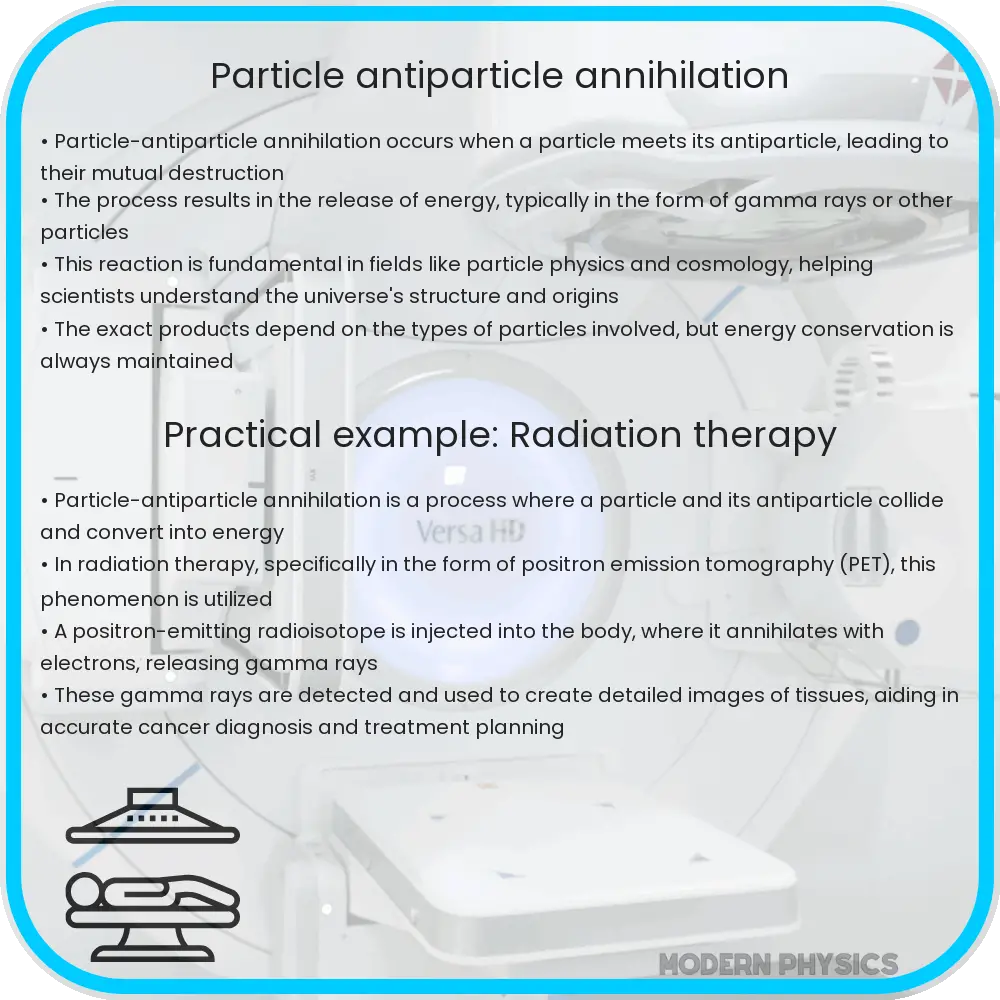
In the fascinating realm of quantum physics, one of the most intriguing phenomena is the annihilation of a particle and its antiparticle. This process is not only a cornerstone in understanding fundamental particle interactions but also holds promise for revolutionary applications in energy and technology. Particle-antiparticle annihilation occurs when a subatomic particle collides with its corresponding antiparticle, leading to the conversion of their mass into energy.
The Basics of Particle-Antiparticle Pairs
Every fundamental particle in the universe has a corresponding antiparticle. These pairs are nearly identical in mass but opposite in other properties like electric charge. For instance, the electron, a negatively charged particle, has a positron as its antiparticle, which carries a positive charge. When they meet, they annihilate each other, releasing energy in the form of photons.
Annihilation Process and Energy Release
The annihilation process is governed by Einstein’s famous equation E=mc2, where E represents energy, m is mass, and c is the speed of light. This equation implies that even a small amount of mass can be converted into a significant amount of energy, making particle-antiparticle annihilation a potential source of immense power. The energy released is directly proportional to the total mass of the particles involved.
Applications in Medicine and Research
One of the most well-known applications of this phenomenon is in Positron Emission Tomography (PET) scans, a medical imaging technique. In PET scans, positrons emitted from a radioactive substance inside the body annihilate with electrons, producing gamma rays that are detected to create detailed images of internal organs.
Quantum Power and Insight
Beyond medical imaging, the insights gained from studying particle-antiparticle annihilation are pivotal in advancing our understanding of the universe. It helps scientists in probing the fundamental laws of physics, exploring the early stages of the universe, and even in the hunt for dark matter. The precision in measurements and control in high-energy physics experiments further accentuates the importance of this phenomenon.
In the next section, we will delve deeper into the theoretical implications of particle-antiparticle annihilation, its role in cosmology, and the potential for future technological advancements.
Theoretical Implications and Cosmological Significance
Particle-antiparticle annihilation is not just a physical process but a gateway to understanding the fundamental forces of the universe. Theoretically, it provides insight into symmetry and asymmetry in the universe. One of the big questions in cosmology is why the universe consists predominantly of matter, despite the expectation of equal amounts of matter and antimatter created during the Big Bang. This asymmetry is a key area of research in particle physics, potentially explaining the very existence of our universe.
Dark Matter and Annihilation
Another intriguing aspect of particle-antiparticle annihilation is its potential link to dark matter. Dark matter, which makes up about 85% of the universe’s mass, remains one of the most elusive subjects in astrophysics. Some theories suggest that dark matter could be composed of particles that are their own antiparticles, known as Majorana particles. If these particles annihilate, they could produce detectable signals, offering a method to study dark matter.
Future Technological Advancements
The principles of particle-antiparticle annihilation could pave the way for groundbreaking technologies. One such prospect is in the field of energy production. If harnessed, the process could lead to a new class of power sources, offering an immense energy yield from minimal mass. While this remains speculative and faces enormous technical challenges, the potential for a near-limitless, clean energy source is an exciting possibility.
Quantum Computing and Annihilation
Furthermore, advancements in quantum computing may also benefit from insights gained through studying annihilation phenomena. Understanding the intricate behaviors of particles at this fundamental level could contribute to developing more powerful and efficient quantum computers, which rely on quantum states of particles for computation.
Conclusion
Particle-antiparticle annihilation, a cornerstone of quantum physics, offers more than just theoretical understanding; it has practical implications that stretch across various fields, from medicine to astrophysics. Its role in advancing our understanding of the universe’s fundamental laws, potential in exploring dark matter, and prospects for future technological innovations cannot be overstated. As research continues to unravel the mysteries of particle physics, the insights gained from particle-antiparticle annihilation will undoubtedly continue to inspire and drive scientific and technological progress,
illuminating the path towards a deeper comprehension of the cosmos and the development of transformative technologies.
Thus, while the concept may seem esoteric and confined to theoretical physics, its implications permeate many aspects of our understanding of the universe and our pursuit of technological advancement. The journey from the tiny world of subatomic particles to the vast expanses of cosmological phenomena underscores the interconnected nature of our universe and the relentless human quest for knowledge and innovation.