
Explore the cutting-edge world of Panoramic Optical Systems, where clarity, range, and precision redefine visual technologies for diverse applications.
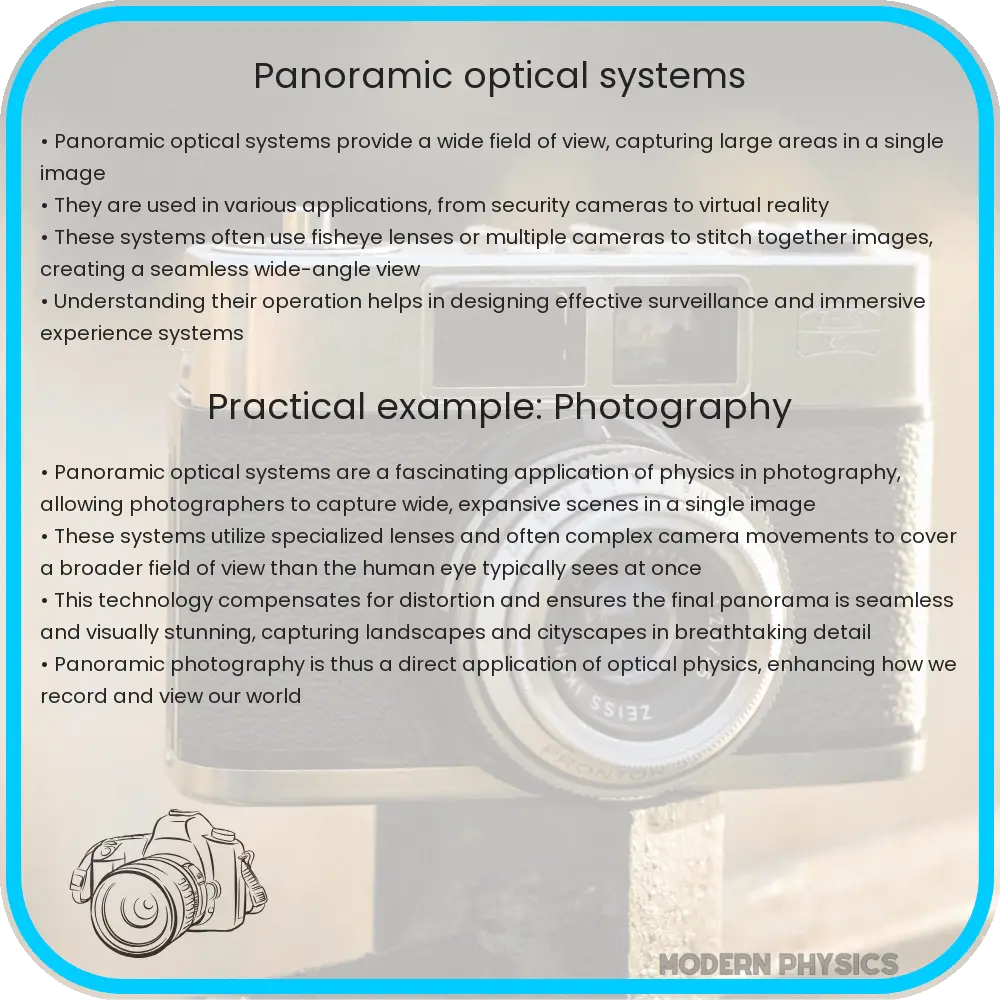
Panoramic Optical Systems: Enhancing Vision Across the Spectrum
Panoramic optical systems represent a pinnacle of innovation in the field of optics, merging expansive field of view with unparalleled clarity, range, and precision. These systems are designed to extend the human eye’s capability, allowing for a wide-angle perspective without compromising on the detail and accuracy essential for various applications, from surveillance and security to astronomy and environmental monitoring.
Clarity: The Foundation of Optical Excellence
At the heart of panoramic optical systems lies the principle of clarity. Clarity is the measure of an optical system’s ability to produce sharp, detailed images free of blurs and aberrations. Advanced lens design and coating technologies play a critical role in achieving this. Anti-reflective coatings, for example, minimize the loss of light due to reflection, ensuring that more light passes through the lens to create a brighter and clearer image.
Range: Bridging Distances with Precision
The range of a panoramic optical system determines how far the user can see with clarity and precision. This is particularly important in fields such as surveillance, where the ability to identify details at significant distances can be crucial. The development of telephoto lenses and adaptive zoom capabilities allows these systems to cover vast areas, bringing distant objects into sharp focus.
Precision: The Art of Accurate Imaging
Precision in panoramic optical systems refers to the accuracy with which these devices can capture and reproduce the details of a scene. This is achieved through sophisticated calibration of the optical elements and the integration of high-resolution sensors that can capture minute details over wide areas. Furthermore, digital enhancement techniques such as image stabilization and real-time processing algorithms work to refine the image quality, ensuring that the output is not only broad in scope but also rich in detail.
Together, these three pillars—clarity, range, and precision—form the foundation upon which panoramic optical systems stand. They are a testament to the incredible advances in optical engineering and technology, providing users with a powerful tool to observe and analyze the world around them with unprecedented breadth and detail.
Understanding Panoramic Optical Systems
Panoramic optical systems represent a revolutionary approach in visual technology, offering users an unprecedented clarity, extensive range, and precise imaging capabilities. These systems are designed to provide a comprehensive field of view, combining multiple optical elements and advanced imaging techniques to capture wide-angle perspectives with minimal distortion. This article delves into the core aspects that make panoramic optical systems stand out: clarity, range, and precision, and how they are achieved.
Clarity: The Foundation of Visual Excellence
Clarity in panoramic optical systems is achieved through sophisticated lens design and the integration of high-resolution sensors. The use of aspherical lenses reduces spherical aberration, a common issue in wide-angle lenses that can blur images. Additionally, anti-reflective coatings are applied to lens surfaces to minimize glare and lens flare, further enhancing image sharpness and contrast. The result is a crisp, clear image that captures even the finest details across a wide field of view.
Range: Expanding Horizons
The range of panoramic optical systems refers to both the breadth of the field of view and the distance over which the system can capture high-quality images. These systems typically employ a series of lenses or a specialized panoramic camera setup to stitch together images from multiple angles, creating a seamless wide-angle or 360-degree view. This capability is particularly beneficial in surveillance, photography, and virtual reality applications, where a comprehensive view of the surroundings is crucial.
Precision: The Art of Accuracy
Precision in panoramic optical systems is critical for ensuring that the images produced are not only wide-ranging but also accurate and detailed. This is accomplished through advanced calibration techniques and image processing algorithms. Distortion correction plays a vital role, especially in rectifying the curvature associated with wide-angle lenses, ensuring that lines appear straight and true to their real-world counterparts. Furthermore, the integration of gyroscopes and software stabilization techniques helps in reducing the impact of vibrations and movement, maintaining the integrity of the panoramic image.
Conclusion
Panoramic optical systems have transformed the way we capture and experience the world around us, offering a blend of clarity, range, and precision that was once thought impossible. From enhancing surveillance capabilities to providing immersive virtual reality experiences, these systems leverage cutting-edge technology to deliver unparalleled visual performance. The continuous evolution of optical design and imaging technology promises even greater advancements in the future, expanding the possibilities of panoramic visualization and opening new horizons for exploration and innovation.