
Explore the Pancharatnam-Berry phase and its impact on optical spin, geometric phase, and polarization, driving innovations in photonic devices and quantum computing.
Understanding the Pancharatnam-Berry Phase in Optical Physics
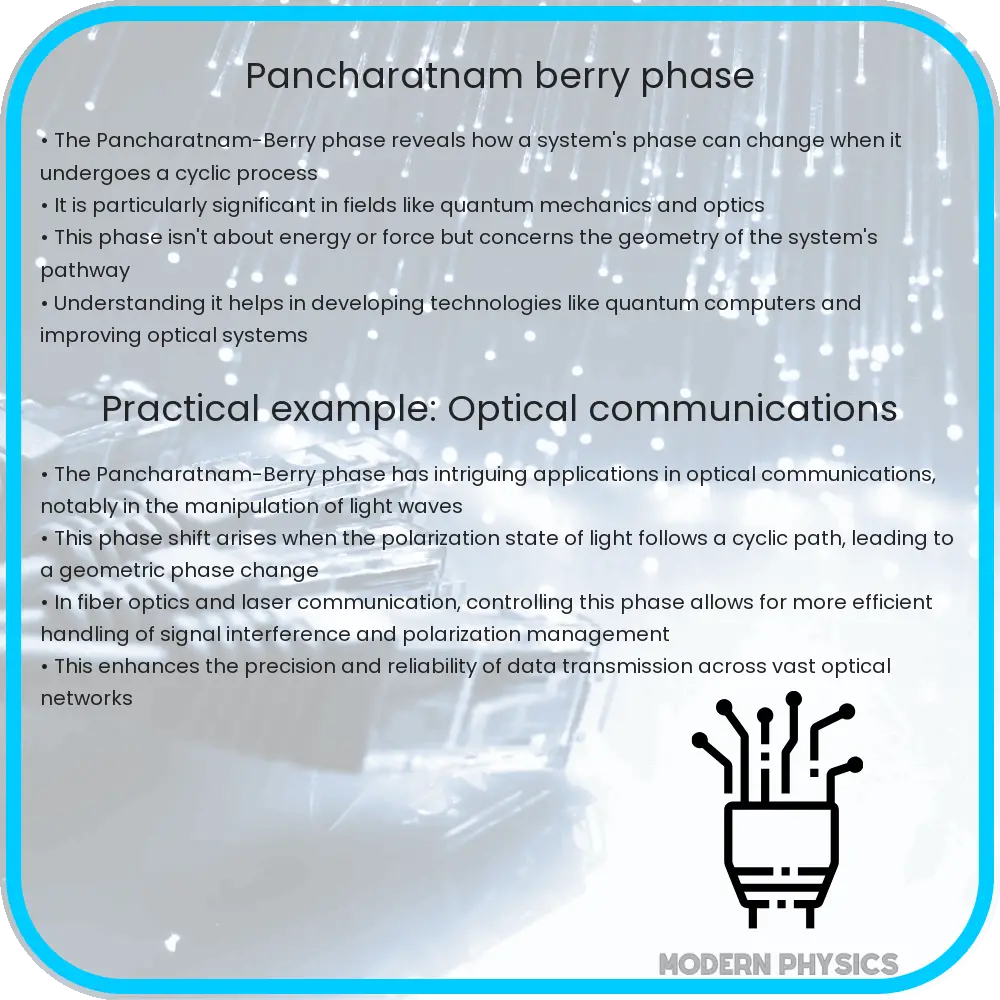
The Pancharatnam-Berry phase, a fascinating concept in optical physics, offers profound insights into the geometric phase that light waves acquire due to their polarization states. This phase, named after S. Pancharatnam and Sir Michael Berry, reveals the intricate relationship between optical spin, geometric phase, and the polarization of light. It plays a crucial role in various optical phenomena and applications, including the manipulation of light in photonic devices, quantum computing, and the study of topological insulators.
Optical Spin and Polarization
At the heart of understanding the Pancharatnam-Berry phase is the concept of optical spin, which is closely related to the polarization of light. Light waves, being transverse electromagnetic waves, can oscillate in different planes relative to their direction of propagation. This oscillation pattern, or polarization, is a fundamental property of light that can be linear, circular, or elliptical. The optical spin refers to the spin angular momentum of photons, which is determined by the polarization state. Circularly polarized light, for example, carries spin angular momentum, with right-handed and left-handed circular polarizations corresponding to different spin directions.
Geometric Phase and Its Significance
The geometric phase, or Pancharatnam-Berry phase, arises when the polarization state of light undergoes a cyclic evolution, tracing a closed path on the Poincaré sphere. Unlike dynamic phases that depend on the optical path length and refractive index, the geometric phase depends only on the shape of the path taken by the polarization state. This phase shift is purely geometric in nature and provides deep insights into the wavefunction’s topology and symmetry properties.
One of the most intriguing aspects of the Pancharatnam-Berry phase is its manifestation in various optical systems. For instance, when light passes through a series of polarizers arranged in a particular manner, it acquires a phase shift that depends solely on the geometric path traced by its polarization state. This property has been exploited in designing optical elements like waveplates and polarizers that control light based on its polarization.
The application of the Pancharatnam-Berry phase extends beyond basic physics. It has become a cornerstone in the development of advanced optical technologies, such as liquid crystal displays (LCDs), optical tweezers, and even in the exploration of quantum information science. By harnessing the geometric phase, researchers are able to manipulate light in innovative ways, paving the path for new technological advancements.
Applications and Technological Advancements
The practical applications of the Pancharatnam-Berry phase are vast and diverse, stretching across multiple fields of optics and photonics. One significant area is in the design and optimization of photonic devices, where control over light’s phase and polarization is crucial. Devices such as vortex beam generators and holographic elements utilize the Pancharatnam-Berry phase to manipulate light in precise ways, enabling advancements in telecommunications, data storage, and imaging technologies.
Furthermore, in the realm of quantum computing and quantum information, the geometric phase provides a powerful tool for encoding and processing information. By exploiting the Pancharatnam-Berry phase, scientists can implement quantum gates and algorithms with photons, offering a pathway towards the development of highly secure quantum communication systems. This application underscores the potential of geometric phases in facilitating the next generation of computing technology.
Challenges and Future Directions
Despite its promising applications, the exploration and exploitation of the Pancharatnam-Berry phase face several challenges. Precise control over the polarization states and the paths they trace on the Poincaré sphere requires sophisticated optical setups and materials with specific anisotropic properties. Research is ongoing to discover new materials and configurations that can offer greater flexibility and efficiency in manipulating the geometric phase of light.
Moreover, the integration of devices based on the Pancharatnam-Berry phase into existing optical systems and technologies necessitates overcoming compatibility and scalability hurdles. As research progresses, innovative solutions to these challenges are expected to emerge, further expanding the utility and impact of this phenomenon in optical science and engineering.
Conclusion
The Pancharatnam-Berry phase, with its profound implications for the study and manipulation of light’s polarization, continues to be a subject of intense research and exploration. Its unique nature, rooted in the geometry of polarization states, offers unparalleled opportunities for advancing optical technologies and exploring new frontiers in physics. As we develop better tools and materials for controlling this geometric phase, we can anticipate a wide range of applications, from enhanced imaging systems to quantum computing. The journey to fully unlock the potential of the Pancharatnam-Berry phase is still underway, promising exciting discoveries and innovations in the field of optical science.