
Explore the intricacies of overconstrained mechanism design, delving into its precision, stability, and dynamics in modern engineering.
Understanding Overconstrained Mechanism Design: Precision, Stability, and Dynamics
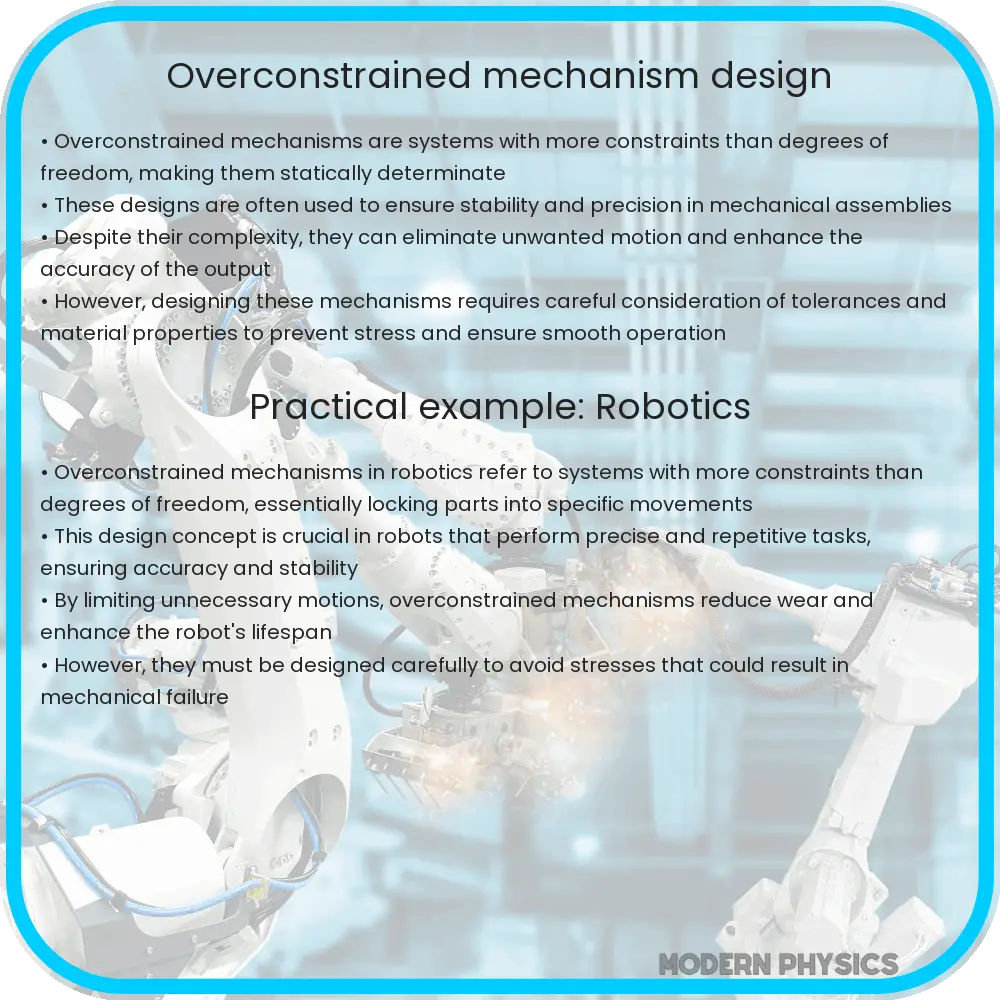
In the realm of mechanical engineering, the concept of overconstrained mechanism design plays a pivotal role in creating systems that are precise, stable, and dynamically efficient. This approach involves designing mechanisms with more constraints than necessary for static determinacy, enhancing their performance in various applications, from robotics to aerospace engineering.
Precision in Overconstrained Mechanisms
Precision is a cornerstone of overconstrained mechanisms. These systems are engineered to minimize deviations and maintain exactness in movement and alignment, which is crucial in high-precision fields like micro-manufacturing and biomedical devices. The key lies in the meticulous design that reduces slack and play within the mechanism, thereby ensuring consistent and repeatable movements.
Stability and Its Importance
Stability in overconstrained mechanisms is paramount, particularly in applications where external forces and environmental factors come into play. These mechanisms are adept at maintaining their structural integrity and functional accuracy even under varying loads and conditions. This stability is achieved through redundant constraints that distribute stresses and strains more evenly across the structure, thereby enhancing the mechanism’s resilience and longevity.
The Dynamics of Overconstrained Mechanisms
The dynamic behavior of overconstrained mechanisms is a complex yet fascinating area. These systems exhibit unique vibrational characteristics due to the extra constraints, which can be both advantageous and challenging. Understanding and optimizing these dynamics are crucial for ensuring smooth operation and avoiding resonant frequencies that could lead to failure.
Case Studies and Practical Applications
Real-world applications of overconstrained mechanisms are diverse. For instance, in precision telescopes, overconstrained designs ensure that the optical elements remain perfectly aligned, even in changing temperatures and orientations. Similarly, in robotics, these mechanisms contribute to the precise control of robotic arms, essential for tasks requiring high accuracy.
Another notable application is in the aerospace industry. Overconstrained designs in aircraft landing gear systems provide the necessary stability and shock absorption during landing, a critical phase of flight. This ensures not only the safety of the aircraft but also enhances the comfort of passengers.
In conclusion, overconstrained mechanism design is a field that merges the principles of precision, stability, and dynamics to create highly efficient and reliable mechanical systems. Its applications are vast and pivotal in advancing technology in various high-precision industries.
Advanced Materials and Techniques in Overconstrained Mechanism Design
The advancement of materials and manufacturing techniques has significantly impacted the development of overconstrained mechanisms. Materials with high strength-to-weight ratios, like carbon fiber composites and advanced alloys, are increasingly used. These materials offer enhanced performance by reducing the overall weight without compromising the mechanism’s strength and stability. Additionally, cutting-edge manufacturing techniques like 3D printing and precision machining allow for the creation of complex geometries and components with extremely tight tolerances, further enhancing the precision of these mechanisms.
Challenges and Solutions in Design and Analysis
Designing overconstrained mechanisms is not without its challenges. One of the primary difficulties lies in accurately predicting and managing stresses and strains within the system. Advanced computational methods, like finite element analysis (FEA), play a crucial role in overcoming these challenges. FEA allows engineers to simulate and analyze the mechanical behavior of these systems under various conditions, enabling them to optimize the design for both performance and durability.
Future Prospects and Innovations
The future of overconstrained mechanism design is promising, with ongoing research and innovation. One area of focus is the integration of smart materials and sensors. These additions enable mechanisms to adapt dynamically to changing conditions, enhancing their functionality and lifespan. Furthermore, the incorporation of artificial intelligence and machine learning in the design process can lead to more efficient and optimized mechanisms, tailor-made for specific applications.
Conclusion
Overconstrained mechanism design is a fascinating and crucial aspect of modern mechanical engineering. By exceeding the traditional constraints of mechanical design, these systems achieve unparalleled precision, stability, and dynamic performance. The integration of advanced materials, innovative manufacturing techniques, and computational tools has further enhanced their capabilities. As technology continues to evolve, the field of overconstrained mechanism design promises to bring forward even more groundbreaking applications, shaping the future of engineering and technology. The ongoing research and development in this area are not just academic pursuits but are pivotal in solving real-world problems, pushing the boundaries of what is mechanically possible.