
Explore the exciting world of organic superconductors: from efficient synthesis to innovative applications, uncover the challenges and future of this transformative technology.
Introduction to Organic Superconductors
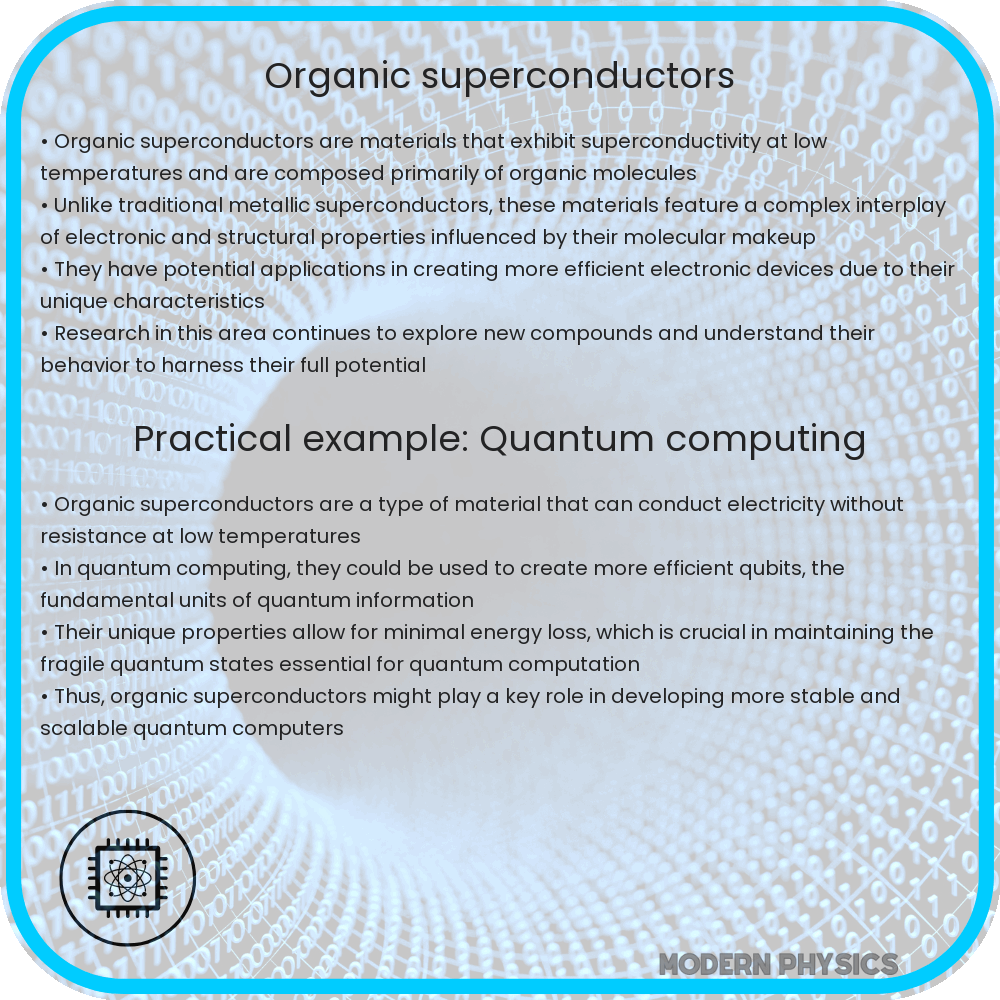
Organic superconductors represent a fascinating and innovative field within materials science, merging the realms of organic chemistry and quantum physics. Unlike their inorganic counterparts, these materials are primarily composed of carbon-based molecules, offering a unique pathway to superconductivity—a state where electrical resistance vanishes and magnetic flux fields are expelled. The discovery of organic superconductors has paved the way for new technologies and applications, challenging traditional notions of superconducting materials.
Efficient Synthesis of Organic Superconductors
The synthesis of organic superconductors often involves complex organic chemistry techniques, focusing on the creation of flat, planar molecules like the BEDT-TTF (bis(ethylenedithio)tetrathiafulvalene) family. These molecules stack into layers, facilitating the electron pairing necessary for superconductivity. Efficient synthesis requires precise control over molecular structure and purity, as even minor impurities can significantly impact superconducting properties. Recent advancements have utilized novel organic synthesis methods, including palladium-catalyzed cross-coupling reactions, to improve yield and efficiency in creating these critical compounds.
Applications of Organic Superconductors
Organic superconductors hold immense potential across various high-tech applications. One of the most promising areas is in quantum computing, where their unique properties could help overcome current limitations in qubit coherence and interconnectivity. Additionally, their mechanical flexibility and lower material costs compared to traditional superconductors make them ideal candidates for innovative electronics, such as flexible displays and advanced sensors. Furthermore, the study of organic superconductors contributes significantly to our understanding of high-temperature superconductivity, offering insights that could lead to the development of room-temperature superconductors, revolutionizing energy transmission and magnetic levitation technologies.
Challenges in Organic Superconductor Development
Despite their potential, organic superconductors face several challenges. The most significant is their critical temperature (Tc), which is generally lower than that of conventional superconductors. This necessitates cooling to extremely low temperatures, limiting practical applications. Moreover, the mechanical stability and durability of organic materials under operational conditions are subjects of ongoing research. Additionally, the reproducibility of synthesis and the scaling up of production processes remain hurdles that need addressing to make these materials more commercially viable.
Future Perspectives and Research Directions
Research in organic superconductors is vigorously advancing, with scientists exploring new molecular structures and synthesis techniques to enhance their superconducting properties. Efforts are also underway to integrate organic superconductors with other materials, forming hybrid systems that leverage the best properties of each. Furthermore, theoretical studies continue to provide deeper insights into the mechanisms of superconductivity in organic compounds, guiding the development of materials with higher Tc and better performance characteristics.
Conclusion
Organic superconductors represent a vibrant and promising field of research that challenges conventional boundaries and opens new avenues for technological innovation. While they currently face significant challenges, particularly in terms of critical temperature and material stability, ongoing research and development are paving the way for more practical and wide-ranging applications. The synthesis of these materials, leveraging advanced organic chemistry techniques, continues to evolve, offering the promise of more efficient and scalable production methods. As scientists and engineers address these challenges, the future of organic superconductors looks bright, with potential impacts across a range of industries from electronics to energy. The journey from laboratory curiosity to technological cornerstone is complex, but the unique properties of organic superconductors offer a tantalizing glimpse into the future of materials science and quantum technologies.