
Optoelectronic Oscillators (OEOs) convert optical signals into electronic oscillations, offering unparalleled precision, stability, and speed for applications like telecommunications, radar, and timing instruments.
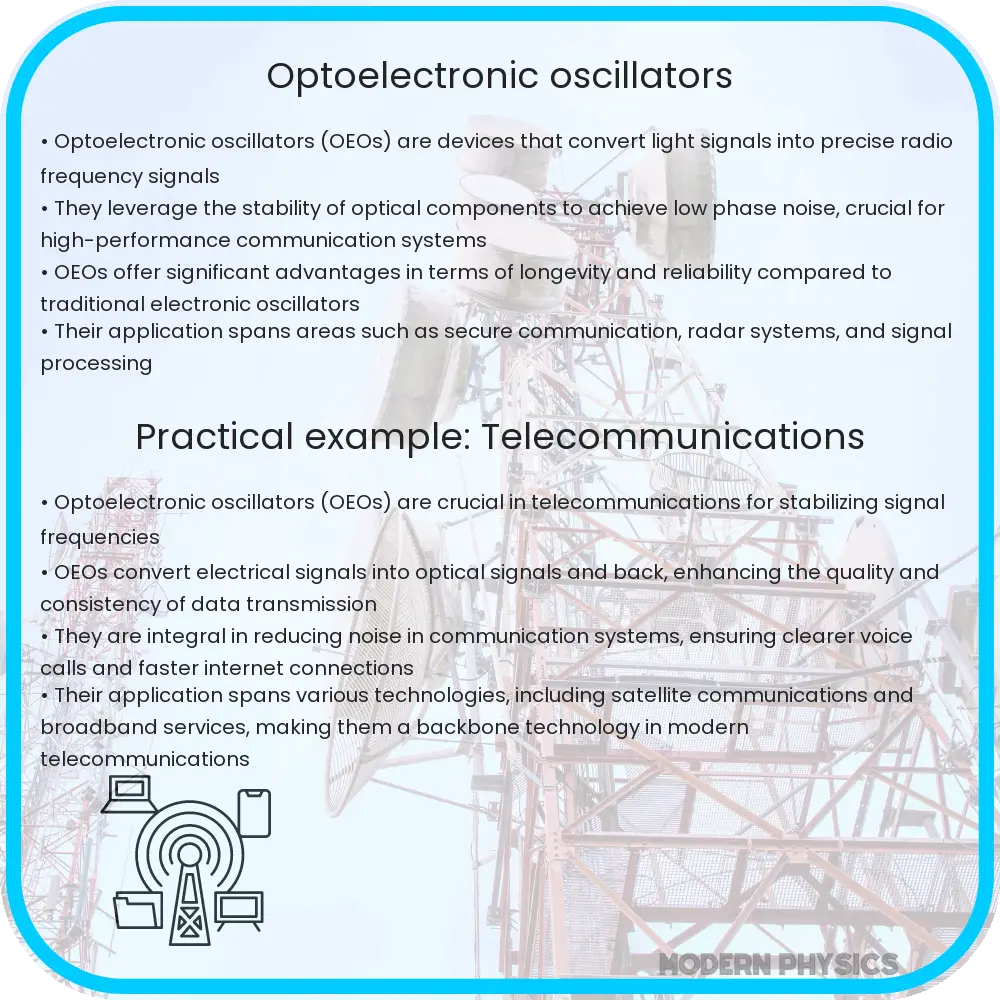
Optoelectronic Oscillators: Precision, Stability, & Speed
Optoelectronic Oscillators (OEOs) are devices that convert continuous optical signals into electronic oscillations. They are critical components in various applications, such as telecommunications, radar systems, and precise timing instruments. In this article, we will explore the key aspects of OEOs, specifically focusing on their precision, stability, and speed.
How Optoelectronic Oscillators Work
An OEO typically consists of an optical feedback loop and an electronic feedback loop. The optical feedback loop uses components like lasers, modulators, and optical fibers, while the electronic feedback loop includes amplifiers and filters. The basic working principle involves converting an electrical signal to an optical signal, modulating this optical signal, and then using it to drive an electronic oscillator.
The core process can be summarized in the following steps:
- The electrical signal is emitted by an electronic oscillator.
- This signal modulates an optical carrier via an electro-optic modulator.
- The modulated optical signal circulates within a fiber loop, creating an optical delay.
- The optical signal is then converted back into an electrical signal using a photodetector.
- The electrical signal is amplified and fed back into the electronic oscillator, completing the loop.
Precision
Precision in OEOs is largely determined by the quality factor (Q-factor) of the optical components used. The Q-factor describes the efficiency of the resonator in terms of energy loss. Higher Q-factors correspond to lower energy losses and more precise frequency generation.
The formula for the Q-factor (Q) is given by:
\[ Q = \frac{f_0}{\Delta f} \]
where:
- f0 is the resonant frequency
- Δf is the bandwidth of the resonator
Stability
Stability refers to the ability of the OEO to maintain a constant frequency over time and under varying environmental conditions. This is crucial for applications where long-term phase noise performance is vital. Factors that influence the stability of OEOs include:
- The thermal stability of the optical fiber
- The stability of the laser source
- The stability of the electronic circuits
To enhance stability, various techniques can be employed, such as temperature stabilization of the optical fiber and using highly stable laser diodes.
Speed
Speed in OEOs is defined by the oscillation frequency and the time it takes for the system to reach steady oscillation. High-speed OEOs are essential for applications requiring rapid signal processing and high-frequency synthesis. The achievable frequency range in OEOs spans from MHz to tens of GHz, making them versatile for various high-speed applications.
To improve speed, the design often includes:
- Low latency optical components
- High-speed electronics
- Minimizing the optical and electronic path lengths
Applications of Optoelectronic Oscillators
OEOs find application in several high-tech areas due to their superior precision, stability, and speed. Let’s explore some common applications:
- Telecommunications: OEOs are used for generating stable frequency sources which are critical in signal transmission, modulation, and detection.
- Radar Systems: The high stability and precision of OEOs make them ideal for generating the reference frequency required in radar systems for accurate distance and speed measurements.
- Timing Instruments: Instruments like atomic clocks and GPS systems depend on OEOs for their precise timekeeping abilities.
- Scientific Research: OEOs are used in various experimental setups requiring high-frequency stability and low phase noise.
Challenges and Future Directions
While OEOs offer numerous advantages, several challenges still need to be addressed to fully leverage their potential:
- Thermal Management: Fluctuations in temperature can affect the stability of optical components, leading to frequency drifts. Advanced thermal management techniques are needed to maintain consistent performance.
- Miniaturization: Reducing the size of OEOs while maintaining performance is a significant challenge, particularly for portable and integrated applications.
- Integration: Integrating OEO components with existing electronic and photonic circuits requires sophisticated fabrication and packaging technologies.
Future research is focusing on innovations in materials, design, and fabrication processes aimed at developing next-generation OEOs with enhanced performance metrics.
Conclusion
Optoelectronic Oscillators (OEOs) play a crucial role in a variety of high-tech applications, thanks to their remarkable precision, stability, and speed. By converting optical signals into electronic oscillations, they serve as indispensable tools in telecommunications, radar systems, and precise timing instruments. OEOs achieve their high level of performance through a well-designed combination of optical and electronic components.
Despite their numerous advantages, challenges like thermal management, miniaturization, and integration remain. Ongoing advancements in materials science and fabrication technology hold promise for overcoming these obstacles and pushing the performance boundaries of OEOs even further. As research progresses, the future of OEOs looks bright, offering endless possibilities for innovation in various fields.
Understanding the fundamentals of OEOs not only highlights their current significance but also encourages further exploration and development, ensuring that these sophisticated devices continue to meet the evolving demands of advanced technological applications.