
Explore the role of optical wedges in beam steering for precision, efficiency, and control across defense, medical imaging, and telecommunications.
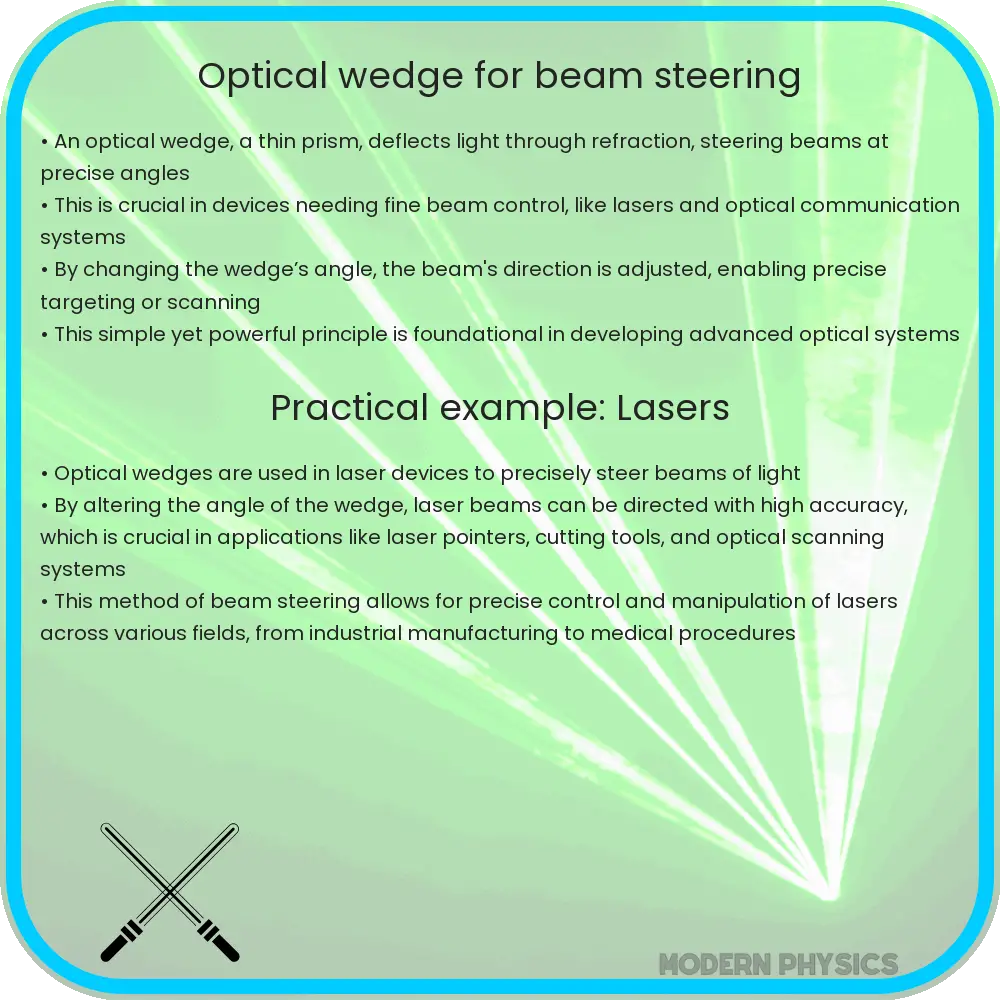
Understanding Optical Wedges for Beam Steering
Optical wedges are pivotal in the realm of photonics and optical engineering, offering a versatile method for beam steering that is essential for a wide array of applications ranging from precision targeting in defense systems to enhancing imaging quality in medical devices. These wedges are essentially thin pieces of optical material, typically glass or crystal, with a slight angular difference between the two faces. This simple yet effective design allows for the precise control and manipulation of light paths.
The Mechanics of Beam Steering with Optical Wedges
At the heart of an optical wedge’s functionality is Snell’s Law, which describes how light bends, or refracts, when it passes from one medium into another at an angle. When a light beam enters an optical wedge, it is refracted at both interfaces—where it enters and exits the wedge—due to the wedge’s angular design. By altering the angle of incidence and the material properties of the wedge, such as its refractive index, engineers can finely tune the direction of the light beam. This adjustment capability makes optical wedges a powerful tool for beam steering applications.
Precision, Efficiency, and Control in Beam Steering
The use of optical wedges for beam steering is marked by high levels of precision, efficiency, and control. Precision is achieved through the careful design and manufacturing of the wedge, allowing for exact adjustments to the beam’s direction. Efficiency comes from the minimal loss of light energy during the steering process, as the design of the wedge can be optimized to reduce absorption and scattering. Lastly, the level of control offered by optical wedges is unparalleled. Users can adjust the beam’s direction dynamically, in real-time, by simply rotating or translating the wedge, providing a level of agility that is critical for applications requiring rapid changes in beam direction.
Furthermore, the simplicity and compactness of optical wedges make them an attractive option for systems where space is at a premium and where the addition of complex optical components is not feasible. This combination of benefits underscores why optical wedges are a cornerstone technology in modern optical systems, enabling advancements in a wide range of fields.
Applications of Optical Wedge Beam Steering
Optical wedge beam steering technology finds its applications in a multitude of fields, demonstrating its versatility and importance. In defense and aerospace, it is utilized for precision targeting and navigation systems, allowing for the accurate guidance of projectiles and drones. Medical imaging benefits from the precision control of light, enhancing the clarity and resolution of images in techniques such as optical coherence tomography (OCT). In telecommunications, beam steering is crucial for free-space optical communication systems, enabling the alignment of laser communication links for high-speed data transmission.
Advancements and Innovations
The field of optical wedge beam steering continues to evolve, with ongoing research and development leading to significant advancements. Innovations in materials science, such as the development of new optical materials with higher refractive indices or lower absorption rates, are expanding the capabilities of optical wedges. Additionally, the integration of digital controls and actuation mechanisms allows for more precise and automated beam steering, opening up new possibilities for dynamic optical systems that can adapt to changing conditions in real-time.
Choosing the Right Optical Wedge
Selecting the appropriate optical wedge for a specific application requires careful consideration of several factors, including the wedge’s material, angle, and size. The material’s refractive index and transparency at the operational wavelengths are critical for ensuring efficient light transmission and steering. The wedge angle determines the range of steering capability, and the size must be compatible with the optical system’s spatial constraints. Consulting with experts in optical design is often necessary to tailor the wedge’s specifications to the application’s requirements.
Conclusion
Optical wedges stand as a testament to the elegant simplicity and effectiveness of optical engineering. By leveraging basic principles of physics, these components achieve precise, efficient, and controllable beam steering, proving indispensable across a broad spectrum of applications. As technology advances, the potential for optical wedges expands, promising even greater achievements in fields as diverse as defense, healthcare, and telecommunications. The continued innovation in materials, design, and control systems for optical wedges is set to further enhance their performance and applicability, ensuring that they remain at the forefront of optical technologies. Through careful selection and customization, optical wedges will continue to play a pivotal role in the development of sophisticated optical systems, driving forward scientific and technological progress.