
Explore the fascinating world of optical vortices: their applications, creation methods, and analysis, paving the way for revolutionary optical technologies.
Introduction to Optical Vortices
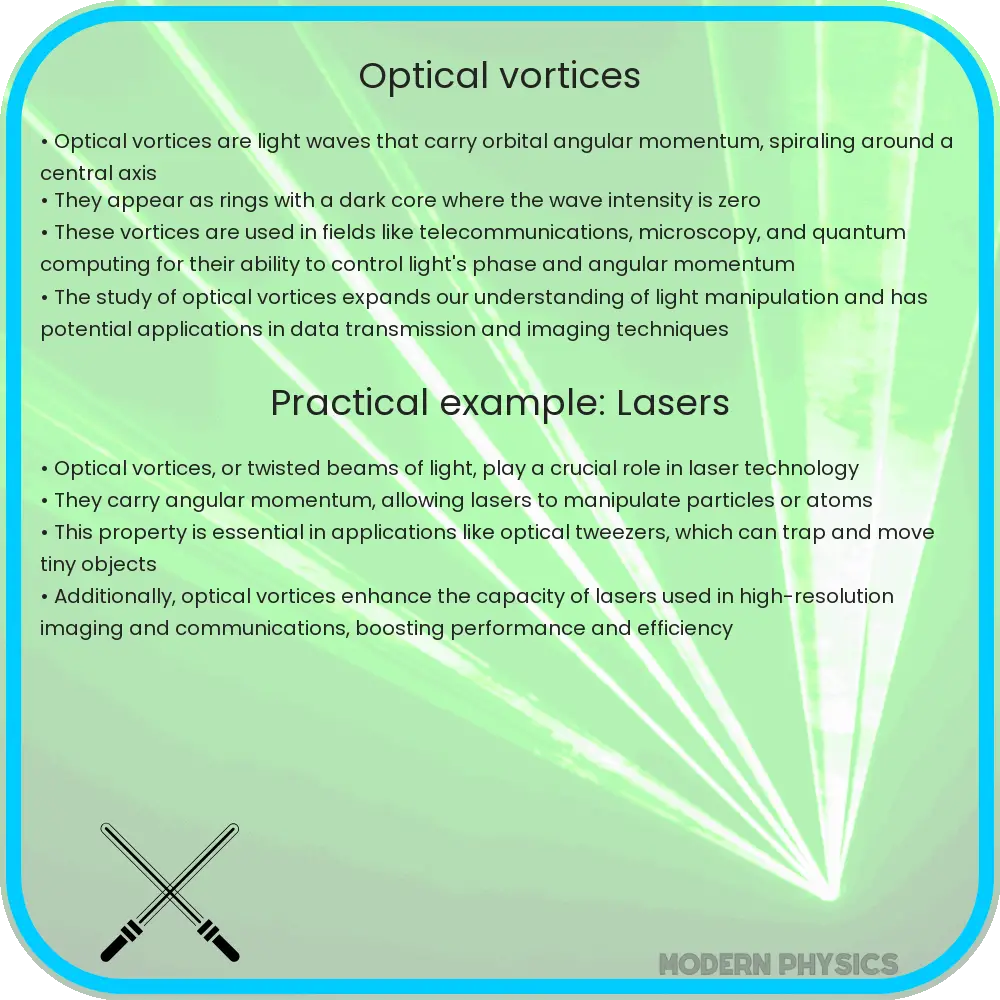
Optical vortices, also known as phase singularities or optical singularities, represent a fascinating area of photonics research. These unique phenomena occur when light waves intertwine to create points or lines of zero intensity, around which the phase of light exhibits a helical structure. This spiraling phase front is akin to a tornado, with the light’s phase rotating around a central axis, creating a “twist” in the light beam itself.
Applications of Optical Vortices
The intriguing properties of optical vortices have led to a variety of applications across multiple fields. In telecommunications, they offer a novel approach to increase data transmission capacities by encoding information not just in the amplitude and frequency of light, but also in its orbital angular momentum (OAM). This multiplexing technique can significantly boost the bandwidth of optical communication systems. In microscopy and optical tweezers, the unique interaction of optical vortices with matter allows for the manipulation of particles and cells with unprecedented precision. Furthermore, their use in quantum information science is emerging as a powerful tool for encoding and processing quantum information in high-dimensional quantum states, paving the way for advanced quantum computing and secure quantum communication networks.
Creation of Optical Vortices
Creating optical vortices requires techniques that can impart the characteristic helical phase structure to a light beam. This is typically achieved using spatial light modulators, diffractive optical elements, or specially designed holograms. These devices modify the phase profile of an incoming light beam to produce the twisted phase front of an optical vortex. Another method involves the use of vortex phase plates, which are optical elements with a spiral structure that induces the desired phase shift in the light passing through them. The choice of method depends on the specific requirements of the application, such as the desired topology of the vortex, its stability, and the wavelength of the light.
Analysis and Characterization
The study and characterization of optical vortices involve sophisticated techniques to measure their unique properties. Interferometry is commonly used to reveal the phase structure of a vortex beam, while techniques like computer-generated holography can analyze and manipulate optical vortices with high precision. Additionally, specialized microscopy methods enable the observation of the microscale interactions between optical vortices and matter, crucial for applications in optical manipulation and quantum information science.
Advanced Techniques in Optical Vortex Manipulation
As the field of optical vortices continues to evolve, so do the techniques for their manipulation and control. Adaptive optics and dynamic holography are at the forefront, allowing for real-time adjustment of optical vortices in response to changing environmental conditions or for specific application needs. These advancements are crucial for applications in atmospheric optics, where optical vortices can be used for probing and correcting atmospheric turbulences in astronomical observations.
Challenges and Future Directions
Despite the promising applications of optical vortices, there are challenges that need to be addressed. One of the main issues is the stability of these vortices under real-world conditions, as perturbations can lead to the decay or unwinding of the vortex phase. Furthermore, efficiently generating and manipulating high-order vortices, which carry higher angular momentum, remains a technical challenge. Research in this domain is focused on developing more robust methods for creating and maintaining optical vortices, as well as on exploring novel materials and nanostructures that can enhance their properties.
Conclusion
Optical vortices represent a remarkable intersection of physics, engineering, and technology, offering a plethora of opportunities for advancing current applications and exploring new frontiers. From enhancing communication technologies to enabling precise manipulations in the microscopic world, the potential of optical vortices is vast. The ongoing research and development in this field promise to overcome existing challenges and unlock new capabilities, solidifying the role of optical vortices in the next generation of optical and quantum technologies. As we continue to unveil the mysteries of these fascinating light structures, the future of optical vortices shines bright, promising to revolutionize the way we harness light for science and technology.