
Explore optical steganography for invisible data transmission and secure communication, highlighting advancements, challenges, and future outlook.
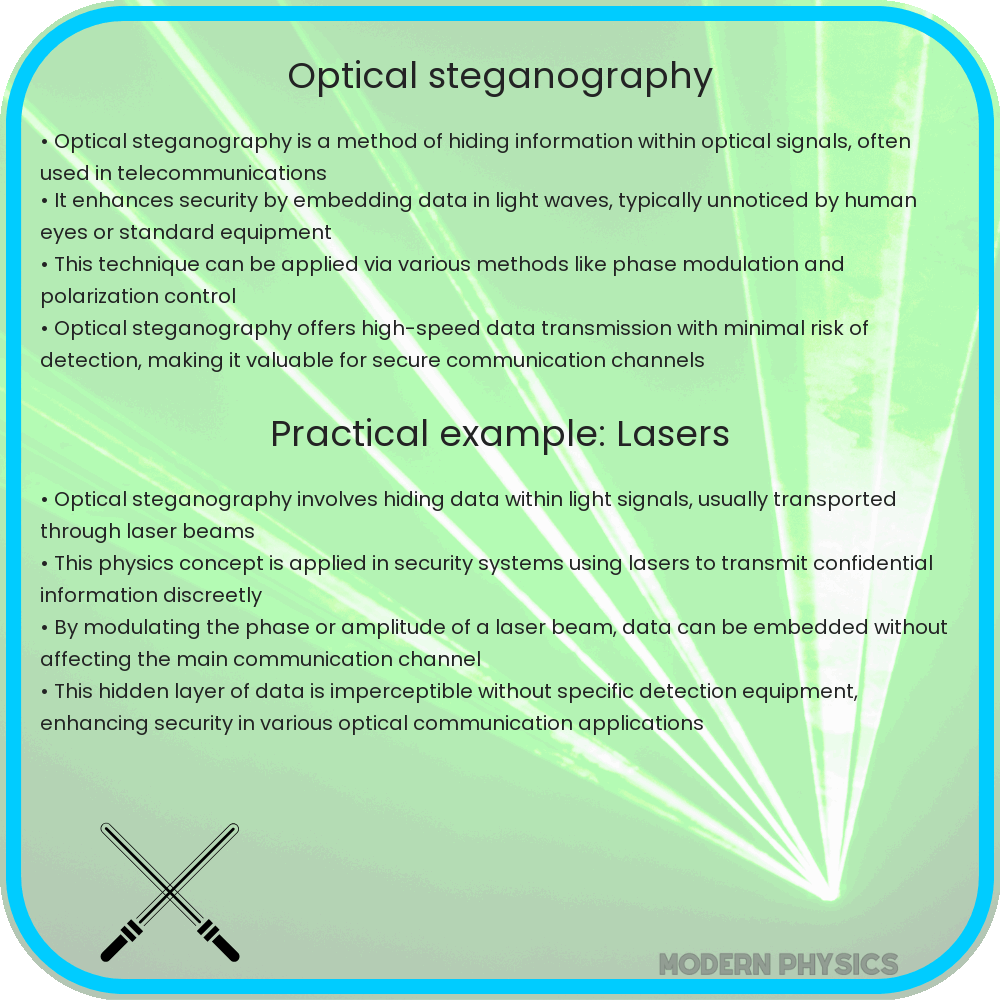
Introduction to Optical Steganography
Optical steganography is a cutting-edge technology that enables the invisible transmission of information by manipulating light. This technique, which falls under the broader category of steganography, involves embedding data within an optical signal in such a way that it is undetectable to the unaided eye. Optical steganography holds great promise for secure data transmission, offering a new layer of security in the digital age.
Principles of Optical Steganography
The core principle of optical steganography lies in its ability to hide information within light waves. This is achieved by using various methods such as phase modulation, polarization, or frequency shifting, making the presence of the data imperceptible to those without the necessary tools or knowledge to detect it. Unlike traditional encryption, which secures data by making it unreadable, optical steganography secures data by making it invisible.
Applications and Advantages
- Secure Communications: Optical steganography is invaluable for military and government communications, where the invisibility of data can prevent interception and unauthorized access.
- Network Security: In the realm of cybersecurity, it enhances the security of data transmission across optical fiber networks, safeguarding against data breaches.
- Intellectual Property Protection: It offers a novel way to protect sensitive information embedded in digital media, such as watermarks in images and videos, without altering their perceivable quality.
Technical Challenges
Despite its advantages, optical steganography faces several technical challenges. The primary concern is the robustness of data transmission. Factors such as optical signal degradation, interference, and the need for precise alignment in the transmission and reception of steganographic data pose significant hurdles. Additionally, the development of detection methods by adversaries could potentially compromise the invisibility of the transmitted data, necessitating ongoing advancements in steganographic techniques.
Another challenge is the trade-off between data payload size and the invisibility of the transmission. Higher data payloads can increase the risk of detection, requiring a delicate balance between the amount of data transmitted and the method used to conceal it.
Advancements in Optical Steganography
Research in optical steganography is rapidly advancing, with new techniques being developed to improve the reliability and capacity of invisible data transmissions. Quantum cryptography, for instance, has been integrated with optical steganography to create ultra-secure communication channels that are virtually immune to eavesdropping. Furthermore, advancements in nanotechnology and photonics have opened new avenues for manipulating light at the microscopic level, enhancing the capacity and stealth of optical steganographic methods.
Futuristic Outlook
The future of optical steganography is promising, with potential applications extending beyond secure communications to include innovations in healthcare, where it could be used for secure patient data transmission, and in smart cities, for enhancing privacy and security in IoT networks. As technology evolves, the integration of AI and machine learning could further refine steganographic techniques, making them more adaptive and difficult to detect.
Conclusion
Optical steganography represents a fascinating frontier in the quest for unbreakable data security. By leveraging the unique properties of light to conceal information, it offers a novel approach to secure communication that complements traditional encryption methods. Despite facing technical challenges, ongoing research and technological advancements promise to overcome these hurdles, expanding the possibilities for invisible data transmission. As the digital world becomes increasingly interconnected and the demand for secure communication grows, optical steganography stands out as a promising solution to protect data in ways previously thought impossible. Its potential applications, from military communications to protecting intellectual property, highlight its significance in today’s digital age. As we look to the future, the continued development of optical steganography will undoubtedly play a crucial role in shaping the landscape of cybersecurity and secure communications.