
The optical spring effect merges light and mechanics, allowing lasers to act like springs and enabling precision measurement, optical tweezers, and advanced optomechanical devices.
Optical Spring Effect: Precision, Applications & Theory
In the fascinating world of physics, the optical spring effect is a concept that merges light and mechanics, creating a realm where lasers can act like springs. This phenomenon plays a significant role in precision measurement and various modern applications, offering a unique insight into the interaction between light and matter.
What is the Optical Spring Effect?
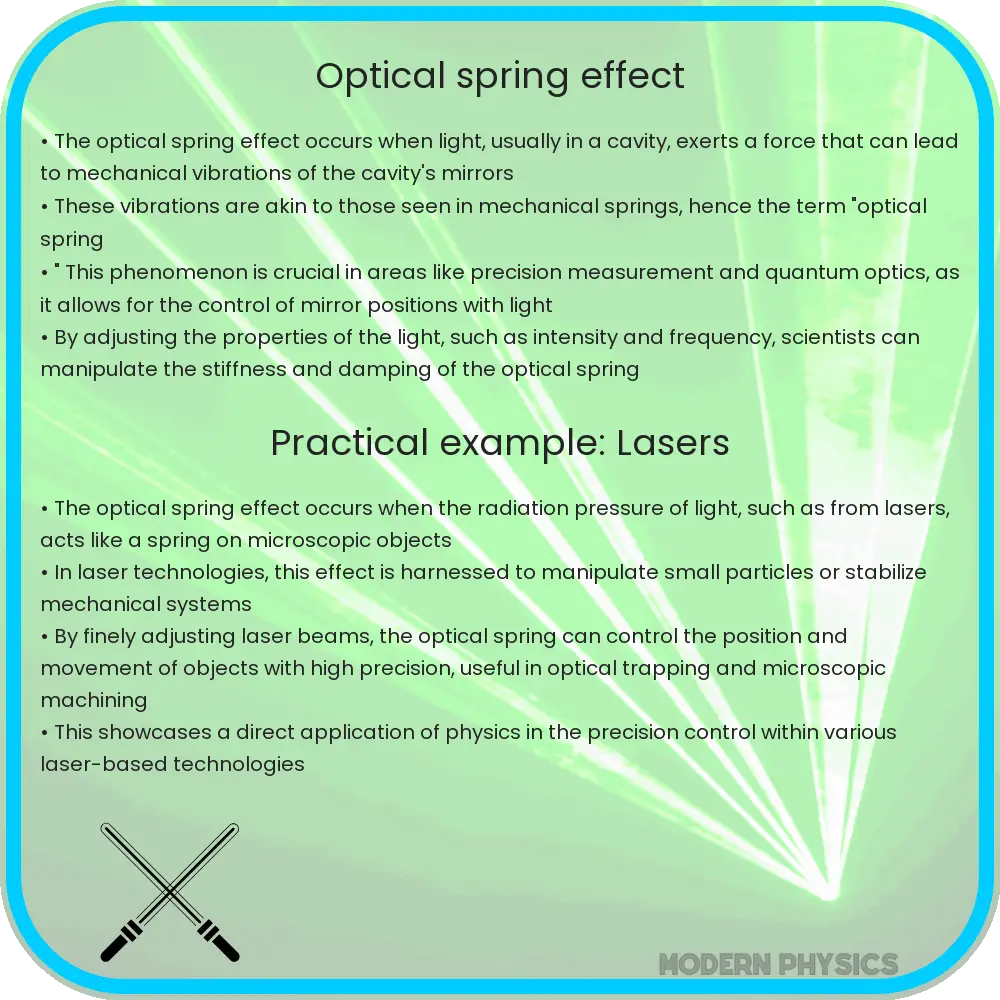
The optical spring effect occurs when a laser beam exerts a force on an object, causing it to behave as if it were attached to a spring. This is primarily due to the radiation pressure of light. When photons—tiny particles of light—strike an object, they transfer momentum to it, creating a force. By carefully controlling these forces, scientists can manipulate the positions and movements of small objects with extreme precision.
Theory Behind the Optical Spring Effect
To understand the theory, let’s dive into the mechanics. Suppose a laser beam is directed at a small, spherical mirror suspended in a vacuum. When photons from the laser strike the mirror, they exert a force due to radiation pressure. This pressure can be modeled similarly to Hooke’s Law for springs, which states:
- F = -kx
Here, F is the force exerted, k is the spring constant, and x is the displacement from the equilibrium position. In the case of optical springs, the force comes from the laser’s radiation pressure, and the spring constant k can be adjusted by varying the intensity and angle of the laser beam. This adjustable spring constant leads to high-precision control over the object’s position.
Mathematical Representation
When a laser beam hits a mirror, the force exerted by the radiation pressure F can be expressed as:
F = \frac{P}{c}
Here, P is the power of the laser, and c is the speed of light in a vacuum. When the mirror moves, this force can create a restorative potential similar to a mechanical spring.
The effective spring constant K_eff in an optical spring system can be derived from the change in momentum with respect to displacement. For small displacements, this is:
K_eff = \frac{d}{dx}\left(\frac{2P}{c}\right) = \frac{2P}{c d}
where d is the distance between the laser’s reflection points on the mirror.
Applications of the Optical Spring Effect
- Precision Measurement: One of the most important applications is in precision measurement systems, such as gravitational wave detectors like LIGO (Laser Interferometer Gravitational-Wave Observatory). The optical spring effect is used to stabilize and control the mirrors within the interferometer, allowing for incredibly precise measurements of minute disturbances in spacetime.
- Optical Tweezers: Another application is in the field of optical tweezers, which use laser beams to trap and manipulate microscopic particles, such as cells or small molecules. By adjusting the laser’s intensity, scientists can precisely control the position and movement of these particles, making it a valuable tool in microbiology and materials science.
- Optomechanical Devices: The optical spring effect is also utilized in various optomechanical devices, where mechanical motion is coupled with optical fields. These devices find applications in sensing, communications, and fundamental physics experiments.
The optical spring effect illustrates the interplay between light and matter, creating opportunities for advancements in technology and deepening our understanding of the physical world.
Optomechanical Interactions
A crucial aspect of the optical spring effect is the interplay between optical fields and mechanical motion, forming the basis of optomechanics. In optomechanics, the radiation pressure from light can be harnessed to engineer intricate systems where the mechanical properties of objects are modulated by light. This leads to the development of components such as high-precision sensors and actuators.
How Optomechanical Systems Work
These systems typically consist of a mechanical resonator coupled with an optical cavity. As the mechanical resonator moves, it changes the optical path length within the cavity, thereby affecting the resonance condition. This mutual interaction leads to phenomena such as optical cooling, where the motion of the mechanical resonator can be damped using light, effectively cooling it down.
Optical Cooling and Its Importance
Optical cooling—also known as laser cooling—is a process by which the kinetic energy of particles or mechanical objects is reduced using the radiation pressure of light. This technique is instrumental in reaching extremely low temperatures, which are pivotal in exploring quantum behaviors and observing new physical phenomena.
A practical example is the cooling of atomic gases to form Bose-Einstein condensates, a state of matter where particles occupy the same low-energy quantum state, exhibiting unique properties. Optical cooling is also used in reducing thermal noise in high-precision measurement devices, enhancing their sensitivity and accuracy.
Real-World Implementations
The principles of the optical spring effect and optomechanics are not confined to theoretical realms; they have several real-world implementations. Below are some instances where these concepts come to life:
Advanced Gravitational Wave Detection
The success of detectors like LIGO and Virgo in identifying gravitational waves is largely due to the optical spring effect. By utilizing radiation pressure to precisely position mirrors and manage noise, these observatories can detect incredibly small ripples in the fabric of spacetime caused by cosmic events such as black hole mergers.
Medical and Biological Applications
In the medical field, optical tweezers have revolutionized the way scientists manipulate and study biological specimens at the microscopic level. Cells, DNA strands, and even individual proteins can be grasped and moved meticulously, thanks to the precision offered by controlled laser beams. This has profound implications for drug development, genetic research, and the study of cellular processes.
Cutting-Edge Nanotechnology
In the realm of nanotechnology, the optical spring effect enables the manipulation of nanoparticles and nanostructures with high accuracy. This is essential in fabricating and assembling nanoscale devices, which are crucial for advanced electronics, photonics, and materials science. Such precise control also aids in studying the properties of materials at the nanoscale, leading to new discoveries and innovations.
Conclusion
The optical spring effect represents a fascinating intersection of light and mechanics, offering a powerful toolset for both scientific research and practical applications. By exploiting the radiation pressure of light, researchers can achieve extraordinary control over small objects, leading to advancements in precision measurement, biomedicine, and nanotechnology. The ongoing exploration of this effect is poised to unlock even more potential, pushing the boundaries of what is possible with the interplay between light and matter.