
Explore the intricacies of optical pulse shaping, a technology enhancing precision, speed, and control in photonics, with applications in telecommunications and research.
Understanding Optical Pulse Shaping
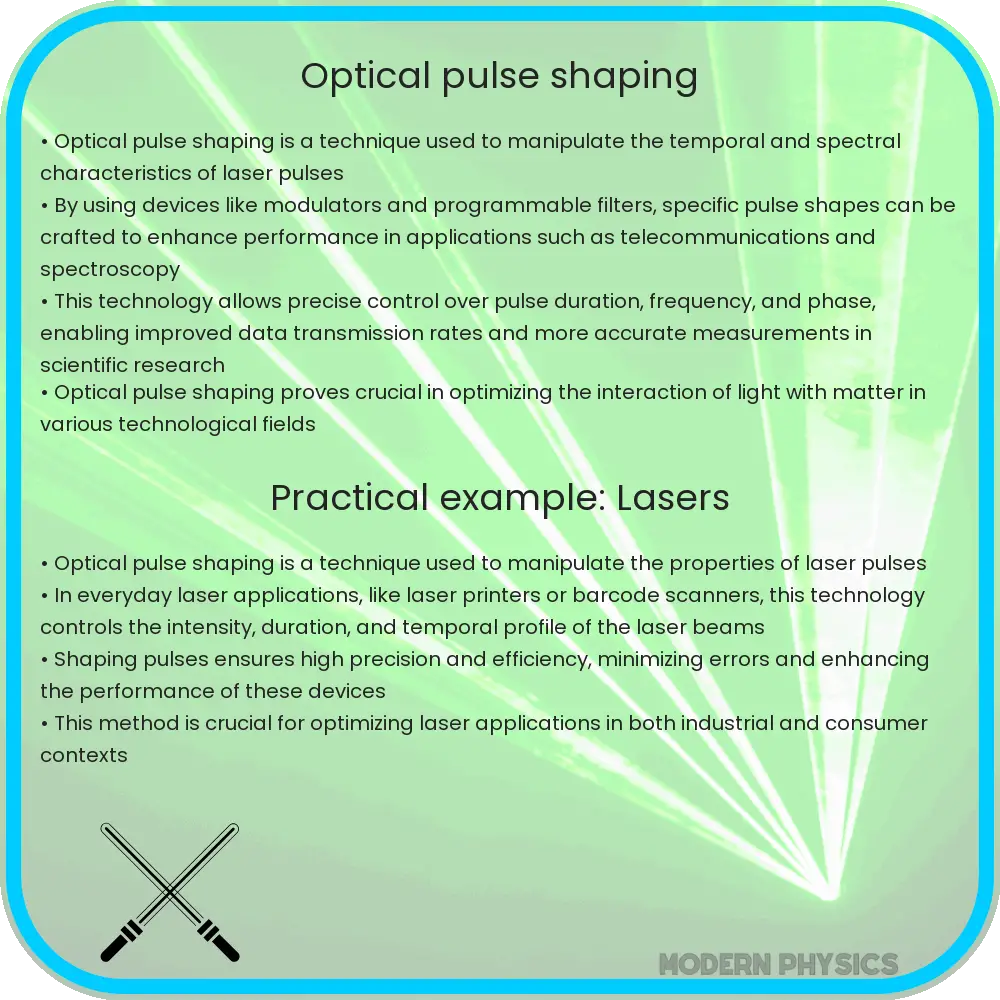
Optical pulse shaping is a pivotal technique in the field of photonics, enabling the manipulation of light pulses to achieve precise control over their properties. This technology is crucial for a myriad of applications, from high-speed telecommunications to advanced research in quantum computing and biomedical imaging. At its core, optical pulse shaping involves altering the phase, amplitude, and temporal profile of light pulses, offering unprecedented precision, speed, and control in optical systems.
The Science Behind Optical Pulse Shaping
Optical pulse shaping leverages the principle of Fourier transform, which posits that any light pulse can be represented as a sum of different frequency components. By adjusting these components through devices known as pulse shapers, scientists can craft pulses with specific characteristics. The process typically involves modulating the spectral phase or amplitude of the pulse using spatial light modulators (SLMs), diffractive optical elements, or acousto-optic modulators (AOMs).
Applications and Advantages
The versatility of optical pulse shaping has led to its widespread use across various fields. In telecommunications, it enhances data transmission rates and reduces errors by optimizing the shape of optical signals. In ultrafast spectroscopy, it allows researchers to probe the dynamics of molecules with unprecedented temporal resolution. Moreover, in optical computing and quantum technologies, shaped pulses are instrumental in controlling quantum states and executing complex operations at the speed of light.
- Precision: The ability to fine-tune the waveform of light pulses enables unmatched accuracy in targeting and manipulation of optical signals.
- Speed: Optical pulse shaping facilitates the generation and manipulation of ultrafast light pulses, often in the femtosecond (10-15 seconds) to picosecond (10-12 seconds) range, crucial for high-speed optical communications and computing.
- Control: Advanced pulse shaping techniques offer comprehensive control over the temporal and spectral properties of light, enabling complex waveform generation for specific applications.
This innovative technology not only enhances the efficiency and performance of existing optical systems but also paves the way for new discoveries and advancements in the field of photonics. As we continue to explore the potential of light, optical pulse shaping stands as a testament to the ingenuity and creativity of scientists and engineers in harnessing the power of light for the betterment of technology and society.
Technological Innovations in Optical Pulse Shaping
Recent advancements in optical pulse shaping have been driven by cutting-edge technologies such as adaptive optics and machine learning algorithms. These innovations have enabled more sophisticated control mechanisms, allowing for real-time adjustments to pulse shapes based on feedback mechanisms. Adaptive optics, for instance, compensates for aberrations in the optical path, enhancing the precision of pulse shaping in complex environments. Meanwhile, machine learning algorithms optimize pulse shapes for specific applications, significantly reducing the time required for manual adjustments and increasing the efficiency of processes such as multiphoton microscopy and optical coherence tomography in biomedical imaging.
Challenges and Future Directions
Despite its numerous advantages, optical pulse shaping faces challenges, particularly in terms of hardware limitations and the complexity of design algorithms. The high cost of spatial light modulators and the need for high-resolution, fast-response modulating devices are significant barriers to widespread adoption. Furthermore, developing algorithms that can accurately predict and generate desired pulse shapes in real-time is an area of ongoing research. However, the future of optical pulse shaping looks promising, with ongoing efforts focused on overcoming these hurdles through the development of cost-effective modulators and more intuitive software interfaces.
Conclusion
Optical pulse shaping is a cornerstone technology in the evolution of photonic systems, offering unparalleled precision, speed, and control over light pulses. Its applications span from enhancing telecommunications to pushing the boundaries of scientific research. Despite facing challenges such as hardware limitations and the complexity of control algorithms, continuous technological innovations are paving the way for overcoming these obstacles. As the field progresses, we can anticipate more sophisticated optical pulse shaping techniques, further broadening the horizons of what’s possible with light. The convergence of optical technologies with areas such as artificial intelligence and nanofabrication holds the promise of revolutionizing industries and leading to breakthroughs in scientific research. Optical pulse shaping, with its ability to precisely manipulate the fundamental properties of light, will undoubtedly play a crucial role in shaping the future of technology and science.