
Explore the fascinating world of solids’ optical properties, covering absorption, reflection, band theory, and their pivotal role in modern technology.
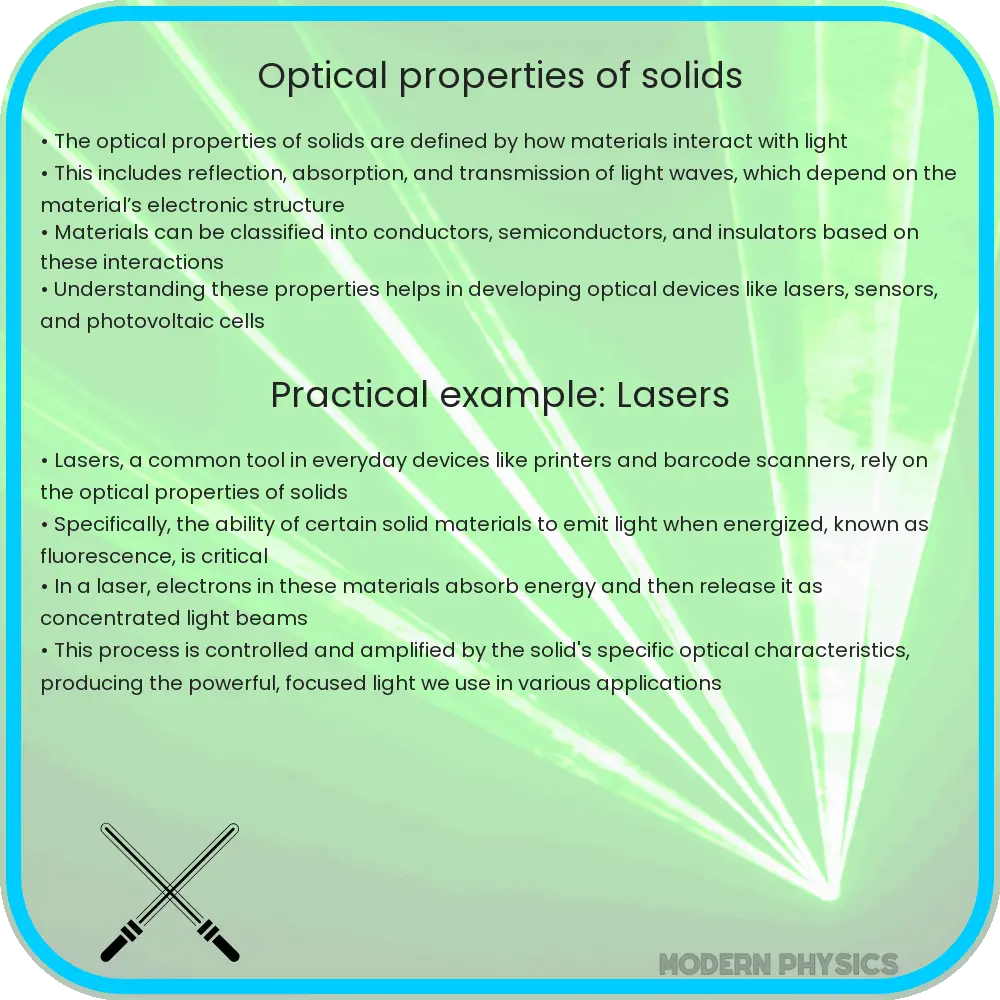
Understanding the Optical Properties of Solids
The interaction between light and solid materials is a fundamental aspect of material science, impacting various technological applications, from solar cells to optical fibers. The optical properties of solids, including absorption, reflection, and transmission, are governed by the material’s electronic structure and band theory. In this article, we delve into these properties and the underlying principles that define them.
Absorption of Light in Solids
Absorption is the process where a material captures energy from light, leading to electronic transitions within the material. The extent of light absorption depends on the wavelength of the incoming light and the material’s electronic structure. When photons have enough energy, they can excite electrons from the valence band to the conduction band, creating electron-hole pairs. This process is crucial in devices like photovoltaic cells, where absorbed light generates electrical power.
Reflection and Transmission
Reflection occurs when light bounces off the surface of a material, while transmission involves light passing through a material. The balance between reflection, absorption, and transmission is critical for understanding a material’s optical behavior. Materials with high reflectivity are used in mirrors and coatings, whereas those with high transmission are essential for lenses and windows. The Fresnel equations describe the reflection and transmission of light at an interface, highlighting the dependence on the angle of incidence and the material’s refractive index.
Band Theory of Solids
At the heart of understanding the optical properties of solids is the band theory, which explains the distribution of electron energy levels in a solid. In insulators and semiconductors, a significant energy gap exists between the valence band, occupied by electrons, and the conduction band, where electrons move freely. The band gap’s size determines the material’s ability to absorb certain wavelengths of light. For instance, materials with a larger band gap are transparent to visible light but can absorb ultraviolet light.
This foundational knowledge of absorption, reflection, and band theory provides a basis for exploring the vast applications and phenomena related to the optical properties of solids, including photonic devices, energy harvesting, and sensor technologies.
Applications and Phenomena Related to Optical Properties
The optical properties of solids are not only fascinating from a theoretical standpoint but also have practical implications in various fields. For example, the development of photonic devices leverages materials’ ability to guide, modulate, and emit light. Similarly, in energy harvesting technologies, understanding and optimizing absorption properties can significantly enhance the efficiency of solar panels. Furthermore, the optical properties of materials are crucial in the design of sensors that detect light or changes in environmental conditions.
Nonlinear Optical Effects
Beyond the basic interactions of light with matter, there are complex phenomena such as nonlinear optical effects. These effects, which include second-harmonic generation and two-photon absorption, occur when materials interact with high-intensity light. Such interactions are pivotal in creating devices for high-speed data transmission and advanced imaging technologies.
Challenges and Future Directions
Despite significant advancements, challenges remain in fully exploiting the optical properties of materials. For instance, finding materials with tailored band gaps for specific applications requires extensive research and development. Additionally, improving the efficiency of light-matter interactions in devices often involves complex fabrication processes. However, ongoing research in material science and nanotechnology holds promise for overcoming these challenges, potentially leading to groundbreaking applications in telecommunications, computing, and beyond.
Conclusion
The study of optical properties in solids—encompassing absorption, reflection, and band theory—lays the groundwork for a myriad of technological advancements. From the development of energy-efficient lighting and solar cells to the creation of sophisticated optical communication systems, the manipulation and understanding of light-matter interactions are central. As we continue to explore and innovate, the optical properties of materials will undoubtedly play a crucial role in shaping the future of technology, offering new solutions and enhancing existing applications. The interplay between theoretical knowledge and practical applications in this field continues to drive progress, illustrating the profound impact of material science on our daily lives and the technological landscape of the future.