
Explore the essentials of Optical Phase Retrieval, its impact on accuracy, speed, advancements, and diverse applications in microscopy, astronomy, and beyond.
Understanding Optical Phase Retrieval: A Comprehensive Overview
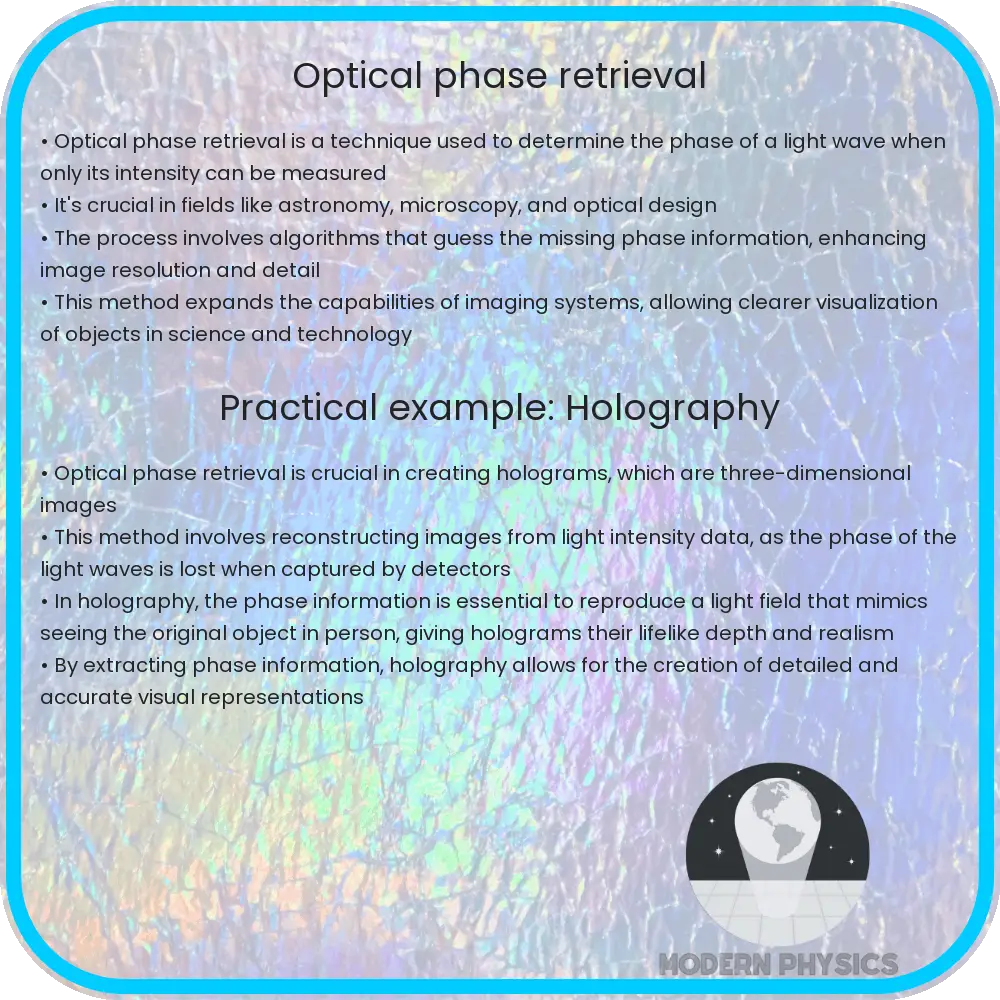
Optical Phase Retrieval is a crucial technique in the field of optics, enabling the determination of an object’s phase information from intensity measurements. This method plays a pivotal role in various applications, ranging from microscopy to astronomical imaging, where direct phase measurement is often challenging or impossible. The accuracy and speed of phase retrieval processes significantly impact their effectiveness and applicability in real-world scenarios.
Accuracy in Optical Phase Retrieval
The accuracy of optical phase retrieval is paramount for generating high-fidelity images and precise measurements. It depends on several factors, including the algorithm used, the quality of the input data, and the noise level. Common algorithms like Gerchberg-Saxton and Fienup’s iterative algorithms have been widely adopted due to their balance of simplicity and effectiveness. However, the presence of noise and the non-uniqueness of solutions often pose challenges, necessitating advanced computational techniques and regularization strategies to enhance accuracy.
Speed Considerations
Speed is another critical aspect of optical phase retrieval, especially for applications requiring real-time processing or dealing with large datasets. The computational complexity of phase retrieval algorithms directly affects their execution speed. While iterative methods offer good accuracy, they can be computationally intensive. Recent advancements in machine learning and parallel computing have opened new avenues for accelerating phase retrieval processes, enabling faster convergence and reducing computational time without significantly compromising accuracy.
Applications of Optical Phase Retrieval
Optical phase retrieval has a wide array of applications across different fields. In microscopy, it allows for the visualization of transparent specimens without staining. In astronomy, it aids in correcting atmospheric distortions to enhance telescopic images. The technique is also essential in optical testing, where it helps in the characterization and testing of optical components and systems. Furthermore, in the realm of X-ray crystallography, phase retrieval is crucial for determining the atomic structure of molecules.
Each application presents unique challenges, from the need for high-resolution imaging in biological microscopy to the requirement for rapid processing in astronomical imaging. The ongoing development of more accurate and faster phase retrieval methods continues to expand the technique’s utility, making it a cornerstone of modern optical science.
Advancements and Future Directions in Optical Phase Retrieval
The field of optical phase retrieval is constantly evolving, with research focused on overcoming existing limitations and expanding its capabilities. Advanced algorithms that incorporate machine learning and artificial intelligence have shown promise in improving both accuracy and speed. These approaches leverage vast datasets to train models that can predict phase information more accurately and swiftly than traditional methods. Additionally, the integration of hardware acceleration techniques, such as GPUs and specialized processors, has significantly reduced computation times, enabling near real-time phase retrieval in some applications.
Challenges and Considerations
Despite these advancements, several challenges remain. The accuracy of phase retrieval can be affected by factors such as aberrations in the optical system, the complexity of the object being imaged, and the presence of noise. Addressing these issues requires ongoing refinement of algorithms and imaging techniques. Moreover, the trade-off between speed and accuracy necessitates careful consideration in the design and implementation of phase retrieval solutions, particularly for applications with stringent requirements.
Interdisciplinary Impact and Industrial Applications
The interdisciplinary nature of optical phase retrieval has facilitated its application in fields beyond traditional optics, including biomedical engineering, materials science, and security. In the industrial sector, it is used for quality control and inspection processes, where non-invasive imaging and precise measurements are critical. The technique’s ability to provide detailed phase information without physical contact offers a significant advantage in sensitive or hazardous environments.
Conclusion
Optical phase retrieval stands as a testament to the remarkable progress in the field of optics and photonics. Its impact spans across scientific research, industrial applications, and technological innovation, driven by the continuous quest for improved accuracy, speed, and applicability. As we look forward, the integration of emerging computational techniques and the development of more sophisticated algorithms hold the promise of unlocking new possibilities and overcoming current limitations. The future of optical phase retrieval is bright, with its potential only beginning to be tapped into. Its role in advancing our understanding and capabilities in imaging and measurement is undeniable, marking it as a key area of focus for researchers and practitioners alike.