
Explore the efficiency, tunability, and applications of Optical Parametric Oscillation (OPO), a key technology in modern optics and photonics.
Understanding Optical Parametric Oscillation
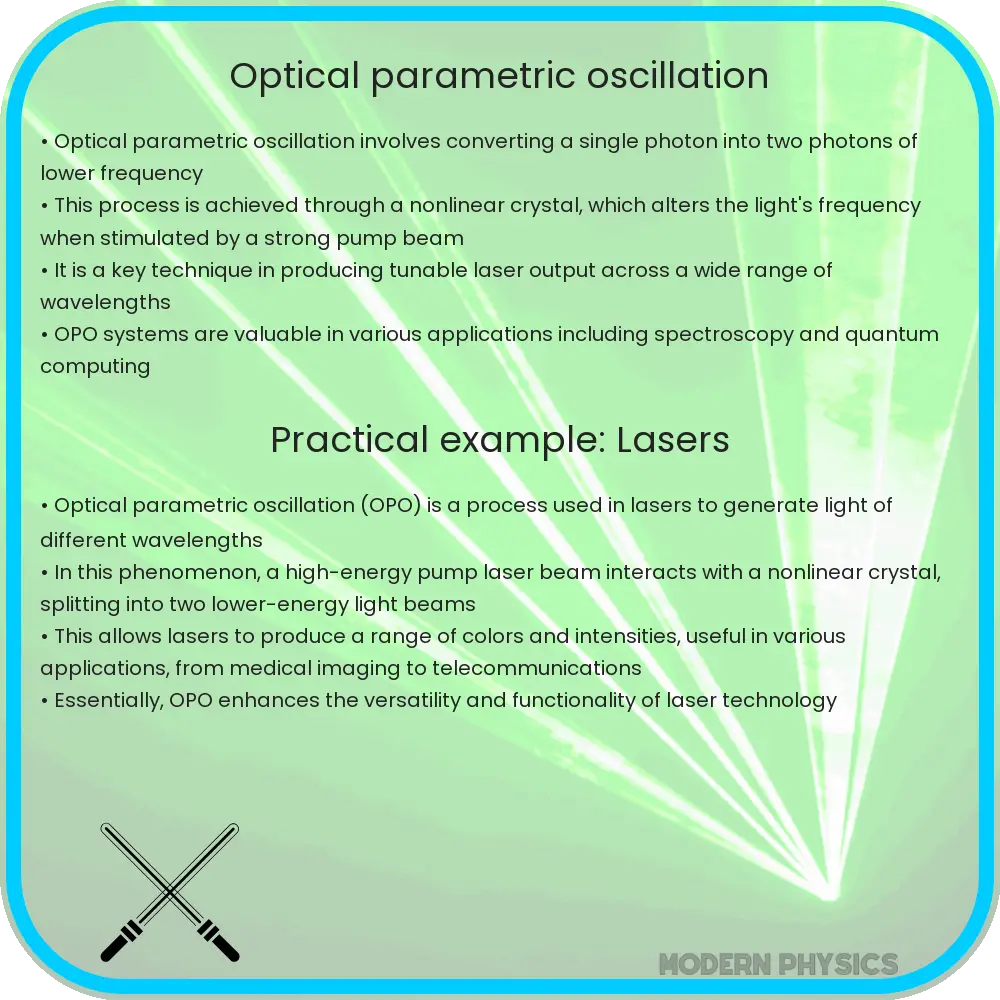
Optical Parametric Oscillation (OPO) is a critical phenomenon in the field of nonlinear optics. It involves the conversion of a pump laser beam into two different beams: the signal and the idler. This process occurs in a nonlinear optical crystal, where the original beam’s energy is conserved but distributed between the new beams.
Efficiency of Optical Parametric Oscillators
The efficiency of an OPO system is paramount, dictating its practicality for various applications. Efficiency is influenced by factors such as the type of nonlinear material used, the wavelength of the pump laser, and the phase-matching conditions. Advanced materials like Lithium Niobate (LiNbO3) and periodically poled crystals have shown to enhance the efficiency significantly.
Tunability of OPO Systems
One of the most remarkable features of OPOs is their tunability. By adjusting the phase-matching conditions, such as the angle of the crystal or the temperature, users can modify the wavelengths of the signal and idler beams. This tunability makes OPOs extremely versatile, suitable for applications ranging from spectroscopy to laser radar systems.
Applications of Optical Parametric Oscillators
OPOs find their use in a myriad of fields. In medical diagnostics, they are employed in imaging techniques like Optical Coherence Tomography (OCT), providing high-resolution images of biological tissues. In environmental monitoring, OPOs aid in detecting trace gases and pollutants through sophisticated spectroscopy methods.
- Spectroscopy: OPOs are instrumental in high-resolution spectroscopy, allowing scientists to study the molecular composition of materials.
- Laser Ranging and Lidar: The tunability of OPOs makes them suitable for distance measurement and atmospheric studies.
- Telecommunications: In fiber optics, OPOs can be used to generate a range of wavelengths, enhancing data transmission capabilities.
In summary, Optical Parametric Oscillation stands as a cornerstone in modern optics, offering high efficiency, exceptional tunability, and diverse applications across various scientific and industrial fields. Its ongoing developments continue to push the boundaries of optical technologies.
Advanced Developments in Optical Parametric Oscillators
Recent advancements in OPO technology have led to the development of more compact, efficient, and versatile systems. Innovations such as the integration of waveguide structures and the use of quasi-phase matching have significantly improved the output power and beam quality. These enhancements are pivotal in expanding the applicability of OPOs in both scientific research and commercial sectors.
Challenges and Future Directions
Despite their versatility, OPOs face challenges, particularly in terms of power scalability and stability. Research is ongoing to address these issues, with a focus on developing new materials and configurations that can sustain higher power levels while maintaining efficiency. The future of OPO technology also lies in its integration with emerging fields such as quantum optics and photonic integrated circuits, promising revolutionary changes in optical computing and communication.
- Quantum Optics: OPOs are being explored in the generation of entangled photon pairs, crucial for quantum computing and cryptography.
- Photonic Integrated Circuits: Integrating OPOs into photonic chips could lead to new compact sources of coherent light for on-chip optical data processing.
Conclusion
Optical Parametric Oscillation is a technology that has profoundly impacted various sectors, from environmental monitoring to telecommunications. Its unique properties, such as high efficiency and tunability, make it an indispensable tool in the arsenal of modern optics. The advancements in this field are not just contributing to the enhancement of existing applications but are also paving the way for new innovations in areas like quantum technology and integrated photonics. As research continues to overcome the present challenges, the potential of OPO systems in transforming our understanding and utilization of light remains boundless, holding the promise of further groundbreaking applications in the future.