
An in-depth look at Optical Kerr Effect Spectroscopy, a technique using nonlinear optics to study material properties and molecular dynamics by observing changes in refractive index.
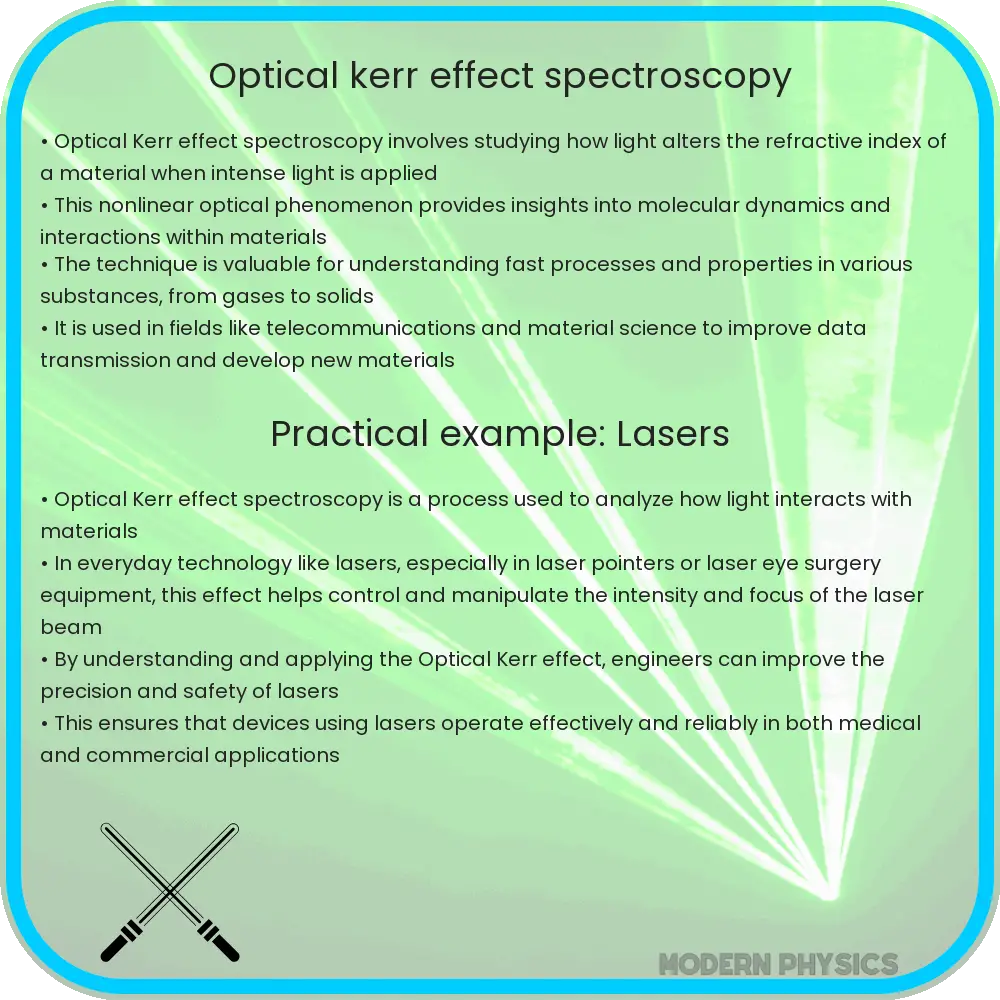
Introduction to Optical Kerr Effect Spectroscopy
Optical Kerr Effect (OKE) spectroscopy is a fascinating and powerful tool used to explore the molecular dynamics and structural properties of materials at a microscopic level. Utilizing the principles of nonlinear optics, this technique provides unique insights into the interactions of light with various substances, characterized by changes in their refractive index in response to an applied electric field. In this article, we’ll dive deep into the analysis, speed, and precision of OKE spectroscopy, elucidating why it’s such a valuable method in scientific research.
Understanding the Optical Kerr Effect
The Optical Kerr Effect refers to the phenomenon where the refractive index of a material changes in response to the intensity of light passing through it. This change is directly proportional to the square of the electric field of the incident light. Mathematically, the change in refractive index, Δn, can be expressed as:
Δn = n2 * I
where n2 is the Kerr coefficient, a material-specific parameter, and I represents the light intensity.
The effect is instantaneous and reversible, which makes it particularly useful for studying rapid processes at nano- and femtosecond timescales. When a pulsed laser beam is used in experiments, the intensity of light can be controlled precisely, allowing researchers to observe the dynamics of the Kerr Effect in real-time.
The Role of Spectroscopy in OKE
Spectroscopy in the context of the Optical Kerr Effect involves the measurement of the intensity and phase changes of a probe light beam as it passes through a sample material influenced by a pump beam. The pump beam’s role is to induce the Kerr Effect, while the probe beam analyzes the resultant changes in the optical properties of the sample. This interaction is key to understanding molecular and electronic environments within materials.
Analysis Techniques in OKE Spectroscopy
The analysis of data from OKE spectroscopy experiments is critical for interpreting the underlying molecular interactions and dynamics. The main aspects analyzed include:
- Time Resolution: OKE spectroscopy can provide insights into processes occurring at femtosecond to picosecond timescales.
- Spectral Bandwidth: The spectral range over which the Kerr Effect is analyzed can reveal different electronic and vibrational transitions in materials.
- Phase Measurements: By observing the changes in the phase of the probe beam relative to the pump beam, scientists can deduce changes in the optical path length that are indicative of molecular rearrangements.
Precision and Speed of OKE Spectroscopy
OKE spectroscopy stands out due to its exceptional precision and speed. The technique’s ability to provide real-time data on molecular dynamics makes it supremely effective for studying fast phenomena such as solvation dynamics or phase transitions in materials. The precision of measurements, dictated by the quality of the laser system and the stability of the entire setup, allows for accurate deductions about molecular sizes, shapes, and interactions.
The speed of OKE spectroscopy is another critical aspect, enabling the capture of transient phenomena that would otherwise be impossible to observe with slower techniques. This makes OKE spectroscopy an invaluable tool in the fields of chemistry, physics, and materials science, where understanding the fast dynamic processes is essential.
Applications of Optical Kerr Effect Spectroscopy
The applications of OKE spectroscopy are vast and varied. They include:
- Studying the structural dynamics of liquids and glasses.
- Investigating conformational changes in biomolecules.
- Exploring electronic delocalization and charge transfer processes in complex systems.
- Assessing thermal and mechanical properties of materials under different environmental conditions.
The ability to probe the microscopic interactions within materials with such speed and precision makes OKE spectroscopy a cornerstone technique in modern scientific investigation. Its non-invasive nature and high sensitivity ensure that it will remain a preferred method for exploring the frontiers of material science and molecular dynamics.
Challenges and Limitations
Despite its numerous advantages, Optical Kerr Effect spectroscopy does face certain challenges and limitations that must be acknowledged. These include:
- Sensitivity to Experimental Conditions: OKE measurements can be highly sensitive to environmental variables such as temperature and pressure, which necessitates meticulous control over experimental conditions to ensure reproducibility and accuracy.
- Complex Data Interpretation: The data obtained from OKE spectroscopy often requires complex interpretation and modeling to extract meaningful results, which can be a barrier for researchers without access to sufficient computational resources or expertise.
- Equipment Cost: The high cost of ultrafast laser systems and other specialized equipment necessary for conducting OKE spectroscopy might be prohibitive for some research institutions, limiting accessibility to this advanced technique.
These challenges highlight the need for ongoing development in the methodologies, equipment, and data analysis techniques used in OKE spectroscopy to broaden its application and enhance its utility in scientific research.
Future Prospects
The future of Optical Kerr Effect spectroscopy looks promising as advancements in laser technology and computational methods continue to evolve. Researchers are constantly finding new ways to improve the resolution and sensitivity of OKE techniques, which is expected to open new avenues in materials science, biochemistry, and nanotechnology. Furthermore, the integration of OKE spectroscopy with other analytical techniques might lead to even deeper insights into the complex behaviors of materials at the molecular level.
As we continue to push the boundaries of what’s possible with OKE spectroscopy, its applications could expand to include more in-depth studies of biological systems, the development of novel materials with engineered properties, and even the exploration of quantum materials, each of which could have profound implications for technology and industry.
Conclusion
Optical Kerr Effect spectroscopy stands as a powerful and versatile tool in the arsenal of modern science, instrumental in advancing our understanding of the molecular world. Through its ability to provide real-time insights into the dynamic processes within materials at exceptionally high speeds and precision, OKE spectroscopy has cemented its role as a fundamental technique in several scientific fields. Despite its challenges, the future promises even greater achievements with this technique as researchers continue to innovate and overcome its current limitations. Embracing the complex yet captivating world of OKE spectroscopy not only enhances scientific inquiry but also paves the way for breakthroughs that could reshape our technological landscape.