
Explore the precision and potential of optical force sensors in biophysics, highlighting their sensitivity, applications, and the technological innovations driving their evolution.
Understanding Optical Force Sensors: A Leap Towards Precision in Biophysics
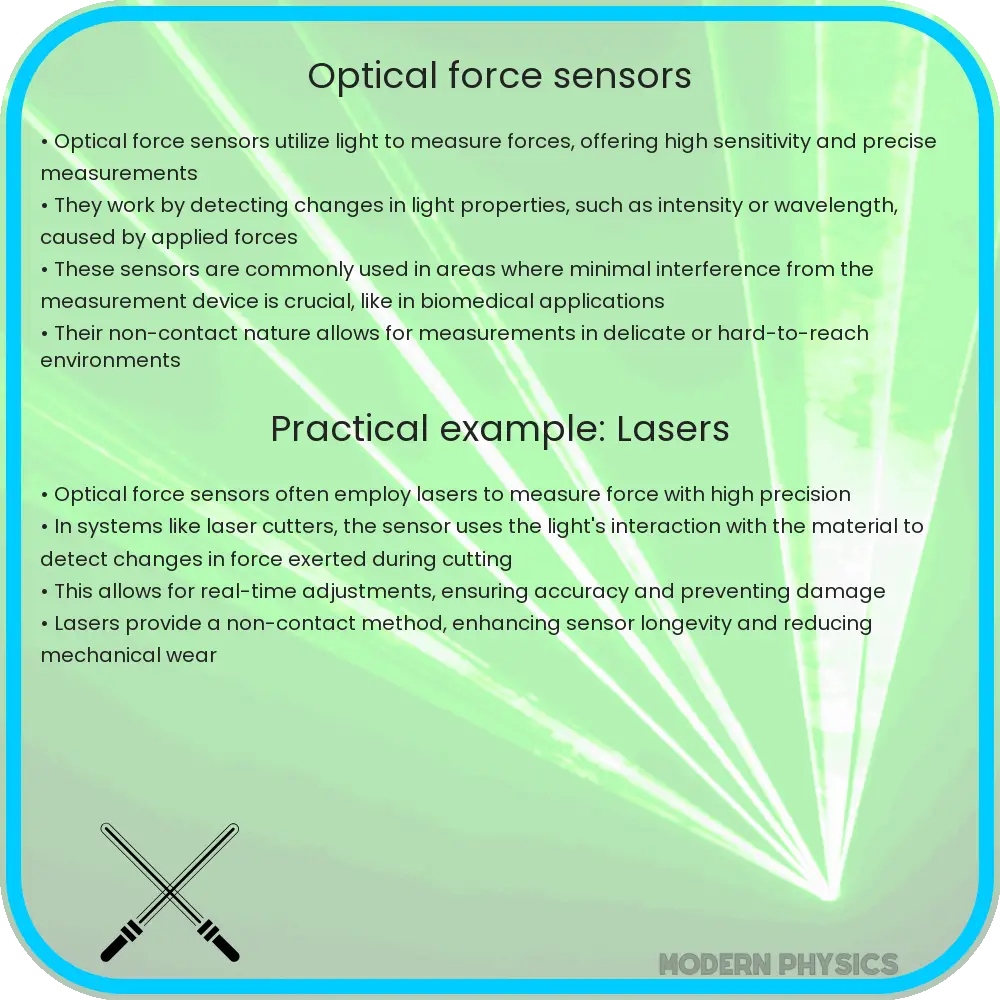
Optical force sensors have emerged as a pivotal technology in the realm of precision measurements, especially within the field of biophysics. These innovative devices leverage the properties of light to measure forces at the micro and nano scale, providing insights into biological processes with unprecedented sensitivity and specificity. The core principle behind optical force sensors lies in the interaction between light and matter, enabling the detection of force through changes in light properties such as intensity, phase, and polarization.
Key Advantages of Optical Force Sensors
The adoption of optical force sensors in biophysical research and precision applications offers numerous advantages over traditional mechanical force measurement techniques. Notably, their non-contact nature minimizes sample disturbance, making them ideal for delicate biological samples. Additionally, optical force sensors boast a high spatial resolution and can operate in a wide range of environments, including under vacuum, at atmospheric conditions, and even in fluidic environments relevant to biological samples.
Applications in Biophysics
In the realm of biophysics, optical force sensors are revolutionizing our understanding of cellular and molecular mechanics. They are instrumental in studying the mechanical properties of cells, the forces involved in molecular motor functions, and the interactions between biomolecules. For instance, optical tweezers, a type of optical force sensor, allow for the manipulation and measurement of forces on single molecules, such as DNA or proteins, with forces as delicate as a few piconewtons (10-12 N).
Enhancing Sensitivity and Precision
The sensitivity and precision of optical force sensors are continually being enhanced through advancements in optical technologies and materials. Innovations such as interferometric and resonant optical force sensors are pushing the boundaries of what can be measured, enabling the detection of forces that were once considered too small to measure. This level of precision is crucial for advancing our understanding of the fundamental forces that govern biological processes at the molecular level.
As we delve deeper into the applications and potential of optical force sensors, it’s evident that their role in biophysics is not just transformative but also indispensable. The precision and sensitivity they offer open new vistas for research, paving the way for breakthroughs in understanding the mechanical underpinnings of life itself.
Technological Innovations and Future Directions
The landscape of optical force sensors is ripe with technological innovations, as researchers and engineers develop more sophisticated methods to improve their functionality and application scope. Among these innovations, the integration of nano-fabrication techniques and novel materials like graphene has led to the creation of smaller, more sensitive sensors. These advancements not only enhance the performance of optical force sensors but also expand their utility in fields beyond biophysics, including nanotechnology, materials science, and precision engineering.
Challenges and Solutions
Despite their remarkable capabilities, optical force sensors face challenges related to calibration, environmental stability, and integration into existing systems. Addressing these challenges requires interdisciplinary efforts, combining optics, material science, and biology to refine sensor design and operation. Recent developments have shown promising approaches to overcome these hurdles, such as the use of reference materials for calibration and the implementation of feedback mechanisms to stabilize sensor performance in fluctuating environments.
Collaborative Opportunities and Educational Impact
The advancement of optical force sensors also opens up collaborative opportunities across scientific disciplines. By bringing together experts in physics, biology, engineering, and computer science, the potential for innovative applications and methodologies expands significantly. Moreover, the growing interest in optical force sensors has spurred educational initiatives aimed at training the next generation of scientists and engineers. These programs focus on the interdisciplinary knowledge required to harness the full potential of optical force sensors, emphasizing hands-on experience and theoretical understanding.
Conclusion
Optical force sensors stand at the forefront of precision measurement in biophysics, offering unparalleled sensitivity and specificity. Through technological innovations and interdisciplinary collaboration, the challenges facing these devices are being addressed, paving the way for new applications that extend far beyond the confines of biophysics. The integration of advanced materials, improvement in sensor design, and focus on education and collaboration highlight the dynamic and evolving nature of this field. As we continue to explore the capabilities and applications of optical force sensors, their impact on science and technology is bound to grow, offering new insights and solutions to complex challenges in biophysics and beyond. In this journey towards understanding the forces that govern biological systems, optical force sensors are not just tools but catalysts for discovery, innovation, and progress.