
Explore the precision and reliability of optical corner cubes in surveying, their principles, applications, and future prospects in enhancing measurements.
Understanding Optical Corner Cubes: Precision and Reliability in Surveying
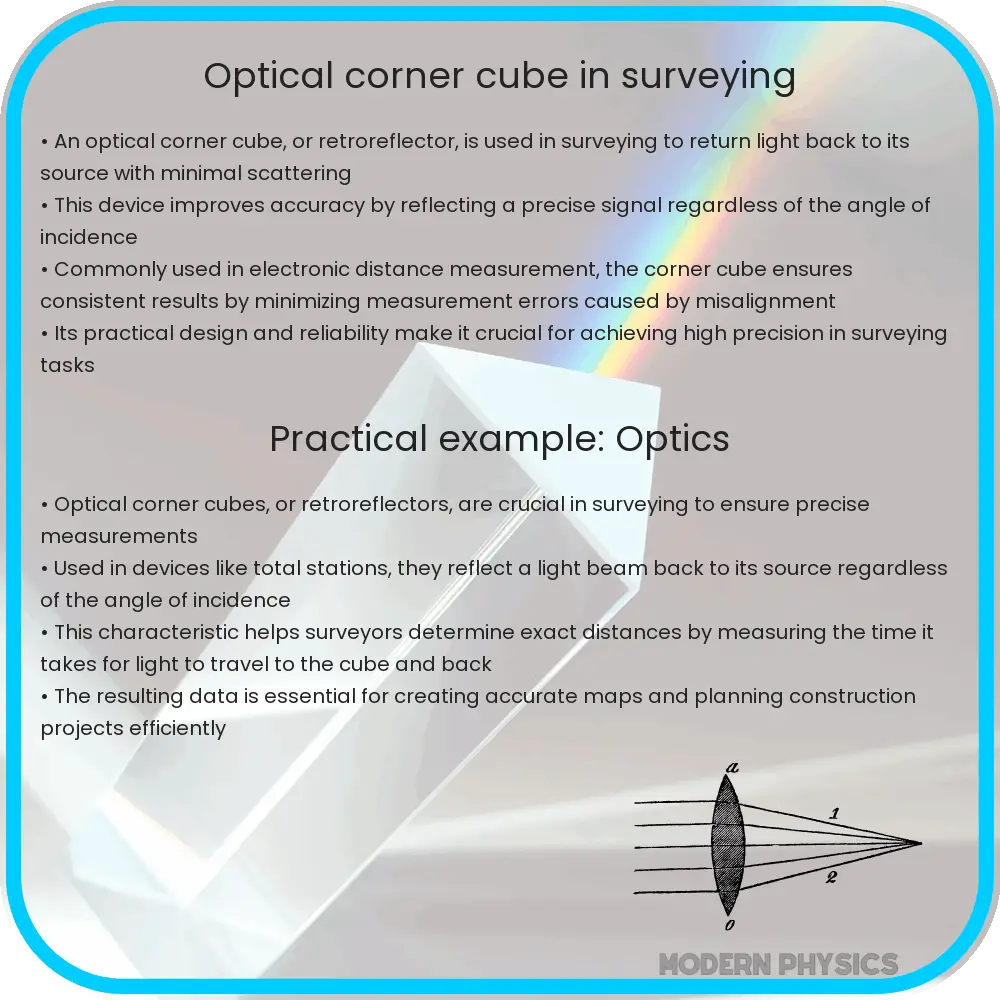
Optical corner cubes, also known as retroreflectors, play a pivotal role in various scientific and engineering applications due to their unique geometric properties. These devices reflect any incoming light beam back to its source with minimal scattering, a feature that is invaluable in precision measurements and surveying tasks. This article delves into the principles behind optical corner cubes, their precision, reliability, and utility in survey operations.
Principle of Operation
The fundamental principle behind an optical corner cube’s operation is total internal reflection. Constructed from three mutually perpendicular, reflective surfaces, these devices are designed to reflect light back to its origin regardless of the incident angle. This remarkable characteristic ensures that the reflected light maintains a consistent path, making corner cubes essential for high-accuracy optical systems.
Applications in Surveying
In the realm of surveying, optical corner cubes are indispensable for their precision and reliability. They are commonly employed in theodolites, total stations, and laser rangefinders to facilitate distance measurement, land mapping, and construction alignment. The ability of corner cubes to return a laser beam directly to its source enables surveyors to achieve millimeter-level accuracy in their measurements.
Enhanced Precision and Reliability
The precision of optical corner cubes stems from their geometric design, which minimizes measurement errors. Unlike other optical devices, corner cubes are less susceptible to misalignment or angular deviations, ensuring that measurements are not only precise but also highly repeatable. This reliability is critical in applications where even the slightest inaccuracy can lead to significant errors, such as in the construction of large structures or the alignment of satellite components.
Survey Use and Advancements
Advancements in manufacturing technologies have led to the production of corner cubes with even greater precision and reliability. These improvements have expanded their use in surveying, allowing for more complex and demanding projects to be undertaken with confidence. Whether it’s for land development, infrastructure monitoring, or environmental studies, the optical corner cube remains a cornerstone of modern surveying techniques.
Challenges and Solutions
Despite their inherent precision, the use of optical corner cubes in surveying is not without challenges. Environmental factors such as atmospheric disturbances, temperature fluctuations, and physical obstructions can impact the accuracy of measurements. To mitigate these effects, modern surveying equipment often incorporates advanced technologies like atmospheric compensation algorithms and integrated GPS systems. These enhancements ensure that the data collected remains accurate under a wide range of conditions, maintaining the reliability of optical corner cubes in field applications.
Future Prospects
The future of optical corner cubes in surveying and beyond looks promising, with ongoing research and development aimed at enhancing their performance. Innovations in materials science and optical engineering are expected to lead to corner cubes with even higher reflectivity and durability, opening up new applications in areas such as space exploration, autonomous vehicles, and environmental monitoring. As technology advances, the precision and reliability of optical corner cubes will continue to play a vital role in pushing the boundaries of what is achievable in precision measurement and surveying.
Conclusion
Optical corner cubes stand as a testament to the intersection of geometric precision and optical science, offering unparalleled accuracy and reliability in surveying and numerous other applications. Their ability to reflect light back to its source with minimal deviation has made them an indispensable tool in the precision measurement landscape. Despite the challenges posed by environmental factors, technological advancements continue to enhance their effectiveness, ensuring their place in the future of surveying and beyond. As we look forward to further innovations in this field, the optical corner cube remains a fundamental component in the pursuit of precision, reliability, and efficiency in a wide array of scientific and engineering endeavors.