
Explore the revolutionary world of optical clocks, their precision, impact on relativity, and future in redefining time measurement and technology.
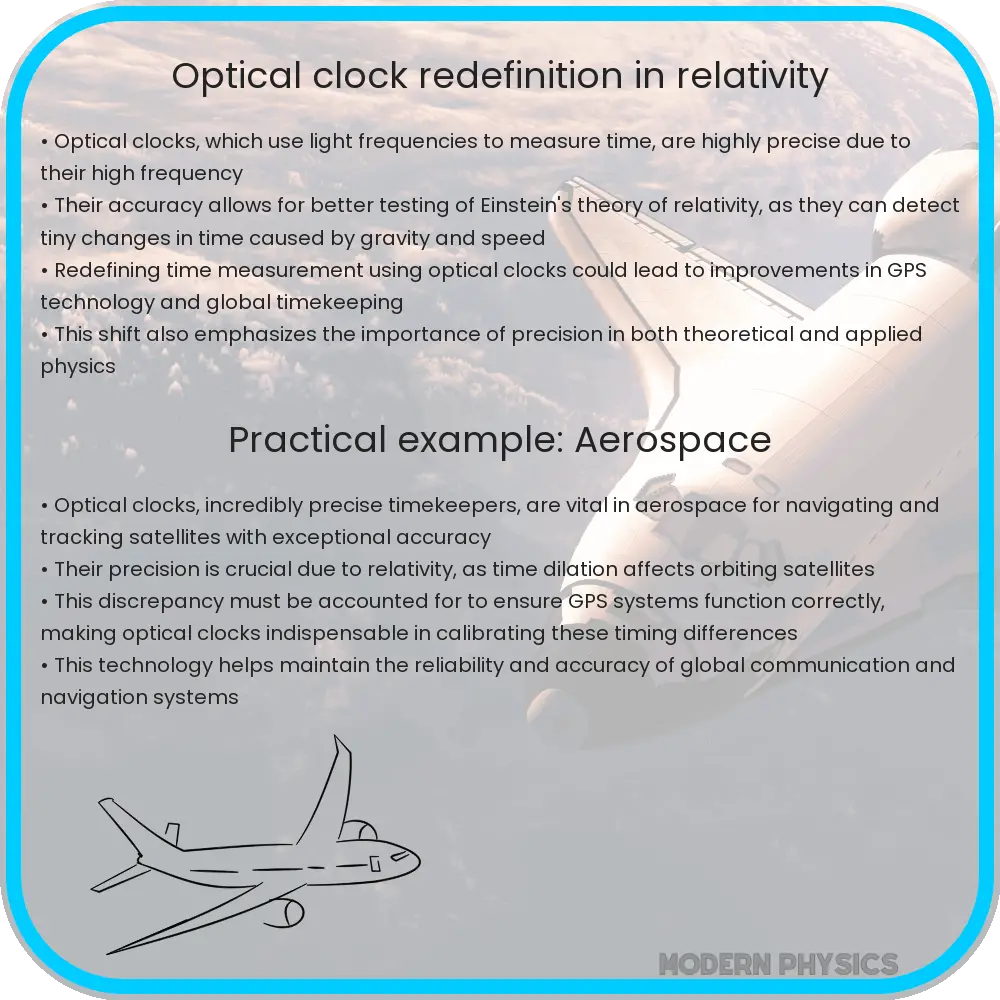
Revolutionizing Time Measurement: The Advent of Optical Clocks
The realm of precision timekeeping has entered a new era with the development of optical clocks. These sophisticated devices, leveraging the oscillations of light waves, are redefining the standards of time measurement. In comparison to their predecessors, the atomic clocks which use microwave frequencies, optical clocks operate at significantly higher frequencies. This leap in frequency enhances their precision and stability exponentially.
Understanding Optical Clocks
At the heart of an optical clock lies an optical lattice or a single ion trap. These components utilize the oscillations of visible light or ultraviolet frequencies, contrasting the microwave frequencies in traditional atomic clocks. The principle behind optical clocks is rooted in quantum mechanics, involving the excitation of electrons in atoms like strontium, ytterbium, or aluminum ions. When these electrons jump to higher energy levels and then return, they emit light at a remarkably consistent frequency. This consistency is what allows optical clocks to achieve unprecedented levels of precision.
Precision and Speed: A New Benchmark
Optical clocks are not just about precision; they also bring remarkable speed to the table. These clocks can perform time measurements at a speed unachievable by their atomic counterparts. Their ability to measure time intervals in femtoseconds (1 fs = 10-15 seconds) opens up new possibilities in various scientific fields.
The Impact of Relativity on Optical Clocks
One of the most intriguing aspects of optical clocks is their sensitivity to gravitational effects, as predicted by Einstein’s theory of relativity. According to General Relativity, time is affected by gravity, meaning that clocks run slightly slower in stronger gravitational fields. This effect, although minute, is detectable by optical clocks. For instance, an optical clock can measure the time difference caused by a change in height as small as one centimeter on Earth’s surface, making them incredibly useful for geodesy and Earth science studies.
The Future of Timekeeping
Optical clocks are paving the way for a redefinition of the second. The current standard, based on cesium atomic clocks, could soon be replaced by the more precise optical clock standard. This transition will not only impact timekeeping but also have profound implications in satellite navigation systems, telecommunications, and fundamental physics research.
Advancements in Technology and Applications
Optical clocks are not just theoretical marvels; their applications extend into various technological and scientific domains. One of the most notable applications is in satellite-based navigation systems like GPS. The enhanced precision of optical clocks can significantly improve the accuracy of these systems, leading to better location tracking capabilities. Additionally, in the field of telecommunications, these clocks can improve the synchronization of networks, enhancing data transfer speeds and reliability.
Enabling New Scientific Discoveries
Beyond practical applications, optical clocks are instrumental in advancing scientific knowledge. Their extreme sensitivity to gravitational variations makes them ideal tools for testing the fundamentals of physics, including the search for dark matter and the exploration of quantum phenomena. Furthermore, they are crucial in space-time experiments, helping to verify Einstein’s theories and exploring the potential of new physics beyond the current understanding.
Challenges and Future Developments
Despite their impressive capabilities, optical clocks face several challenges. The complexity and cost of these devices are significant, limiting their widespread use. Moreover, they require highly controlled environments to operate effectively, which can be a hindrance in certain applications. However, ongoing research is focused on making optical clocks more accessible and robust, potentially leading to more compact and user-friendly designs in the future.
Conclusion
The development of optical clocks marks a significant milestone in the history of timekeeping. With their unparalleled precision and speed, these devices are not only redefining the concept of time but also pushing the boundaries of science and technology. As they become more integrated into various fields, we can expect a future where the accurate measurement of time plays a crucial role in advancing human understanding and capabilities. The era of optical clocks is just beginning, and its full potential is yet to be realized, promising exciting developments for the future.