
Explore the intriguing world of optical analogues to black holes, bridging physics and technology to unlock cosmic mysteries and inspire innovation.
Exploring Optical Analogues to Black Holes
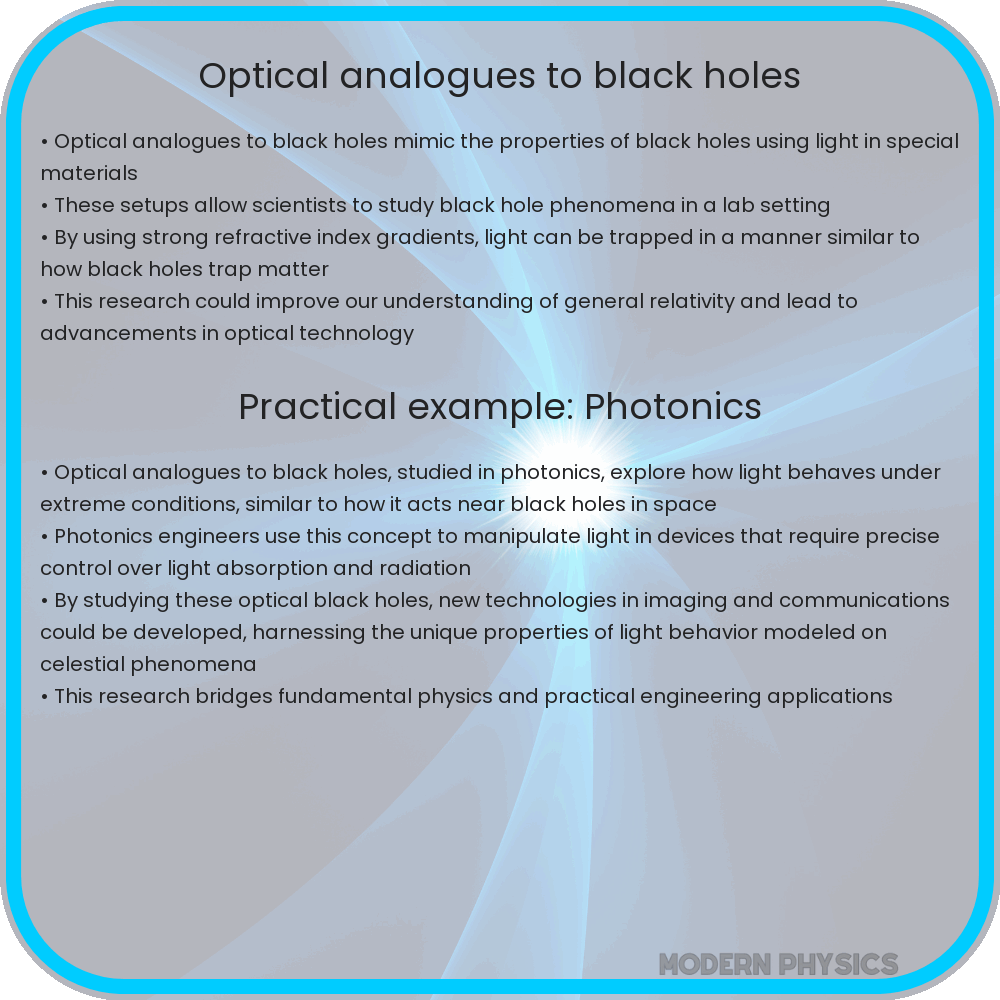
The concept of optical analogues to black holes represents a fascinating intersection of physics and optical science, offering a unique perspective on understanding the enigmatic properties of black holes through analogous systems. This field of study uses systems that manipulate light in ways that mimic the gravitational effects observed in black holes, allowing researchers to explore and experiment with these phenomena in a laboratory setting.
Insights into Optical Black Holes
Optical black holes are created in mediums that cause light to behave in a manner similar to how spacetime directs the paths of objects near a black hole. By varying the refractive index of a material, scientists can create regions where light is bent or slowed down, simulating the gravitational pull that black holes exert on light and matter. This approach has led to groundbreaking insights into event horizons, Hawking radiation, and the behavior of light and matter under extreme conditions.
Research Developments and Discoveries
One of the key research breakthroughs in this area is the experimental observation of Hawking radiation in optical systems. Hawking radiation, a theoretical prediction that black holes emit radiation due to quantum effects near the event horizon, has been difficult to observe directly in space. However, optical analogues have made it possible to study similar radiation processes in a controlled environment, providing valuable evidence supporting Hawking’s theory.
Practical Applications
Beyond enhancing our understanding of black hole physics, optical analogues have practical applications in technology and materials science. For instance, studying how light behaves in these analogues can lead to the development of new optical devices, such as lenses and sensors with enhanced sensitivity or resolution. Additionally, this research has implications for the field of quantum computing and information, offering potential pathways to harnessing quantum effects for computing and data transmission.
As we continue to delve into the mysteries of black holes and their optical analogues, the boundary between theoretical physics and practical technology becomes increasingly blurred. This exciting area of research not only deepens our understanding of the universe but also paves the way for innovative technological advancements.
Advancements in Fabricating Optical Analogues
The fabrication of optical analogues has seen significant advancements, with researchers utilizing a variety of materials and techniques to create conditions akin to those around black holes. Photonic crystals and metamaterials, for example, have been engineered to possess a refractive index gradient capable of bending light in precise ways. These materials enable the simulation of the extreme curvature of spacetime found near black holes, allowing for detailed studies of light dynamics and quantum effects in curved spaces.
Challenges and Future Directions
Despite the progress, challenges remain in the quest to perfect optical analogues. One of the main hurdles is the creation of analogues that can accurately mimic the strong gravitational fields of actual black holes, including the simulation of singularities. Furthermore, refining the detection of phenomena like Hawking radiation in these systems requires sophisticated equipment and methodologies. Looking ahead, researchers are focusing on overcoming these challenges, with the aim of developing more sophisticated analogues that can provide even deeper insights into the nature of black holes and the fabric of spacetime.
Interdisciplinary Collaboration
The field of optical analogues to black holes is inherently interdisciplinary, bridging the gap between theoretical physics, optics, materials science, and quantum computing. This collaborative approach not only enhances our understanding of black holes but also fosters innovation in designing new materials and technologies. By drawing on the strengths of each discipline, scientists and engineers are pushing the boundaries of what’s possible, both in exploring the cosmos and in advancing technological frontiers on Earth.
Conclusion
The exploration of optical analogues to black holes represents a thrilling convergence of theoretical physics and practical experimentation, offering insights into some of the most profound questions about our universe. This research not only brings us closer to understanding the true nature of black holes and the fundamental principles governing light and gravity but also opens up new avenues for technological innovation. As we continue to advance in our ability to simulate and study these cosmic phenomena, the potential for breakthroughs in both science and technology seems limitless. With each discovery, we are reminded of the power of human curiosity and our relentless pursuit of knowledge, driven by the desire to uncover the secrets of the universe and apply them in ways that enhance our world.