
Discover how to measure optical activity accurately, explore various methods and understand their applications in this comprehensive guide.
Understanding Optical Activity: Fundamentals and Importance
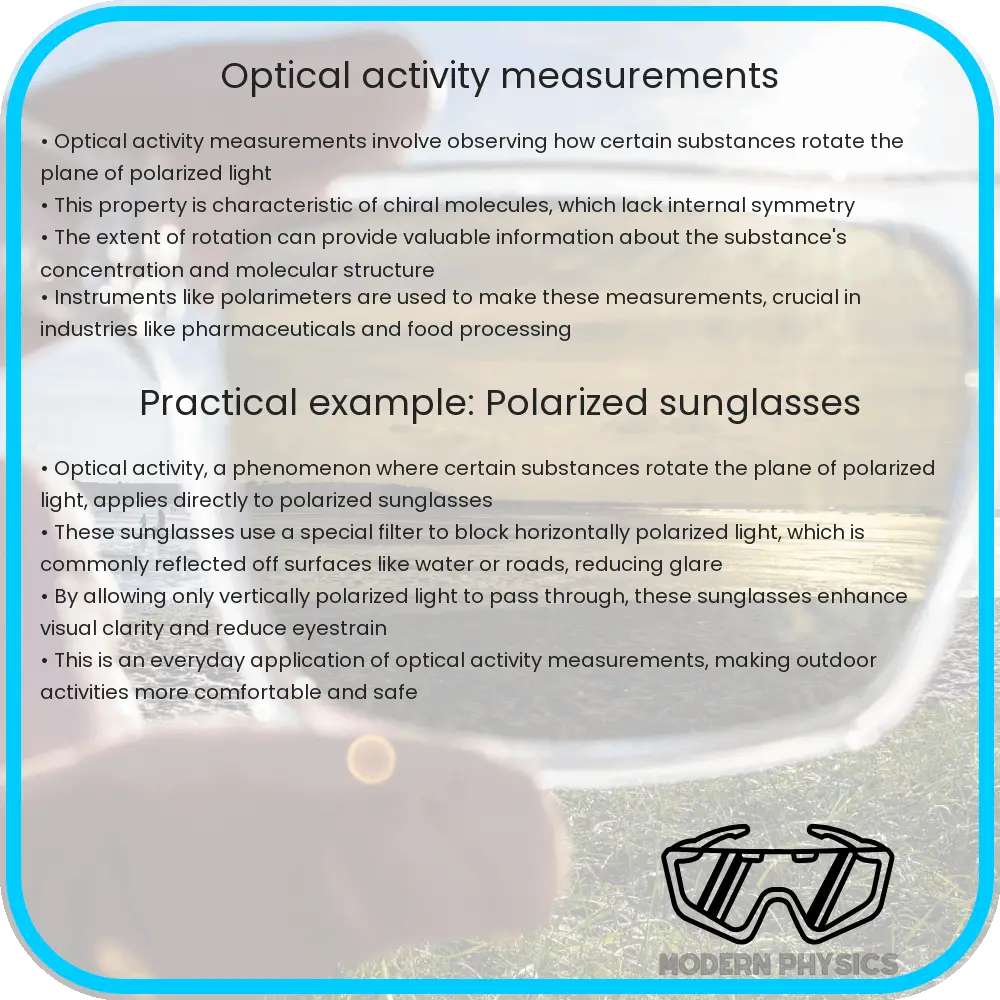
Optical activity is a fascinating property of certain compounds that have the ability to rotate the plane of polarized light as it passes through them. This phenomenon is exclusive to chiral molecules, which are molecules that cannot be superimposed on their mirror image. Chiral molecules come in two forms, known as enantiomers, which rotate light in opposite directions. The degree to which these molecules can rotate polarized light is referred to as their optical activity.
Measuring Optical Activity: Techniques and Tools
The measurement of optical activity is crucial in various scientific and industrial fields, such as pharmaceuticals, food chemistry, and more. The primary instrument used for this purpose is the polarimeter. A polarimeter allows scientists to measure the angle of rotation, which is directly related to the concentration of the chiral compound in the sample. Accuracy in these measurements is paramount, as it can influence the determination of purity, concentration, and the enantiomeric excess of substances.
- Static Method: Involves measuring the optical rotation of a sample at a fixed wavelength and temperature.
- Dynamic Method: Measures changes in optical activity over time, useful for monitoring reactions.
- Circular Dichroism (CD): An advanced technique that measures the difference in absorption of left and right circularly polarized light, providing detailed information about molecular structure.
Ensuring Accuracy in Optical Activity Measurements
Accuracy in optical activity measurements hinges on several factors:
- Calibration of instruments: Regular calibration of polarimeters is essential to ensure precise readings.
- Temperature control: As the optical rotation of substances can vary with temperature, maintaining a constant temperature during measurements is critical.
- Purity of the sample: Impurities can affect optical activity, thus samples must be of high purity.
- Concentration of the solution: Accurate preparation of sample solutions is crucial, as optical activity is concentration dependent.
Understanding and measuring optical activity provides deep insights into the molecular structure and behavior of chiral compounds, facilitating their application across a wide range of scientific disciplines. From the synthesis of drugs to the quality control of food products, the accurate determination of optical activity plays a vital role in ensuring the efficacy and safety of products.
Optical Activity Measurements: A Comprehensive Overview
Optical activity is a fundamental property of certain molecules that can rotate the plane of polarization of polarized light. This characteristic is intrinsic to chiral molecules, which have non-superimposable mirror images, commonly referred to as enantiomers. The measurement of optical activity is not only pivotal in the field of chemistry but also has significant applications in the pharmaceutical, food, and chemical industries. Understanding the accuracy, methods, and uses of optical activity measurements can provide profound insights into the molecular structure and purity of substances.
Accuracy in Optical Activity Measurements
Accuracy in measuring optical activity is crucial for determining the specific rotation of substances, which is the degree of rotation of polarized light caused by a solution at a given concentration and path length. Factors affecting accuracy include the quality of the polarimeter used, the purity of the sample, and the control of experimental conditions such as temperature and wavelength of light. Advanced polarimeters equipped with digital detectors and temperature control mechanisms have significantly enhanced the precision and reliability of optical activity measurements.
Methods of Measuring Optical Activity
- Polarimetry: The most common technique involves using a polarimeter to observe the angle by which the plane-polarized light is rotated when it passes through a sample of the chiral substance.
- Circular Dichroism (CD) Spectroscopy: This method measures the difference in the absorption of left-handed and right-handed circularly polarized light, offering insights into the secondary structure of biomolecules like proteins and nucleic acids.
Applications of Optical Activity Measurements
Optical activity measurements are invaluable in various industries. In the pharmaceutical sector, they help in the identification and quantification of drugs’ enantiomeric purity, crucial for their therapeutic efficacy and safety. In the food industry, these measurements ensure the authenticity and quality of food products, such as sugars and essential oils. Additionally, in chemical research, optical activity serves as a tool for elucidating the stereochemistry of organic compounds.
Conclusion
The measurement of optical activity plays a vital role in understanding the chirality and stereochemistry of molecules, with significant implications across various scientific and industrial fields. The accuracy of these measurements, ensured through sophisticated methods like polarimetry and circular dichroism spectroscopy, allows for precise determination of molecular configurations. As technology advances, the precision, efficiency, and applications of optical activity measurements continue to expand, furthering our ability to characterize and utilize chiral molecules in research, pharmaceutical development, and beyond. Embracing these advancements will undoubtedly enhance the quality and depth of scientific inquiry and industrial application in the years to come.