
Explore the Oppenheimer-Volkoff Limit in astrophysics, delving into neutron stars, relativity, and the balance of cosmic forces.
Understanding the Oppenheimer-Volkoff Limit
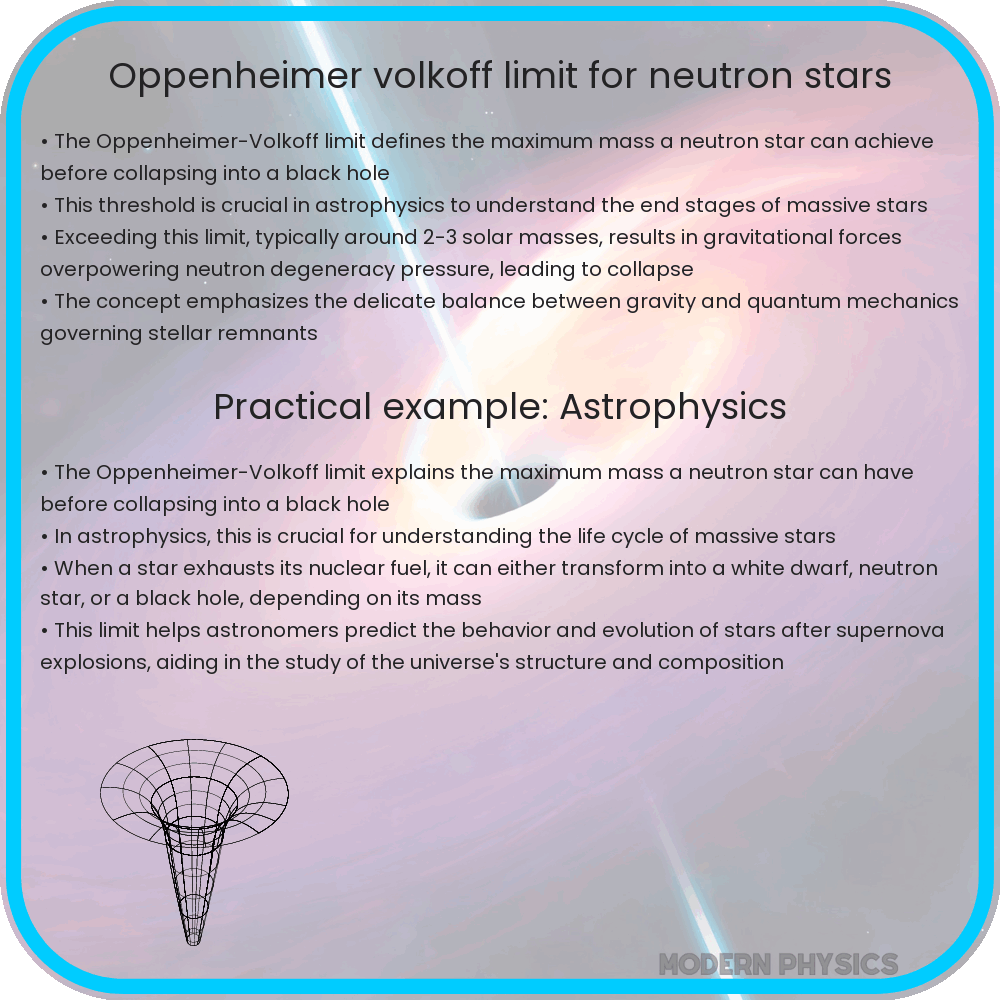
The Oppenheimer-Volkoff Limit is a fundamental concept in astrophysics, crucial for understanding the life cycle of massive stars and the nature of neutron stars. This limit, named after physicists J. Robert Oppenheimer and George Volkoff, represents the maximum mass that a neutron star can have before collapsing into a black hole. To fully appreciate its significance, it is essential to delve into the realms of neutron stars, relativity, and the forces at play in such extreme conditions.
Neutron Stars: Compact Cosmic Phenomena
Neutron stars are the remnants of massive stars that have undergone a supernova explosion. They are incredibly dense, with masses comparable to that of the Sun but compressed into a sphere just about 20 kilometers in diameter. At this extreme density, the atomic structure collapses, and protons and electrons merge to form neutrons. This results in a star composed almost entirely of neutrons, hence the name ‘neutron star’. The density of a neutron star is so high that a sugar-cube-sized amount of its material would weigh about a billion tons on Earth.
Relativity and the Fabric of Space-Time
Understanding neutron stars and the Oppenheimer-Volkoff Limit requires a grasp of Einstein’s theory of general relativity. This theory posits that massive objects cause a distortion in space-time, which we perceive as gravity. In the extreme gravitational fields of neutron stars, the effects of general relativity become pronounced. These effects must be taken into account to accurately describe the star’s structure and stability.
The Oppenheimer-Volkoff Limit: A Delicate Balance
The core principle behind the Oppenheimer-Volkoff Limit is the balance between gravity and neutron degeneracy pressure. In a neutron star, gravity is trying to compress the star further, while the Pauli exclusion principle, which prevents neutrons from occupying the same quantum state, generates a degeneracy pressure that resists this compression. The Oppenheimer-Volkoff Limit marks the point where the gravitational force overcomes this degeneracy pressure, leading to the collapse of the neutron star into a black hole.
Accurately calculating this limit involves complex equations that integrate quantum mechanics and general relativity. The exact value of the limit is still a subject of research, as it depends on the unknown equation of state of neutron star matter, which describes how the star’s density varies with its pressure.
In conclusion, the Oppenheimer-Volkoff Limit is not just a number but a window into the fascinating interplay of fundamental forces and principles that govern the most extreme objects in our universe.
The Equation of State and Its Role in Determining the Limit
The Oppenheimer-Volkoff Limit’s precise value hinges on the equation of state of neutron star matter, a complex relationship between pressure and density in such extreme environments. This equation is pivotal because it dictates how matter behaves under the enormous pressures found inside neutron stars. Theoretical models suggest various forms for this equation, each leading to different maximum masses for neutron stars. These models often incorporate exotic states of matter, including quark-gluon plasmas, that challenge our understanding of physics under extreme conditions.
Observational Evidence and Future Research
Astronomical observations provide crucial insights into the Oppenheimer-Volkoff Limit. Observing neutron stars, particularly those in binary systems, allows astronomers to estimate their masses. These observations have identified neutron stars with masses close to what theoretical models predict as the limit. However, the discovery of neutron stars with masses above previously accepted limits challenges existing models and suggests that our understanding of neutron star matter is still incomplete.
Implications for Astrophysics and Fundamental Physics
The study of the Oppenheimer-Volkoff Limit has far-reaching implications. It not only aids in understanding neutron stars but also provides a testing ground for theories of dense matter physics and general relativity. As such, it represents a unique convergence of astrophysics, nuclear physics, and fundamental theoretical physics. Research in this area could potentially reveal new states of matter and offer insights into the behavior of the universe under the most extreme conditions.
Conclusion
The Oppenheimer-Volkoff Limit is more than a mere theoretical construct; it is a critical threshold in the understanding of the universe’s most extreme objects. It encapsulates the intricate balance between gravitational forces and quantum mechanical effects in neutron stars, standing at the crossroads of several physics disciplines. As research progresses, this limit continues to challenge our understanding, pushing the boundaries of what we know about matter, gravity, and the cosmos. In the quest to unravel the mysteries of the universe, the Oppenheimer-Volkoff Limit remains a beacon, guiding scientists towards deeper insights into the fabric of space-time and the nature of extreme matter.