
Explore the intriguing world of Numerical Relativity, its role in astrophysics, and its impact across science in this comprehensive article.
Numerical Relativity: Unraveling the Mysteries of the Cosmos
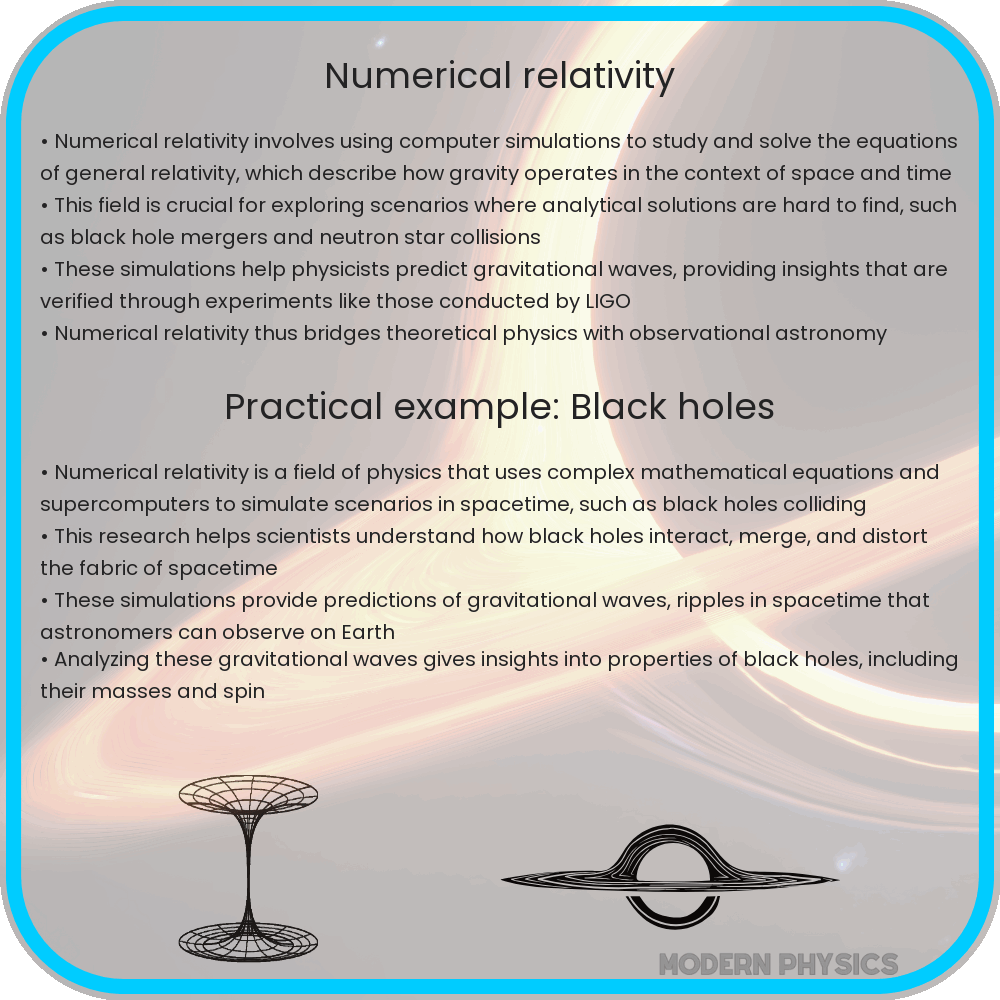
The realm of astrophysics has long been fascinated by the enigmatic behaviors of the universe, from the dance of binary stars to the violent collisions of black holes. Numerical Relativity, a branch of computational astrophysics, stands at the forefront of decoding these cosmic phenomena. This discipline utilizes advanced mathematical models and powerful computational techniques to simulate and understand the dynamics of spacetime as described by Einstein’s General Theory of Relativity.
The Cornerstone of Modern Astrophysics
Numerical Relativity’s significance in modern astrophysics cannot be overstated. It serves as a vital tool for probing scenarios where traditional analytical methods fall short. This includes the study of gravitational waves, black hole mergers, and neutron star collisions. The field’s advancement was notably highlighted in 2015 with the first direct detection of gravitational waves by LIGO (Laser Interferometer Gravitational-Wave Observatory), a milestone that opened a new window into observing the universe.
Challenges and Innovations
Despite its impressive capabilities, Numerical Relativity is not without challenges. The intricate nature of Einstein’s equations, especially when dealing with extreme gravitational fields, necessitates immense computational power and sophisticated algorithms. Researchers continually develop new methods to improve simulation accuracy and efficiency. For instance, adaptive mesh refinement techniques allow for higher resolution in regions of intense gravitational activity while conserving resources in less critical areas.
Real-World Applications
The applications of Numerical Relativity extend beyond theoretical research. It plays a crucial role in informing the design and interpretation of experiments and observations in gravitational physics. For example, simulations of black hole mergers are used to predict gravitational wave signatures, which are essential for the calibration of detectors like LIGO and Virgo. This synergy between theory and observation is pivotal in validating and expanding our understanding of the universe.
Future Prospects
Looking ahead, the future of Numerical Relativity is replete with potential. Advancements in computing technology, like quantum computing and AI-driven algorithms, promise to revolutionize the field. These developments could lead to more precise simulations, allowing for deeper insights into phenomena such as the singularity at the center of black holes, the evolution of the early universe, and even the exploration of theories beyond General Relativity.
Is this conversation helpful so far?
Interdisciplinary Impact
Numerical Relativity is not just confined to astrophysics but extends its influence across various scientific disciplines. Its techniques and algorithms have found applications in fields as diverse as geophysics, fluid dynamics, and even high-energy physics. For instance, the same computational methods used to model spacetime curvatures can also be adapted to simulate complex fluid flows or to explore the dynamics of particles in accelerators. This cross-disciplinary appeal underscores the versatility and foundational importance of Numerical Relativity in the broader scientific community.
Education and Collaboration
Another vital aspect of Numerical Relativity’s evolution is its role in education and collaborative research. Universities and research institutes worldwide have integrated Numerical Relativity into their curricula, nurturing the next generation of astrophysicists and computational scientists. Furthermore, the field is inherently collaborative, often involving international teams that combine theoretical, observational, and computational expertise. This collaborative spirit is not only essential for tackling complex astrophysical problems but also fosters a global scientific community united in its quest to understand the universe.
Public Engagement and Understanding
Numerical Relativity also plays a significant role in public science engagement. The visually stunning simulations of cosmic events, like the collision of neutron stars or the swirling of matter around black holes, captivate public imagination and increase awareness and interest in scientific endeavors. These simulations, often featured in documentaries and science exhibits, serve as powerful tools for science communication, making complex concepts in astrophysics more accessible and engaging to the general public.
Conclusion
In conclusion, Numerical Relativity stands as a beacon of progress in our quest to decipher the universe. It bridges the gap between theoretical physics and observational astronomy, offering unparalleled insights into some of the most profound and elusive phenomena in the cosmos. As computational power continues to grow and interdisciplinary collaborations expand, Numerical Relativity is poised to unveil even more wonders of our universe, reaffirming its critical role in the odyssey of scientific discovery. The future of this field is not just about understanding the cosmos but also about inspiring and educating future generations, fostering public engagement, and driving technological innovations that may have far-reaching impacts across numerous scientific domains.