
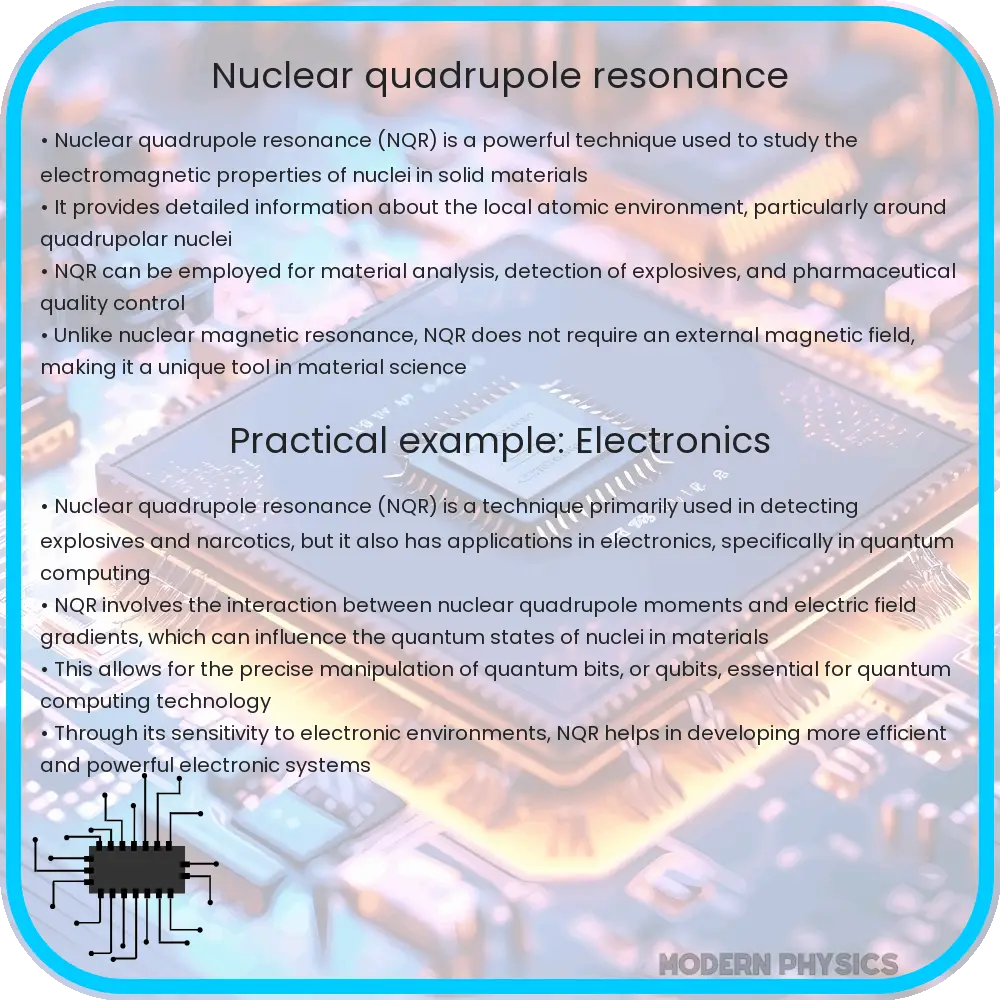
Nuclear Quadrupole Resonance (NQR) is a physics branch exploring the interaction between a nucleus’s quadrupole moment and the surrounding electric field gradient.
Introduction to Nuclear Quadrupole Resonance
Nuclear Quadrupole Resonance (NQR) is a fascinating branch of physics that explores the interaction between the nuclear quadrupole moment of a nucleus and the electric field gradient (EFG) in which the nucleus is situated. This phenomenon provides a unique insight into the electronic environment of a material and has various useful applications in different fields.
Understanding the Basics:
At its core, NQR is about how certain nuclei with a non-spherical charge distribution can interact with an external electric field gradient. The quadrupole moment of a nucleus is a measure of this non-spherical distribution of charge, which is only present in nuclei with a spin (I) greater than 1/2. These specific nuclei experience changes in energy state when exposed to an EFG, leading to the resonance phenomena used for detection in NQR.
The key equation that describes the interaction in NQR is given by the Hamiltonian:
H = (h/2π) * eQVzz * (3Iz2 – I(I+1))
where:
- h is the Planck constant,
- e represents the charge of the electron,
- Q is the nuclear quadrupole moment,
- Vzz is the component of the electric field gradient along the principal axis of the field,
- Iz is the component of the nuclear spin along the z-axis,
- I is the total nuclear spin.
Applications of Nuclear Quadrupole Resonance
NQR is highly prized in various applications due to its specificity to nuclear species and its sensitivity to the electronic environment. Some of the primary applications include:
- Detection of Explosives: NQR is used for the detection of nitrogen-containing explosives. The specific frequencies at which these materials resonate allow for precise identification, crucial for security and anti-terrorism efforts.
- Pharmaceuticals: In the pharmaceutical industry, NQR provides a non-destructive method to investigate the molecular compositions and confirm the presence of certain substances without altering the sample.
Advanced Techniques in NQR
As the field of Nuclear Quadrupole Resonance continues to evolve, researchers and engineers are developing more sophisticated techniques to enhance its accuracy and application. One such advancement involves the use of multi-frequency NQR, which allows for the simultaneous detection of multiple types of nuclei within a sample. This approach significantly reduces measurement time and increases the efficiency of the analysis.
Another innovative application of NQR technology is in the field of quantum computing. Nuclei with quadrupole moments can be used as qubits (quantum bits), the basic units of quantum information. The precise control over the quantum states of these nuclei, facilitated by NQR, makes them suitable candidates for quantum computing operations.
Challenges and Future Prospects
Despite its numerous applications, NQR faces several challenges that impact its broader deployment. The sensitivity of NQR signals to environmental factors such as temperature and magnetic fields can lead to measurement inaccuracies. Furthermore, the relatively weak signal strength often requires sophisticated amplification and signal processing techniques to achieve reliable results.
Looking ahead, the future of NQR appears promising, with ongoing research aimed at overcoming these challenges. Improvements in sensor technology and signal processing algorithms are expected to enhance the sensitivity and selectivity of NQR systems. Furthermore, the integration of NQR with other spectroscopic methods could lead to even more powerful analytical tools.
Conclusion
In essence, Nuclear Quadrupole Resonance (NQR) is a potent tool in both scientific research and practical applications, from security screening to advanced pharmaceutical analysis. Its unique ability to provide precise information about the electronic environment of a nucleus without requiring external magnetic fields sets it apart from other spectroscopic techniques. Despite some challenges, the continuous advancements in technology and techniques promise to broaden the scope and efficiency of NQR applications further. This makes Nuclear Quadrupole Resonance an exciting field with vast potential for new discoveries and innovations that could impact various aspects of technology and daily life.