
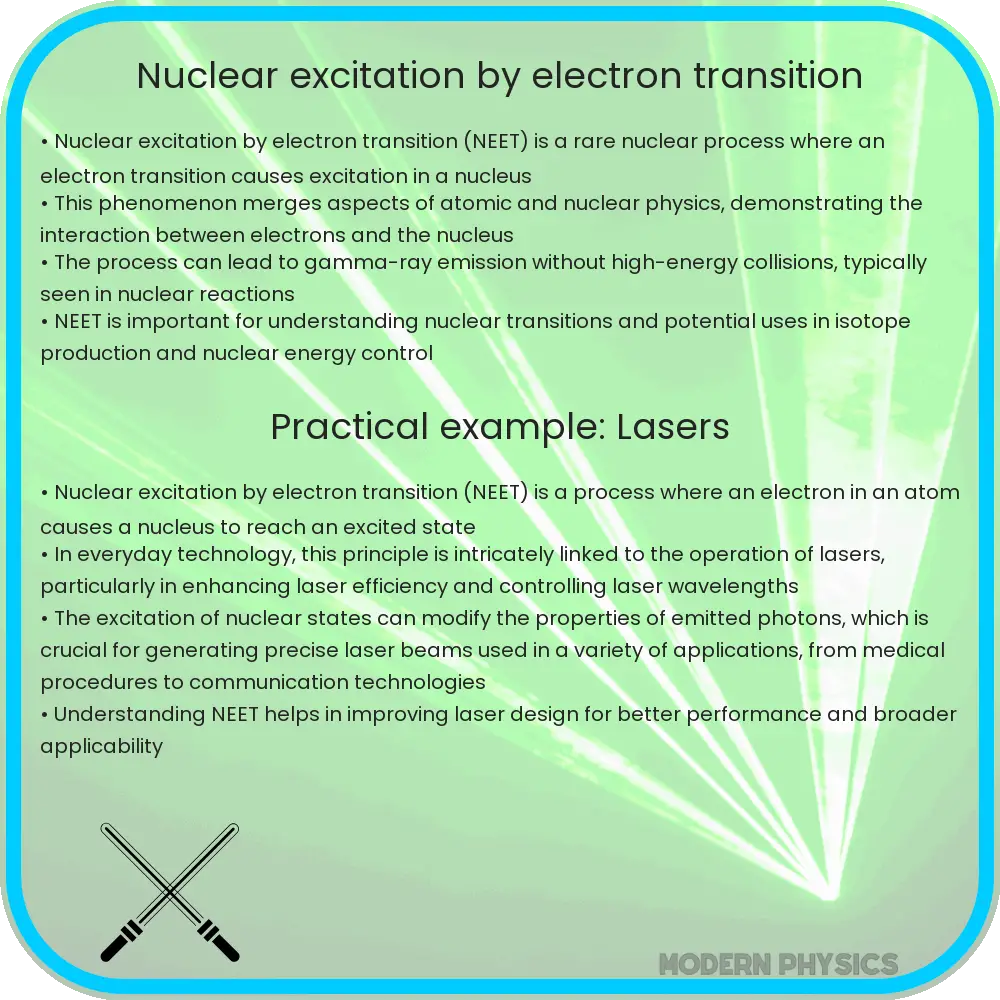
Nuclear Excitation by Electron Transition (NEET) is a nuclear physics phenomenon where electron transitions excite the nucleus, differing from typical interactions involving high-energy particles or gamma rays.
Nuclear Excitation by Electron Transition: An Introduction
Nuclear Excitation by Electron Transition (NEET) is a fascinating phenomenon in nuclear physics where an electron transition leads to the excitation of a nucleus. Unlike most nuclear processes that involve gamma rays or nuclear particles, NEET primarily engages the electrons orbiting the nucleus. This article elucidates the basic concepts of NEET, its significance, and how it differs from other nuclear interactions.
Understanding Electron Transitions and Nuclear Excitation
To grasp NEET, it is crucial to first understand how electron transitions and nuclear excitations typically occur. In an atom, electrons occupy specific energy levels or shells. When an electron absorbs energy, it can jump to a higher energy level, and when it loses energy, it falls back to a lower energy level, emitting energy typically in the form of a photon.
Separately, nuclear excitation occurs when the nucleus of an atom reaches a higher energy state. This process typically requires interaction with high-energy particles or gamma rays. Once excited, the nucleus eventually returns to its ground state, often emitting a gamma ray in the process.
The Mechanism of NEET
NEET intertwines these two normally distinct processes. During NEET, an electron within the atom undergoes a transition that, rather than leading solely to the emission or absorption of a photon, directly causes the nucleus to be excited. This can occur if the energy released by the electron transition matches the energy required to excite the nucleus.
Mathematically, the energy condition can be expressed as:
Eelectron = Enucleus
where Eelectron is the energy change of the electron, and Enucleus is the excitation energy of the nucleus.
The probability of NEET occurring is affected by several factors, including the overlap of the electron wave function with the nucleus, and the matching of the electron transition energy with the nuclear excitation energy. Despite its rarity, when NEET occurs, it can lead to significant outcomes in nuclear physics experiments and applications.
Significance of NEET in Modern Physics
NEET is particularly significant in fields where the precise manipulation of nuclear states is crucial. This includes nuclear isomer triggering, where NEET can be used to manipulate long-lived nuclear isomers, potentially leading to controlled release of nuclear energy. Its applications extend to nuclear spectroscopy and the development of nuclear lasers where the controlled excitation of nuclei is fundamental.
Moreover, understanding NEET enhances our comprehension of fundamental nuclear processes and electron-nucleus interactions, contributing valuable insights into the intricate workings of atoms.
Practical Applications and Future Prospects
The potential applications of NEET are vast and varied. In medical physics, NEET could be used for targeted radiation therapy, where specific nuclear excitations caused by electron transitions might help in attacking cancer cells more precisely without harming surrounding healthy tissue. Additionally, NEET could play a role in improving the efficiency of nuclear batteries, which are used in situations where conventional power sources are unfeasible, such as in deep-space probes or pacemakers.
Looking towards the future, researchers are exploring the possibility of using NEET in quantum computing for better control of qubit states. Here, the manipulation of nuclear states via electron transitions might allow for more stable and efficient quantum gates, a fundamental component of quantum computing architectures.
Challenges in NEET Research
While the applications of NEET are promising, they come with significant challenges. One of the primary challenges is the extreme precision required to match the energy of the electron transition with the nuclear excitation energy. Also, considering the small size of the nucleus compared to the electron cloud, the probability of interaction between an electron and the nucleus is incredibly low, making the consistent replication of NEET conditions difficult.
Furthermore, the rarity of suitable isotopes that can undergo NEET adds another layer of complexity to its study and application. R&D in this area demands interdisciplinary collaboration and innovative approaches to enhance NEET’s practicality and reliability.
Conclusion
Nuclear Excitation by Electron Transition represents a unique intersection between nuclear physics and atomic electron dynamics that challenges our traditional understanding of how these systems interact. Despite the complex nature and rarity of NEET, its potential for revolutionary applications in various fields makes it a subject of keen interest and ongoing research. By bridging gaps in our knowledge and innovating in technological applications, NEET holds the promise to contribute novel solutions across science and engineering, from medical treatments to energy sources and beyond. The precision and depth of understanding required to leverage NEET effectively will undoubtedly spur further advancements in both theoretical and applied physics.