
Explore the advanced realm of nonparaxial optics, delving into wave theory, precision, and its revolutionary applications in modern technology.
Introduction to Nonparaxial Optics
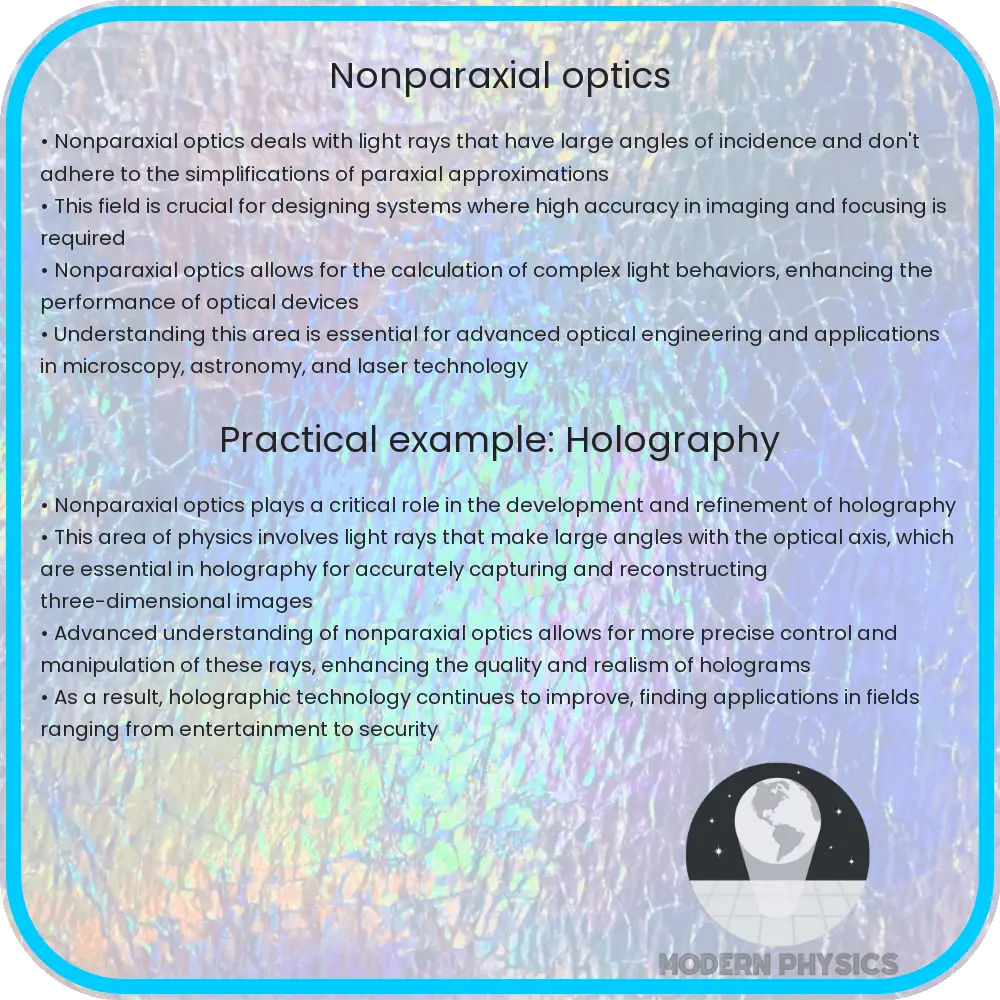
Nonparaxial optics, a branch of optical physics, extends beyond the limitations of paraxial approximation to analyze the behavior of light waves under conditions where they diverge significantly from the optical axis. This advanced perspective is crucial for designing and understanding optical systems that operate with high precision and efficiency, especially in scenarios where traditional paraxial theories fall short.
Understanding Wave Theory in Nonparaxial Optics
At the heart of nonparaxial optics lies the wave theory of light, which treats light as an electromagnetic wave rather than just a ray. This theory is pivotal in explaining phenomena like diffraction, interference, and polarization, which are not adequately described by ray optics. In nonparaxial optics, the wave equation’s solutions are sought in a regime where the angle of incidence and the field variations are such that the paraxial approximations—assuming small angles and thin optical elements—are no longer valid.
Precision in Nonparaxial Optics
The transition from paraxial to nonparaxial optics is marked by a significant increase in precision. This precision is essential for the design and analysis of high-resolution imaging systems, laser focusing devices, and optical communication technologies. Nonparaxial optics allows for the accurate prediction of optical phenomena close to the diffraction limit, where traditional approximations cannot provide reliable results.
Applications of Nonparaxial Optics
Nonparaxial optics finds applications in various cutting-edge technologies. High numerical aperture (NA) systems in microscopy, which require accurate modeling of light behavior to achieve optimal resolution, heavily rely on nonparaxial theories. Similarly, in the field of optical fiber communications, understanding nonparaxial wave propagation is critical for designing efficient data transmission systems. Another prominent application is in the development of laser systems, where nonparaxial optics guides the design of laser cavities and the focusing of laser beams for precise material processing, medical surgery, and optical trapping.
The exploration of nonparaxial optics opens up new horizons in optical science and engineering, pushing the boundaries of what is achievable with light. By addressing the limitations of the paraxial approximation, nonparaxial optics enables the development of optical systems and technologies that operate with unprecedented precision and efficiency.
Challenges and Solutions in Nonparaxial Optics
Despite its significant advantages, nonparaxial optics presents unique challenges, particularly in terms of computational complexity and the need for precise measurements. The mathematical models used to describe nonparaxial phenomena are more complex than those in paraxial optics, requiring advanced numerical methods and computational resources for accurate predictions. Moreover, the design and alignment of optical systems based on nonparaxial theories demand high precision, which can be challenging to achieve in practice.
Advancements in Computational Techniques
To overcome these challenges, researchers and engineers have developed sophisticated computational techniques and algorithms. These advancements enable the efficient simulation and analysis of nonparaxial optical systems, facilitating the design process and allowing for the optimization of optical components and configurations. Machine learning and artificial intelligence are increasingly being employed to predict complex nonparaxial effects, further enhancing the capabilities of optical systems.
Future Directions in Nonparaxial Optics
The field of nonparaxial optics is continually evolving, with ongoing research aimed at expanding its applications and improving the underlying theoretical models. Future developments are expected to lead to even more sophisticated optical devices, including ultra-compact lenses with super-resolution capabilities, advanced photonic circuits for optical computing, and highly sensitive sensors for biomedical applications. As the understanding of nonparaxial phenomena deepens, the potential for innovation in optical science and technology grows, promising to revolutionize various industries.
Conclusion
Nonparaxial optics stands as a pivotal area of study within optical physics, offering a more accurate and comprehensive understanding of light’s behavior beyond the paraxial approximation. Its application spans across numerous fields, driving innovations in microscopy, telecommunications, and laser technology. Despite the challenges associated with its complexity, the advancements in computational methods and the ongoing research in the field are paving the way for groundbreaking optical systems. As we continue to explore the intricacies of nonparaxial optics, the future holds the promise of unlocking new capabilities and applications, pushing the boundaries of what is possible with optical technologies. The journey into the nonparaxial regime not only enriches our fundamental understanding of light but also catalyzes the development of optical solutions that are more precise, efficient, and versatile than ever before.