
Explore the efficiency, stability, and uses of nonlinear optical crystals in photonics, from telecommunications to medical imaging, in our latest article.
Understanding Nonlinear Optical Crystals
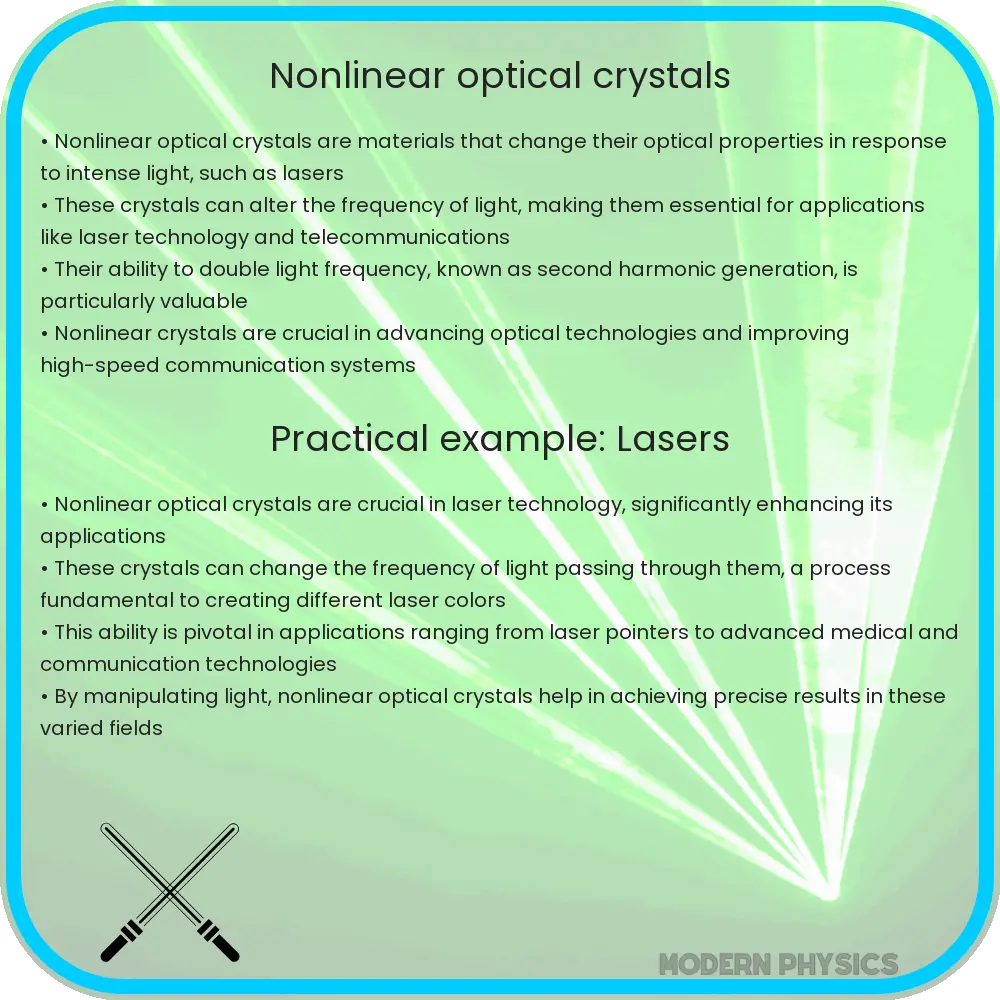
Nonlinear optical (NLO) crystals are pivotal in advancing the field of photonics, playing a crucial role in the manipulation and conversion of light. These materials, characterized by their ability to alter the frequency of light, are fundamental in a variety of applications ranging from telecommunications to medical diagnostics. The efficiency, stability, and utility of NLO crystals depend on their intrinsic properties and the specific demands of their applications.
Efficiency of Nonlinear Optical Crystals
The efficiency of NLO crystals is primarily measured by their nonlinear optical coefficients, which determine the extent to which they can convert input light into output light at different frequencies. This capability is essential for processes such as second harmonic generation (SHG), sum-frequency generation (SFG), and difference-frequency generation (DFG). High-efficiency crystals like Lithium Niobate (LiNbO3), Beta Barium Borate (β-BaB2O4), and Potassium Titanyl Phosphate (KTiOPO4 or KTP) are highly sought after for their superior nonlinear optical properties.
Stability Concerns in NLO Crystals
Stability in NLO crystals pertains to both chemical and thermal aspects. Chemically stable NLO crystals resist degradation over time, maintaining their optical qualities under various environmental conditions. Thermally stable crystals, on the other hand, can withstand high temperatures without losing their nonlinear properties, which is crucial for high-power laser applications. The choice of crystal often involves a trade-off between efficiency and stability, with the selection tailored to the specific application’s requirements.
Applications of Nonlinear Optical Crystals
- Telecommunications: NLO crystals are used in optical parametric oscillators (OPOs) and amplifiers (OPAs) to generate coherent light sources across a broad spectrum, enhancing the capacity and speed of optical communication systems.
- Laser Technology: They enable the frequency doubling of laser light, allowing for the generation of new wavelengths that are pivotal in medical surgery, precision machining, and holography.
- Medical Imaging: Through techniques such as second harmonic generation imaging, NLO crystals contribute to high-resolution imaging, crucial for diagnosing diseases at the cellular level.
The continued advancement in the development of NLO crystals promises even greater efficiencies and broader applications, solidifying their role as a cornerstone in the field of optical technologies.
Advancements and Challenges in Nonlinear Optical Crystals
Recent advancements in the field of nonlinear optics have led to the development of new NLO crystals with enhanced properties. Innovations in material science and crystal growth techniques have yielded crystals with higher nonlinear coefficients, broader transparency ranges, and improved stability. These advancements not only extend the practical applications of NLO crystals but also improve the performance of existing technologies. However, challenges such as the synthesis of defect-free crystals, the increase in thermal conductivity without compromising nonlinear properties, and the reduction of optical losses remain critical areas of research.
Future Prospects of Nonlinear Optical Crystals
The future of nonlinear optical crystals looks promising with ongoing research focused on discovering and engineering new materials that offer a balance between nonlinearity, transparency, and stability. The exploration of novel crystal structures and compositions aims to address the limitations of current materials, opening up possibilities for unprecedented applications in photonics and beyond. Furthermore, advancements in nanostructuring and microstructuring of NLO crystals are expected to enhance their effectiveness in integrated optical circuits, leading to miniaturized and more efficient optical devices.
Conclusion
Nonlinear optical crystals are indispensable in the realm of photonics, offering versatile functionalities that span across telecommunications, laser technology, and medical imaging. Their efficiency, stability, and broad range of applications underscore their importance in advancing optical technologies. Despite the challenges faced in material synthesis and optimization, the continuous advancements in this field are paving the way for more innovative and practical optical solutions. As research progresses, we can anticipate NLO crystals to play an even more significant role in shaping the future of optical and photonic technologies, heralding a new era of high-speed communication, precise medical procedures, and beyond. The journey of NLO crystals from fundamental research to ubiquitous applications exemplifies the transformative power of material science in technological evolution.