
Gain insights into how nonlinear dynamics in chemistry examines complex behaviors in chemical systems, including oscillations, chaos, and pattern formations.
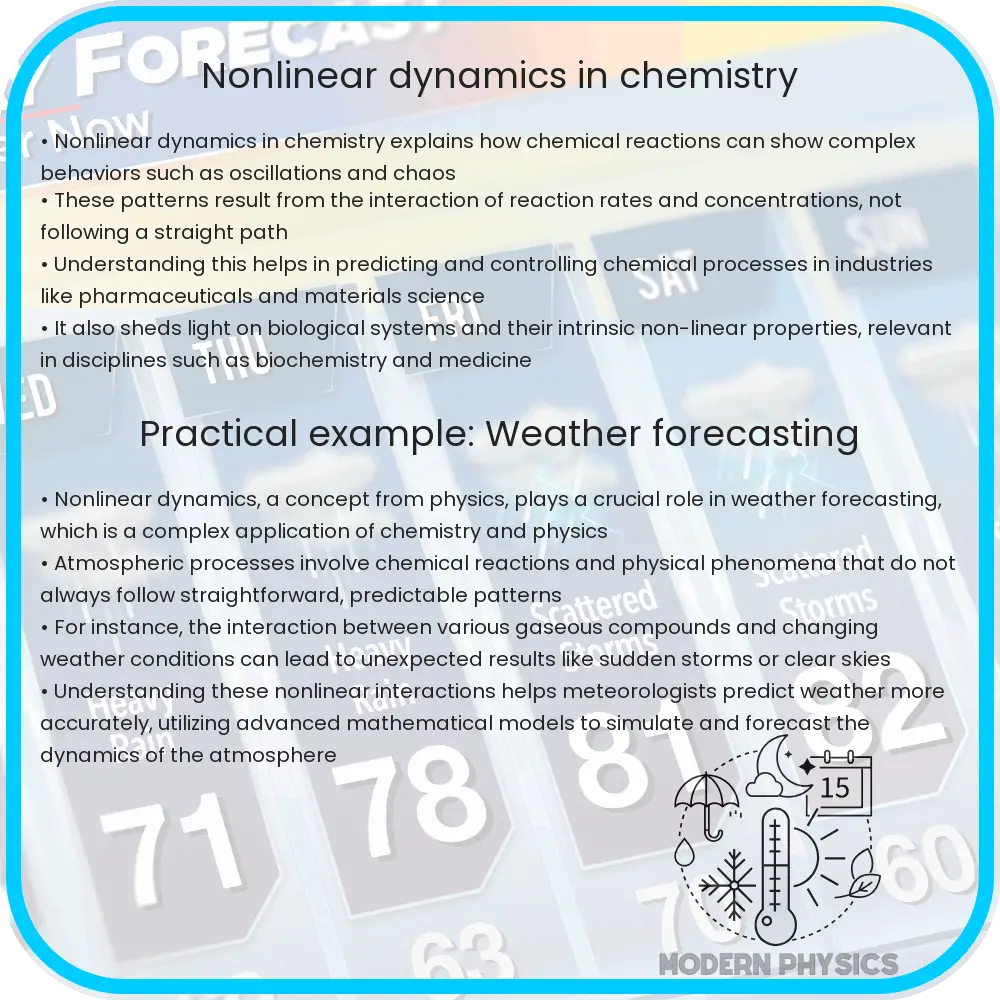
Exploring Nonlinear Dynamics in Chemistry
Nonlinear dynamics in chemistry offers an intriguing lens through which we can understand the complex behaviors and patterns that occur in chemical systems. This area of study sheds light on phenomena such as chemical oscillations, patterns in reaction-diffusion systems, and the concept of chaos, stretching beyond the simpler linear models that only capture steady state behaviors without fluctuations or pattern formations.
Chemical Oscillations and Periodicity
One of the most fascinating aspects of nonlinear dynamics in chemistry is the existence of periodic or oscillatory behavior in some chemical reactions. These are situations where the concentrations of reactants and products undergo regular and sustained oscillations, rather than settling into a steady state. A classic example is the Belousov-Zhabotinsky reaction, a well-studied oscillating chemical system. In this reaction, the color of the solution periodically changes due to the cyclic oxidation and reduction of metal ions catalyzed by bromate ions.
Understanding these oscillations requires a look at the feedback mechanisms and nonlinear rate laws within the reaction. For instance, certain reactions in the system may produce products that in turn accelerate or decelerate other reactions, creating a loop that drives periodic behavior.
Patterns and Chaos in Reaction-Diffusion Systems
Another significant area within nonlinear dynamics is the study of patterns and chaos in reaction-diffusion systems. In these systems, chemicals undergo reaction and diffuse through space, potentially creating intricate spatial patterns such as stripes, spots, or labyrinthine structures. A key model that helps to describe this is the Turing pattern, named after the mathematician Alan Turing. This model explains how interactions between two or more diffusing chemicals can destabilize a uniform state leading to the formation of complex patterns.
The conditions for the emergence of Turing patterns depend critically on the rates of diffusion and the nature of chemical interactions. Typically, a fast-diffusing inhibitor and a slow-diffusing activator are necessary. The inhibitor must diffuse sufficiently faster than the activator to create a stabilizing effect, yet not so fast as to suppress pattern formation entirely.
Chaos in Chemical Systems
Chaotic behavior in chemical systems represents an extreme form of nonlinear dynamics where the system is highly sensitive to initial conditions. This is often referred to as the “butterfly effect”, where minute changes at the start of a reaction can lead to vastly different outcomes. Chaos in chemical reactions is generally associated with complex, unpredictable behavior over time, even though the underlying rules are deterministic.
Studying chaos in chemical systems often involves detailed numerical simulations and mathematical models which highlight how tiny alterations in parameters can shift a system from regular oscillations to erratic, unpredictable behavior. This area of research not only expands our understanding of chemistry but also integrates concepts from mathematics and physics, illustrating the interdisciplinary nature of science.
- Periodicity in Chemical Reactions
- Emergence of Spatial Patterns
- The Nature and Impact of Chaotic Dynamics
The exploration of nonlinear dynamics in chemistry not only enhances the understanding of complex chemical systems but also aligns with practical applications in material science, biological systems, and industrial chemistry, where understanding and controlling complex behaviors can lead to significant technological advancements.
Practical Applications of Nonlinear Dynamics
The principles of nonlinear dynamics in chemistry are not just theoretical but also have practical applications in various fields. For instance, the ability to control oscillating reactions has implications in developing chemical sensors and switches. These devices rely on precise detection and modulation of chemical states, which can be fine-tuned using knowledge of nonlinear dynamics.
In the realm of pharmaceuticals, understanding how chemical reactions oscillate and generate patterns can aid in the design of more effective drug delivery systems. For example, reaction-diffusion systems could potentially be used to create environments where drugs are released steadily over time, based on the reaction patterns that govern their dispersion.
Moreover, the insights gained from studying chaos in chemical systems can be pivotal in improving the safety and stability of industrial chemical processes. By predicting chaotic shifts, manufacturers can design more robust systems that minimize the risk of unexpected and potentially hazardous deviations during production.
Conclusion
The exploration of nonlinear dynamics in chemistry serves as a compelling example of how complex and seemingly unpredictable phenomena can be understood through a deeper scientific inquiry. From the rhythmic changes in the Belousov-Zhabotinsky reaction to the fascinating patterns predicted by Turing’s model, and the unpredictable nature of chaos, this field illustrates the richness of chemical systems and the potential they hold for scientific and technological innovation.
By integrating concepts from mathematics, physics, and engineering, researchers are able to not only describe but also predict and sometimes control complex behaviors in chemical systems. This not only enhances our fundamental understanding but also opens new avenues in material science, medicine, and industrial processing. As we continue to unlock the secrets of nonlinear dynamics, we might find more ways in which these principles can be applied to solve real-world problems, highlighting the importance of interdisciplinary research and collaboration in the advancement of science and technology.
Ultimately, the study of nonlinear dynamics in chemistry epitomizes the synergy between theory and application, exemplifying how theoretical frameworks can provide profound insights in understanding nature’s complexities and contributing to technological progress.