
Explore non-relativistic Quantum Electrodynamics (QED), its applications in quantum optics and challenges in precision experiments and computation.
Understanding Non-Relativistic Quantum Electrodynamics (QED)
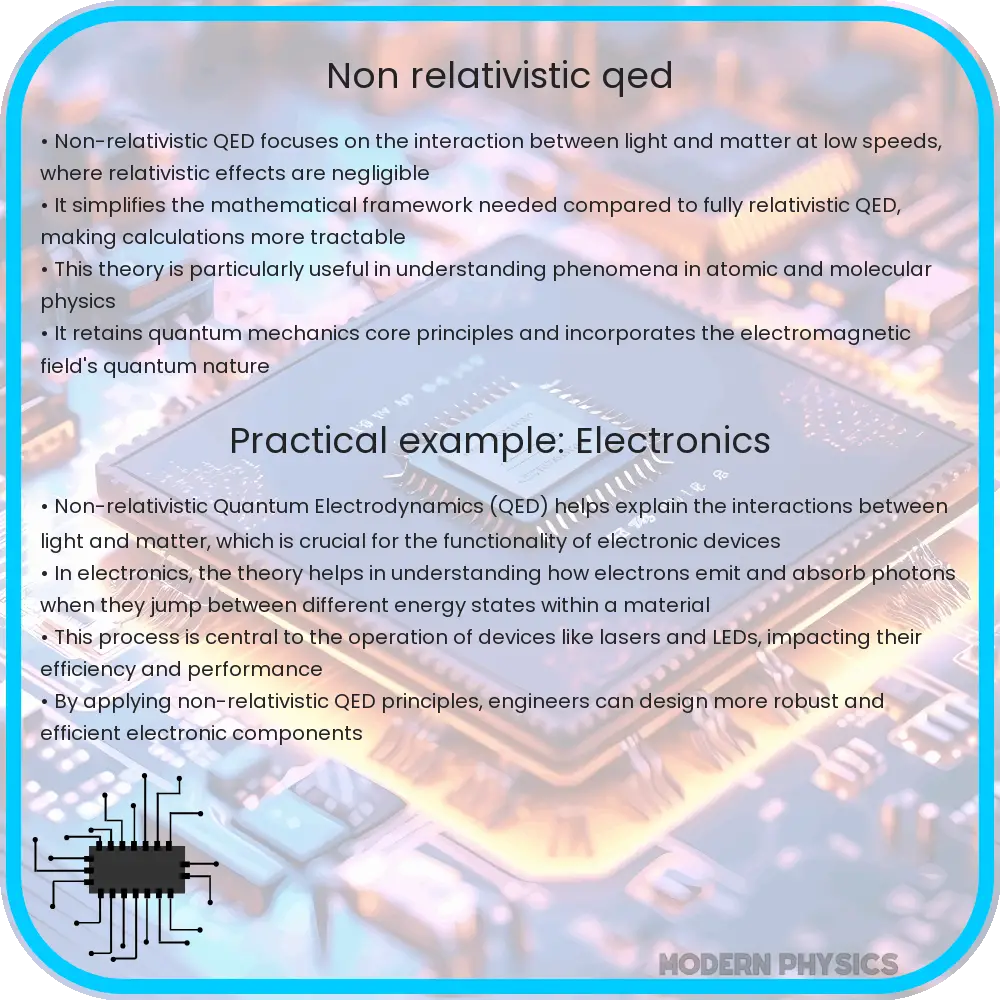
Non-Relativistic Quantum Electrodynamics (QED) is an essential branch of quantum mechanics, focusing on the interaction between light (photons) and matter, particularly electrons. This field blends the principles of quantum mechanics with the electromagnetic force, offering a deeper understanding of photon interactions at energy levels where relativistic effects are negligible.
Photon-Electron Interactions in Non-Relativistic QED
In non-relativistic QED, the interactions between photons and electrons are described using quantum mechanics without incorporating the complexities of Einstein’s theory of relativity. This simplification is valid when dealing with low-energy photons and electrons, where the velocities are significantly lower than the speed of light. The fundamental process at the heart of non-relativistic QED is the absorption and emission of photons by electrons. This interaction is governed by the principles of quantum mechanics, which dictate the probabilistic nature of these events.
The Role of Precision in Non-Relativistic QED Experiments
Precision plays a crucial role in non-relativistic QED experiments. Precise measurements and calculations allow physicists to test the predictions of QED with high accuracy. For instance, the Lamb shift—an energy difference in the hydrogen atom’s electron orbitals predicted by QED—requires extremely precise spectroscopic techniques to observe. Such precision experiments not only validate the theory but also help in refining our understanding of fundamental interactions.
Mathematical Formalism of Non-Relativistic QED
The mathematical formalism of non-relativistic QED involves wave functions, operators, and perturbation theory. The wave function describes the quantum state of a system, encompassing both the particles’ positions and their momenta. Operators are mathematical tools used to extract physical properties from the wave function, such as position, momentum, and energy. Perturbation theory, a crucial tool in QED, deals with small deviations from a known solution of a quantum mechanical problem, allowing the calculation of photon-electron interactions in a series expansion.
In conclusion, non-relativistic QED is a pivotal area in quantum mechanics, providing valuable insights into the interaction between light and matter. Its applications extend to various fields, including quantum computing, spectroscopy, and the development of new materials and technologies.
Applications and Challenges of Non-Relativistic QED
The applications of non-relativistic QED are vast and diverse. One significant area is in the field of quantum optics, where understanding the interaction between light and matter is fundamental. This knowledge is crucial in developing lasers, quantum computers, and other optical devices. Additionally, non-relativistic QED principles are instrumental in spectroscopy, aiding in the analysis of materials and biological molecules by studying their interaction with light.
Another crucial application is in the development of precision instruments, such as atomic clocks. These devices rely on the precise measurements of energy levels in atoms, a phenomenon that QED accurately predicts and explains. Furthermore, non-relativistic QED is essential in understanding and designing semiconductors and nanostructures, where quantum effects play a significant role.
Challenges in Non-Relativistic QED Research
Despite its successes, non-relativistic QED is not without challenges. One of the main difficulties lies in the complexity of the calculations involved. As systems become more complex, the calculations required for predicting interactions become increasingly intricate, often necessitating advanced computational methods. Additionally, in certain situations, non-relativistic QED must be supplemented with relativistic effects to provide a more complete picture, particularly when dealing with high-energy phenomena.
Another challenge is experimental verification. Due to the incredibly small scale and high precision required, experiments in QED are often expensive and technically demanding. This makes it challenging to test the predictions of QED and to push the boundaries of our understanding further.
Conclusion: The Future of Non-Relativistic QED
In conclusion, non-relativistic Quantum Electrodynamics stands as a cornerstone in our understanding of quantum mechanics and its interplay with electromagnetic forces. Its applications are crucial in advancing technology and scientific understanding, from quantum computing to precision measurement. However, the field continues to face challenges, particularly in computational complexity and experimental verification.
As technology advances, the potential to overcome these challenges increases, paving the way for new discoveries and innovations. The future of non-relativistic QED promises not only deeper insights into the quantum world but also practical advancements that could significantly impact various scientific and technological fields.