
Explore the intriguing world of non-equilibrium work relations, their theoretical foundations, applications in science, and future advancements.
Understanding Non-Equilibrium Work Relations
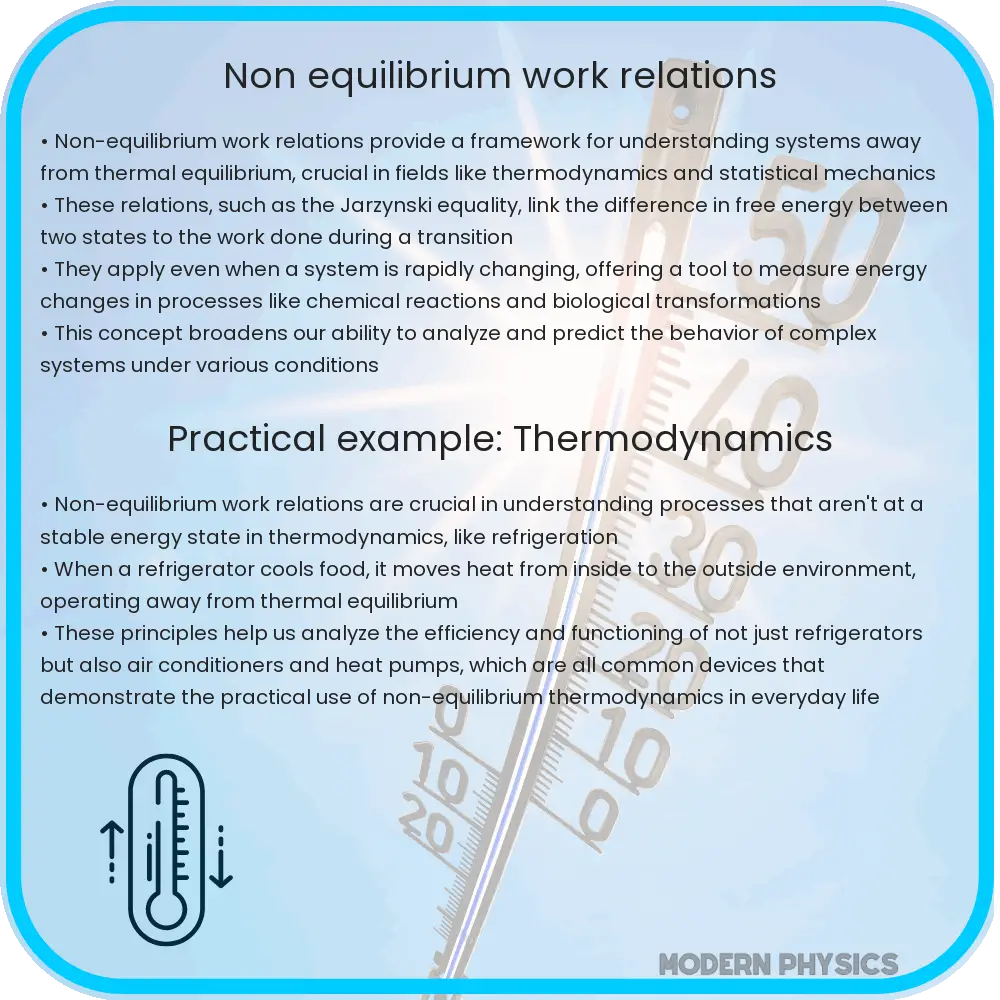
Non-equilibrium work relations represent a fundamental aspect of thermodynamics and statistical mechanics, providing crucial insights into the behavior of systems far from equilibrium. These relations, which include the Jarzynski Equality and Crooks Fluctuation Theorem, have transformed our understanding of the microscopic world, particularly in chemical and biological systems.
Theoretical Foundations
At the heart of non-equilibrium work relations is the concept that the work done on a system during a non-equilibrium process can be related to free energy differences between states. This is significant because it offers a way to calculate free energy changes, which are usually difficult to measure directly, especially in complex systems. The Jarzynski Equality, for example, states that the exponential average of the work done on a system is equal to the free energy difference, expressed as e−βW = e−βΔF, where β is the inverse temperature, W is the work done, and ΔF is the free energy change.
Applications in Chemistry and Biology
In the realms of chemistry and biology, these relations have found profound applications. For instance, they have been used in understanding the folding mechanisms of proteins and the operation of molecular machines. In these scenarios, non-equilibrium work theorems provide a way to explore energy landscapes and understand how molecular systems transition between different states under various conditions.
Experimental Verification
The experimental verification of non-equilibrium work relations has been a significant milestone. Advanced techniques like single-molecule force spectroscopy have allowed scientists to apply and measure forces on individual molecules, thereby testing the predictions of non-equilibrium thermodynamics in real time. These experiments not only confirm theoretical predictions but also help refine our understanding of molecular dynamics.
Another important aspect is the application in the design of efficient energy systems and nanotechnology. By understanding how systems behave under non-equilibrium conditions, scientists and engineers can design more efficient processes and devices, particularly at the nanoscale, where classical thermodynamics may not be fully applicable.
Furthermore, non-equilibrium work relations are pivotal in the study of systems that undergo rapid changes. This includes biological systems like enzymes and motor proteins, where traditional equilibrium methods fall short. The ability to predict and understand these processes opens new frontiers in biotechnology and pharmaceutical development.
Overall, non-equilibrium work relations are not just theoretical constructs but tools with wide-ranging applications in science and technology. They provide a bridge between the abstract world of thermodynamics and the practicalities of chemical and biological systems, paving the way for innovations in various fields.
Advancements in Computational Methods
The surge in computational power and the development of sophisticated algorithms have played a pivotal role in the advancement of non-equilibrium work relations. Simulations, particularly molecular dynamics, provide a virtual platform to test and observe these relations in action. Computational methods enable researchers to model complex systems, from biomolecules to new materials, under non-equilibrium conditions, offering insights that are often unattainable through experimental methods alone.
Challenges and Future Directions
Despite their successes, non-equilibrium work relations face challenges, particularly in dealing with highly complex systems. The accuracy of these relations depends on factors like the rate of process, system size, and the presence of external fields. As such, ongoing research aims to extend these relations and overcome limitations, particularly in systems with strong interactions or far from equilibrium conditions.
Another exciting direction is the integration of machine learning and AI techniques with non-equilibrium thermodynamics. This integration promises to enhance our ability to predict and control complex systems, leading to breakthroughs in material science, nanotechnology, and bioengineering.
Conclusion
Non-equilibrium work relations stand as a cornerstone in the understanding of thermodynamic processes beyond the realm of equilibrium. From their theoretical underpinnings to practical applications in chemistry, biology, and material science, these relations have opened new pathways for scientific inquiry and technological innovation. The exploration of these relations continues to challenge and expand our understanding of the natural world, offering a rich field of study that intersects with various scientific disciplines.
The future of non-equilibrium work relations is bright and promising. As we delve deeper into the microscopic world and harness the power of computational and AI techniques, these relations will continue to unveil the complexities of the universe, from the tiniest molecules to the grandest cosmic systems. Ultimately, the continued study and application of non-equilibrium work relations will not only enhance our scientific knowledge but also pave the way for advancements in technology and industry, impacting our lives in myriad ways.