
Understanding nodal points in hydroelasticity, which are specific points on submerged elastic structures that remain stationary under dynamic fluid forces.
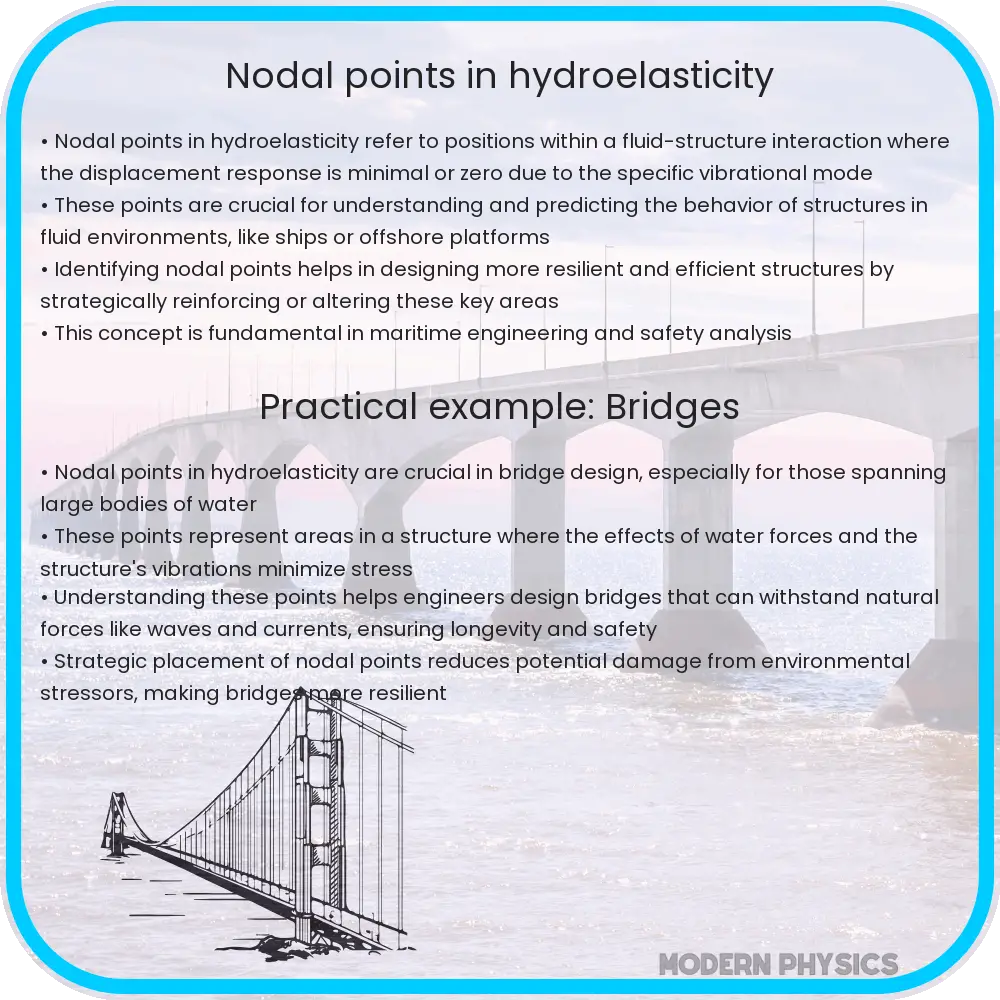
Nodal Points in Hydroelasticity
Hydroelasticity is a fascinating field of physics that combines the complexities of fluid dynamics with the principles of elasticity. It pertains specifically to the behavior of elastic structures when submerged in fluid environments. Understanding nodal points within this context not only enhances our grasp of engineering applications like the design of marine structures and vessels but also broadens our understanding of natural phenomena such as sea waves interacting with ice sheets.
What are Nodal Points?
Nodal points in hydroelasticity refer to points on a structure that are at rest (not moving) when the structure is exposed to dynamic fluid forces. These are crucial for analyzing the response of the structure to various external influences. In essence, nodal points are areas of zero displacement in a vibrating system, and their positions depend on the vibration mode and the interaction between the structural material and the enveloping fluid.
Understanding the Dynamics of Nodal Points
The analysis of nodal points involves both the dynamic response of the structure and the fluid forces acting upon it. When a fluid such as water interacts with an elastic structure like a ship’s hull or an offshore platform, waves and vibrations are generated. The positioning and behavior of nodal points under such circumstances can tell engineers a lot about the stability and integrity of the structure.
In hydroelastic systems, the governing equations are typically derived from the principles of fluid dynamics and elasticity. For example, the Navier-Stokes equations may be used alongside the equations of motion for elastic bodies, giving rise to complex differential equations that describe the hydroelastic system:
- Navier-Stokes Equation: \(\rho \left(\frac{\partial \vec{v}}{\partial t} + \vec{v} \cdot \nabla \vec{v}\right) = -\nabla p + \mu \nabla^2 \vec{v} + \vec{f}\)
- Equation of Motion for Elastic Body: \(m \frac{d^2 \vec{x}}{dt^2} = \vec{F}_{elastic} + \vec{F}_{fluid}\)
Where \(\rho\) is the fluid density, \(\vec{v}\) is the fluid velocity, \(p\) represents pressure, \(\mu\) is the dynamic viscosity, \(\vec{f}\) are external forces, \(m\) denotes mass of the elastic structure, \(\vec{x}\) is the displacement, \(\vec{F}_{elastic}\) are the forces due to elasticity, and \(\vec{F}_{fluid}\) are the forces exerted by the fluid.
The vibration modes resulting from these interactions form patterns, and the nodal points are essentially where these patterns exhibit zero amplitude. The analysis of these points and patterns can be intricate depending on the mode shapes and the system’s boundary conditions.
Practical Applications of Nodal Points
The knowledge of nodal points has practical engineering applications in various areas. In maritime engineering, for instance, understanding where the nodal points are located on a boat hull helps in designing more stable structures that can better withstand the rough sea conditions. Similarly, in the construction of oil platforms, engineers use this information to minimize the resonance phenomena, which can cause catastrophic failures.
In fields like biomechanics, the concept is used to understand the mechanical responses of living tissues submerged in fluid. This has implications for medical device design, such as prosthetics and implants that interact with bodily fluids.
Challenges in Hydroelastic Research
Despite its utility, the study of hydroelasticity and nodal points presents significant challenges. The mathematics involved is often highly complex and requires sophisticated computational tools and methodologies. These include finite element analysis and computational fluid dynamics simulations to accurately model the interactions between fluid and structural dynamics.
Moreover, real-world applications frequently involve variables that are difficult to replicate in a laboratory setting, such as unpredictable sea states and complex boundary conditions. This makes field tests and simulations an indispensable part of the research and design process in hydroelasticity.
Conclusion
Hydroelasticity, with its focus on understanding the intricate interactions between fluids and elastic structures, is an essential field in both natural and engineered systems. Nodal points, as regions of zero displacement in these systems, play a crucial role in assessing and enhancing the stability and integrity of structures exposed to dynamic fluid forces. From designing sturdier ships to developing advanced medical devices, the study of nodal points offers profound insights that bridge the gap between theoretical physics and practical engineering.
As the field continues to evolve, the challenges it presents drive forward innovations in computational modeling and experimental methodologies. This not only helps in overcoming the complexities associated with hydroelastic systems but also enhances the safety and efficiency of structures living under the influence of fluid dynamics. Thus, hydroelasticity remains a vibrant area of research with broad implications for various scientific and engineering disciplines.