
Explore the unique properties and diverse applications of Niobium Nitride (NbN), a superconductor revolutionizing technology with its efficiency and durability.
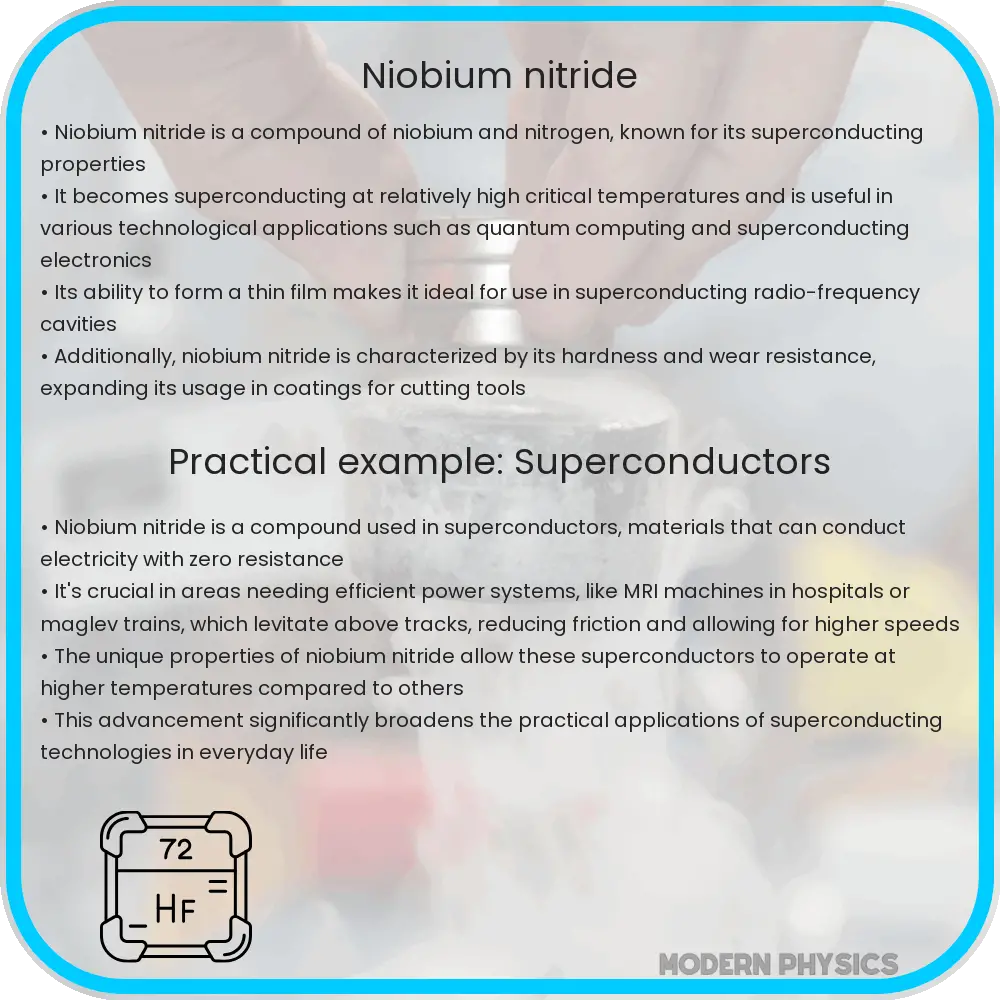
Niobium Nitride: A Promising Superconductor
Niobium Nitride (NbN) is gaining attention in the field of materials science for its superconducting properties, durability, and efficiency. This compound is formed by combining niobium (Nb) and nitrogen (N), resulting in a chemical formula of NbN. Superconductors are materials that can conduct electricity without resistance when cooled below a certain temperature, known as the critical temperature. NbN is particularly notable for its high critical temperature compared to many other superconductors, making it a valuable material for various applications.
Characteristics and Properties
Niobium Nitride is distinguished by its robustness and high critical temperature, which can reach up to 17 Kelvin (-256.15°C or -429.07°F). This property allows for its use in environments that are less extreme than those required for traditional superconductors, which often require cooling to near absolute zero. Furthermore, NbN is characterized by its exceptional hardness and chemical stability, making it suitable for use in harsh conditions.
Applications in Various Fields
- Electronics: Due to its superconducting properties, NbN is used in various electronic components, such as superconducting quantum interference devices (SQUIDs) and rapid single flux quantum (RSFQ) digital circuits. These applications benefit from the material’s ability to carry large currents without power loss.
- Telecommunications: In the telecommunications industry, niobium nitride is utilized in the production of high-frequency and high-power components. Its efficiency and durability make it ideal for use in satellite communication and radar systems.
- Particle Accelerators: The high critical magnetic field and thermal stability of NbN make it a suitable material for the superconducting magnets used in particle accelerators. This enables more powerful and efficient acceleration of particles.
The versatility and superior characteristics of NbN are paving the way for new advancements in technology and industry, making it a material of significant interest for future research and development.
Research and Future Prospects
Research into Niobium Nitride continues to uncover new potentials and applications. Scientists are exploring innovative ways to enhance its superconducting properties and operational efficiency at higher temperatures. Advances in material processing and alloy composition could further expand its applicability in various fields. Additionally, the integration of NbN into nanostructured materials and devices is a burgeoning area of study, offering promising avenues for quantum computing and nanotechnology.
Environmental Impact and Sustainability
The production and utilization of NbN also reflect a growing emphasis on sustainability and environmental impact. As a durable material with high efficiency, NbN contributes to reducing energy waste in superconducting applications, which is crucial for sustainable development. Moreover, the advancement in NbN technologies could lead to more energy-efficient systems in electronics, telecommunications, and large-scale facilities like particle accelerators.
Challenges and Considerations
Despite its advantages, the application of Niobium Nitride is not without challenges. The synthesis and processing of NbN require precise conditions and high-quality materials to achieve the desired superconducting properties. Additionally, the cost and complexity of producing NbN in large quantities can be significant barriers to its widespread adoption. Researchers are therefore focused on developing more cost-effective and scalable production methods to make this material more accessible for various applications.
Conclusion
Niobium Nitride stands out as a superconductor with impressive durability and efficiency, presenting a wealth of opportunities for technological advancements and industrial applications. Its high critical temperature, combined with robust physical properties, makes it a material of choice for a range of applications, from electronics to large-scale scientific equipment. While challenges remain in terms of production and cost, ongoing research and development are likely to overcome these hurdles, paving the way for broader adoption of NbN. As we continue to explore the full potential of Niobium Nitride, its role in shaping the future of superconducting materials and energy-efficient technologies becomes increasingly evident.