
Explore the intriguing concept of neutron-antineutron oscillation, its theoretical basis, experimental challenges, and potential impact on high-energy physics.
Introduction to Neutron-Antineutron Oscillation
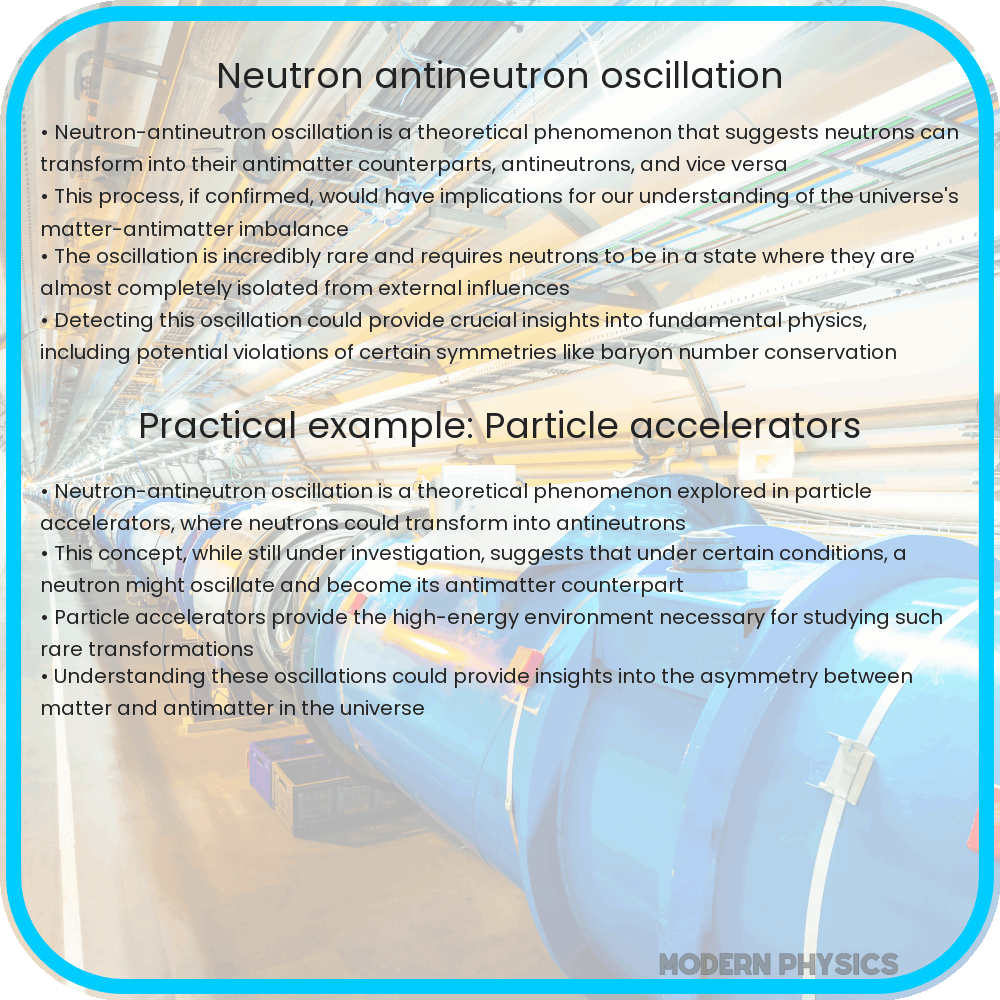
Neutron-antineutron oscillation is a hypothetical phenomenon predicted by certain extensions of the Standard Model of particle physics. This process suggests that a free neutron could convert into its antimatter counterpart, the antineutron, and vice versa. This concept challenges the conventional understanding of matter stability and could have profound implications for our understanding of the universe.
Theoretical Background and Implications
The concept of neutron-antineutron oscillation emerges from the idea that baryon number (a quantum number representing the difference between the number of quarks and antiquarks) might not be a strict conservation law in the universe. In the Standard Model, baryon number conservation is a cornerstone principle that prevents protons and neutrons from decaying, thereby ensuring the stability of matter. However, if neutron-antineutron oscillations were possible, it would imply that baryon number could be violated, leading to potential processes where matter could spontaneously convert into antimatter.
Experimental Searches and Challenges
Despite its intriguing theoretical foundation, the neutron-antineutron oscillation has not yet been observed. Experiments designed to detect this phenomenon place neutrons in conditions where they can potentially oscillate into antineutrons over time. These experimental setups often involve intense scrutiny of neutron beams or stored neutrons to observe any signs of antineutron appearance. However, the expected oscillation time is exceedingly long, making direct observation challenging. Additionally, the detection of antineutrons is complicated by their immediate annihilation upon encountering matter, requiring highly sensitive equipment to identify the resulting particles from such events.
Significance in High-Energy Physics
The pursuit of neutron-antineutron oscillation is not merely academic; it holds significant implications for high-energy physics and cosmology. Observing this phenomenon would provide crucial insights into the asymmetry between matter and antimatter in the universe, potentially explaining why the observable universe is predominantly composed of matter. Moreover, it would signal new physics beyond the Standard Model, opening new avenues of research in particle physics and cosmology.
Current Research and Future Directions
Current research into neutron-antineutron oscillation is driven by advancements in particle accelerator technology and detection methods. Facilities around the world, such as the European Organization for Nuclear Research (CERN) and Fermilab in the United States, are at the forefront of these experimental efforts. These studies not only aim to detect the oscillation directly but also to refine the theoretical models that predict its existence and characteristics. The sensitivity of these experiments has increased dramatically over recent years, enhancing the likelihood of observing this elusive phenomenon.
Future research will likely focus on increasing the precision of neutron beam experiments and improving the methodologies for capturing and analyzing antineutron events. Additionally, interdisciplinary collaborations between theorists and experimentalists are crucial for developing new strategies to investigate baryon number violation and related phenomena. As technology advances, the parameters within which neutron-antineutron oscillation could occur will become further constrained, either leading to the discovery of the oscillation or necessitating revisions to current theories.
Conclusion
Neutron-antineutron oscillation represents one of the most intriguing yet unobserved phenomena in high-energy physics. Its discovery would revolutionize our understanding of the fundamental laws governing the universe, particularly in relation to matter stability and baryon number conservation. While experimental challenges remain formidable, the theoretical and technological strides being made in particle physics bring us closer than ever to understanding the true nature of matter and antimatter. Regardless of the outcome, the search for neutron-antineutron oscillation continues to push the boundaries of science, challenging our most fundamental notions about the universe we inhabit.