
Explore the intriguing world of neutrino oscillations in QED, delving into their impact on particle physics and practical applications in astrophysics.
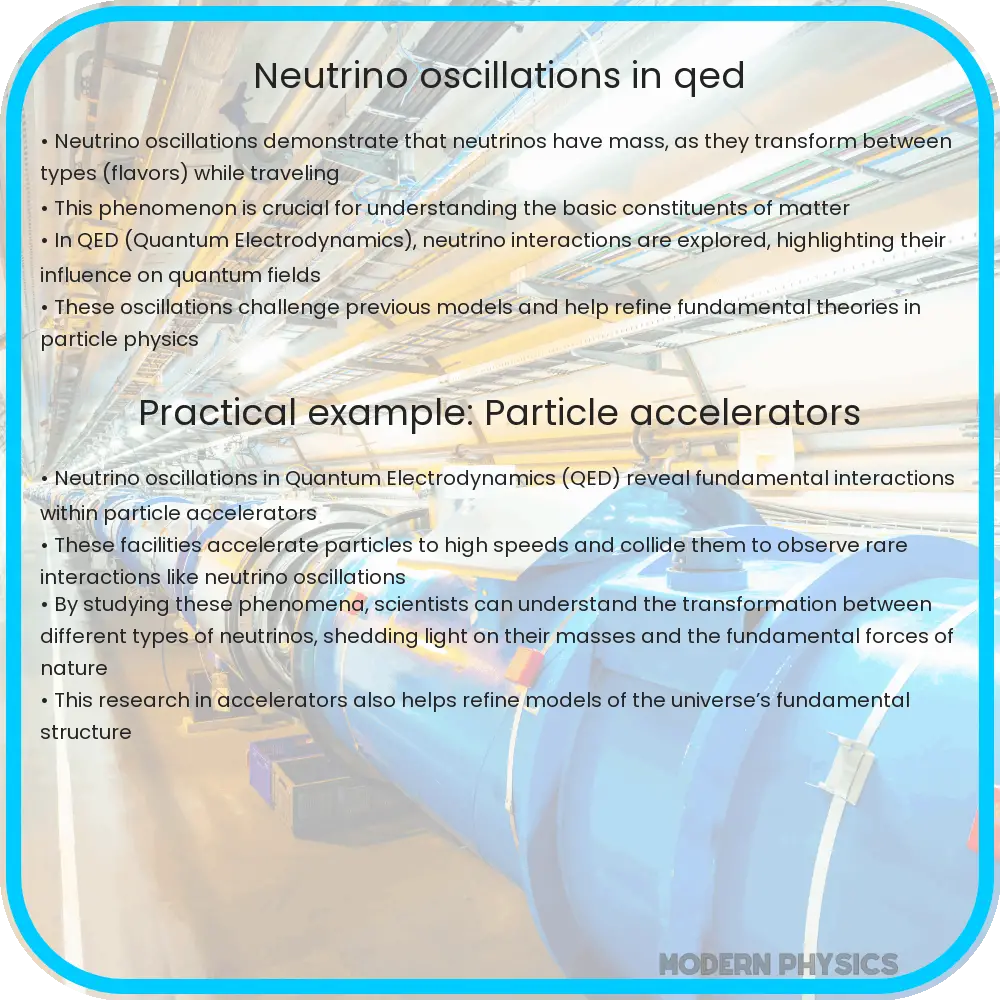
Understanding Neutrino Oscillations in the Quantum Electrodynamics (QED) Framework
Neutrino oscillations, a phenomenon in which neutrinos switch identities among their three types or ‘flavors’ – electron neutrinos, muon neutrinos, and tau neutrinos – presents a fascinating aspect of particle physics. This concept, when explored within the realm of Quantum Electrodynamics (QED), opens new doors to understanding the fundamental forces and particles that compose our universe.
The Fundamentals of Neutrino Oscillations
Neutrinos are elusive subatomic particles, known for their incredibly small mass and lack of electric charge. The process of neutrino oscillation involves the transition of these particles from one flavor to another as they travel through space. This phenomenon was first proposed by Bruno Pontecorvo in the late 1950s and later confirmed through various experiments. It implies that neutrinos have mass, a revelation that challenged the Standard Model of particle physics which initially considered them to be massless.
QED: A Cornerstone of Modern Physics
Quantum Electrodynamics (QED) is a quantum field theory that describes how light and matter interact. Developed by Richard Feynman, Julian Schwinger, and Sin-Itiro Tomonaga, it revolutionized the understanding of electromagnetic forces. QED is integral to the Standard Model, providing a framework to study the interactions of charged particles and photons, the quantum of light.
Integrating Neutrino Oscillations into QED
The integration of neutrino oscillations into the QED framework involves complex theoretical considerations. Since QED primarily deals with charged particles and photons, incorporating neutrinos, which are neutral, requires an extension of the theory. This is achieved by considering the weak force, another fundamental force that plays a crucial role in neutrino interactions. The weak force, responsible for processes like beta decay, allows neutrinos to interact with other particles, albeit weakly.
Understanding neutrino oscillations in the context of QED not only enhances the comprehension of these enigmatic particles but also sheds light on the unification of fundamental forces. It is a step towards a more comprehensive theory that can encompass all known particles and interactions in the universe.
In the next section, we will delve deeper into the theoretical insights provided by the interplay of neutrino oscillations and QED, and explore the practical applications arising from this intriguing symbiosis.
Theoretical Insights from Neutrino Oscillations in QED
The study of neutrino oscillations within the QED framework has provided significant theoretical insights. One such insight is the concept of neutrino mass. The existence of neutrino oscillations implies that neutrinos must have mass, however minuscule. This revelation necessitates revisions to the Standard Model, which initially posited neutrinos as massless. Additionally, the interaction of neutrinos via the weak force, as described in QED, helps to clarify the role of these particles in cosmic events and processes.
Applications of Neutrino Oscillations in QED
Beyond theoretical advancements, understanding neutrino oscillations in QED has practical applications. In astrophysics, neutrinos are used as probes to study cosmic phenomena. Since neutrinos interact weakly with matter, they can travel vast distances unimpeded, carrying information about their origins, like supernovae or the early universe. This information is invaluable in studying cosmic events that are otherwise inaccessible or obscured.
In particle physics, neutrino oscillations challenge and refine existing models. This ongoing research could lead to new technologies based on the unique properties of neutrinos, like neutrino communication or neutrino detectors for monitoring nuclear reactors.
Challenges and Future Directions
Despite these advancements, integrating neutrino oscillations into QED poses challenges. The precise measurement of neutrino masses and the complete understanding of their role in the universe remain elusive. Future experiments and theoretical developments are expected to provide more clarity, potentially leading to a more unified theory that incorporates all fundamental forces and particles.
Conclusion
Neutrino oscillations, when examined through the lens of Quantum Electrodynamics, offer profound insights into the fundamental nature of our universe. These oscillations challenge existing paradigms and extend our understanding of particle physics. The integration of neutrinos into the QED framework not only advances theoretical knowledge but also paves the way for innovative applications in various fields. As research progresses, the study of neutrinos in the context of QED will continue to be a rich and fertile ground for scientific discovery, pushing the boundaries of our understanding of the cosmos.