
Explore how Neutral Particle Analyzers enhance tokamak diagnostics, improve efficiency, and pave the way for sustainable fusion energy in this insightful article.
Understanding the Role of Neutral Particle Analyzers in Tokamak Diagnostics
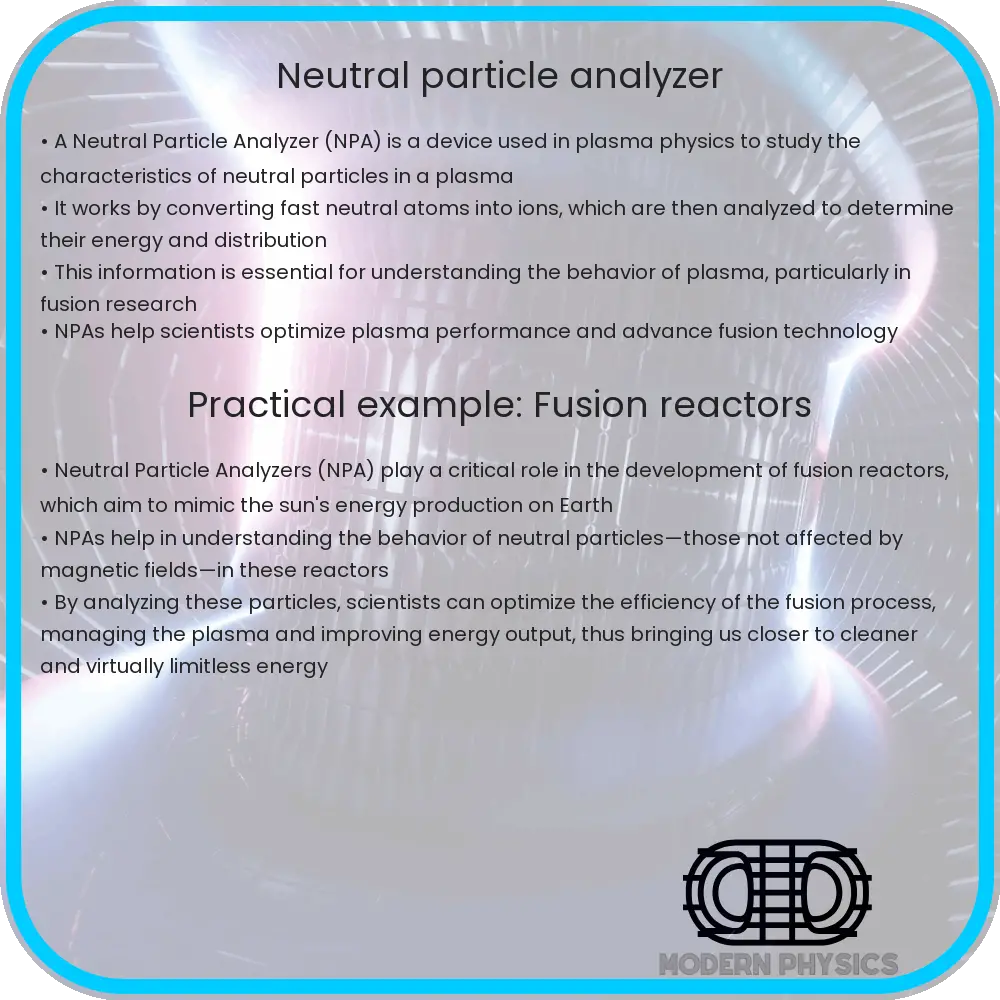
Neutral Particle Analyzers (NPAs) are essential diagnostic tools used in the study and operation of tokamaks, the most researched type of fusion device. Tokamaks aim to achieve controlled thermonuclear fusion, a process that powers the sun and stars, by confining a plasma—a hot, charged state of matter composed of ions and electrons—in a toroidal (doughnut-shaped) magnetic field. Achieving and maintaining the conditions for fusion requires precise control and understanding of the plasma. This is where NPAs come into play, providing critical insights into plasma behavior, energy distribution, and confinement efficiency.
Principles of Operation
At its core, an NPA measures the energy distribution of neutral particles escaping from the plasma. As these particles are not affected by the magnetic field confining the charged plasma, they carry valuable information about the internal processes and conditions within the tokamak. By analyzing the energy and flux of these neutral particles, researchers can infer the temperature, density, and other properties of the plasma, particularly the behavior of fast ions, which play a crucial role in plasma heating and stability.
Enhancing Tokamak Efficiency
The efficiency of a tokamak is fundamentally linked to how well the plasma is heated and confined. NPAs contribute to this by enabling the optimization of heating methods and the magnetic confinement system. For instance, by analyzing the data from NPAs, scientists can adjust the parameters of auxiliary heating systems, like neutral beam injection or radiofrequency heating, to ensure maximum energy transfer to the plasma. Moreover, understanding the loss mechanisms of fast ions, as revealed by NPA measurements, is crucial for designing more efficient confinement schemes, thus directly impacting the overall efficiency of the tokamak.
Challenges and Solutions
Despite their usefulness, implementing NPAs in the high-temperature, high-radiation environment of a tokamak presents several challenges. These include the need for high radiation hardness, the ability to distinguish signal from background noise, and the capability to rapidly process large volumes of data. Advances in sensor technology, signal processing algorithms, and machine learning are helping to overcome these obstacles, enhancing the precision and utility of NPA diagnostics in tokamak research.
Integration with Other Diagnostic Systems
For a comprehensive understanding of plasma behavior, NPAs are often used in conjunction with other diagnostic instruments. Magnetic diagnostics measure the strength and configuration of the magnetic fields confining the plasma, while interferometry and Thomson scattering provide data on plasma density and temperature. By integrating data from NPAs with these other diagnostic systems, researchers can construct a more complete picture of plasma dynamics. This holistic approach is crucial for addressing the complex challenges of achieving stable, efficient fusion reactions in tokamaks.
Future Perspectives
The development and refinement of NPAs continue to play a pivotal role in advancing fusion research. Future improvements in NPA technology, such as increased resolution and faster data acquisition, promise to unlock even deeper insights into plasma processes. Furthermore, as the global fusion research community pushes towards the realization of commercial fusion power, the role of NPAs in optimizing tokamak performance becomes ever more critical. Innovations in diagnostic technology, alongside advancements in tokamak design and operation, are key to overcoming the remaining hurdles on the path to harnessing fusion as a clean, abundant source of energy.
Conclusion
Neutral Particle Analyzers stand as a cornerstone in the quest to unlock the potential of nuclear fusion as a sustainable energy source. By providing detailed measurements of neutral particles escaping from plasma, they offer invaluable insights into plasma characteristics and dynamics within tokamaks. The information gleaned from NPAs aids in the optimization of heating methods and confinement strategies, directly influencing the efficiency and feasibility of fusion energy. As fusion research progresses, the continued evolution of NPA technology and its integration with other diagnostics will be crucial in shaping the future of energy, promising a cleaner, virtually limitless power source for humanity.