
Explore the Navier-Stokes Equation in fluid dynamics, covering its principles, challenges, and future in understanding fluid flow and turbulence.
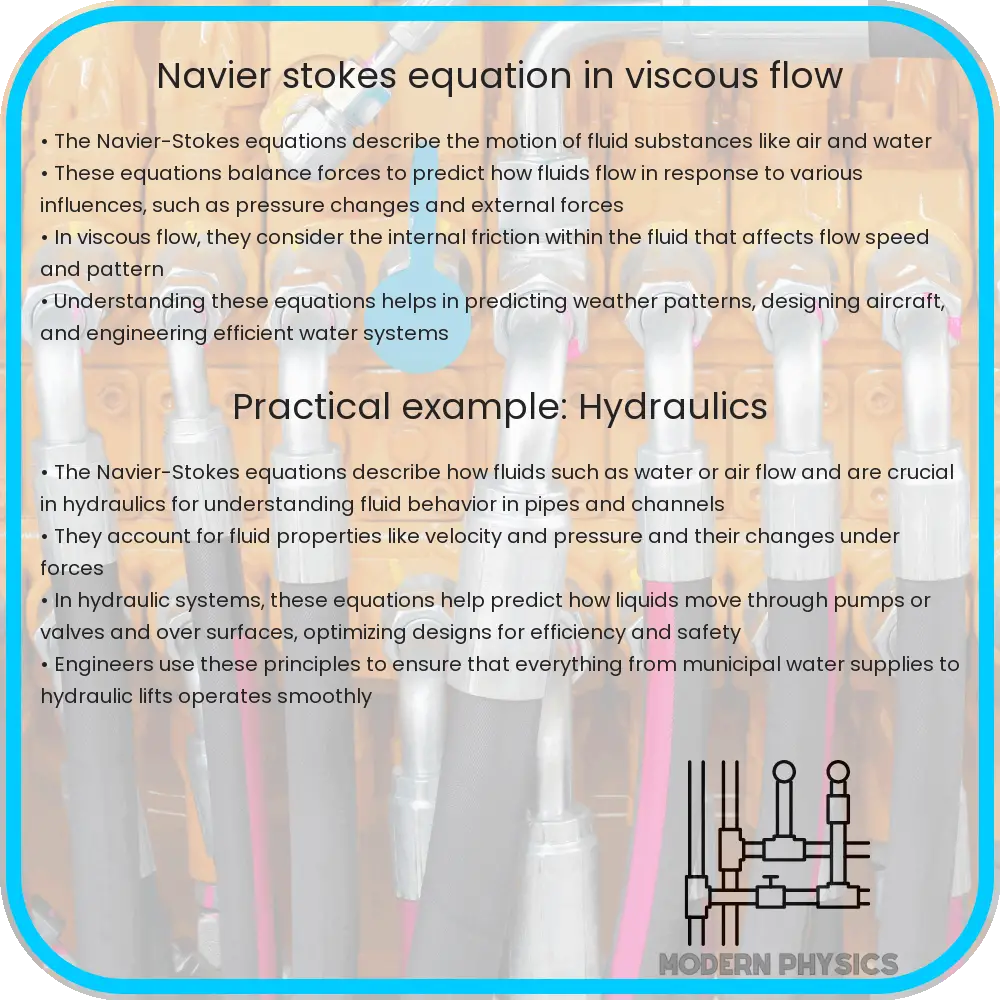
Understanding the Navier-Stokes Equation: Dynamics, Fluid Flow & Turbulence
The Navier-Stokes Equation is a fundamental principle in fluid dynamics, offering profound insights into the behavior of fluid flow and turbulence. This equation, named after Claude-Louis Navier and George Gabriel Stokes, is used to describe the motion of fluid substances such as liquids and gases. It plays a crucial role in a wide range of applications, from aerodynamics and weather forecasting to the design of water supply systems and the study of ocean currents.
Core Principles of the Navier-Stokes Equation
At its heart, the Navier-Stokes Equation is based on Newton’s second law of motion, which states that the force acting on a body equals its mass times its acceleration. In the context of fluid dynamics, this law is applied to fluid particles, considering both the internal and external forces acting on them. The equation balances these forces to describe how the velocity of fluid particles changes over time and space.
- Conservation of Momentum: The equation represents the conservation of momentum, crucial for predicting how fluids flow and interact with their surroundings.
- Viscosity: A key aspect of the Navier-Stokes Equation is its ability to factor in the viscosity of the fluid, which is the measure of its resistance to gradual deformation by shear or tensile stresses.
Applications in Understanding Fluid Flow & Turbulence
One of the most significant applications of the Navier-Stokes Equation is in the study of turbulence. Turbulence is a complex, chaotic flow regime characterized by vortices, eddies, and rapid fluctuations of pressure and velocity. Understanding turbulence is vital for many engineering applications, including aircraft design, pipeline transport, and environmental engineering.
Despite its widespread use, the Navier-Stokes Equation presents certain challenges. The complexity of solving these equations, especially in three dimensions and over time, requires advanced computational methods. Furthermore, the existence and smoothness of solutions in three dimensions is one of the seven Millennium Prize Problems in mathematics, highlighting the depth and intricacy involved in fully understanding these equations.
Overall, the Navier-Stokes Equation is an indispensable tool in fluid dynamics, offering a mathematical framework to analyze and predict the behavior of fluids in various contexts. From predicting weather patterns to designing efficient machinery, its applications are vast and deeply integrated into many aspects of science and engineering.
Challenges and Advances in Navier-Stokes Equation
One of the major challenges in utilizing the Navier-Stokes Equation is its non-linear nature, which makes analytical solutions difficult for most realistic scenarios. As a result, computational fluid dynamics (CFD) has become an essential tool. CFD uses numerical methods and algorithms to solve and analyze problems involving fluid flows, allowing engineers and scientists to simulate complex scenarios that are impossible to study experimentally.
Another challenge is the phenomenon of turbulence, which remains one of the least understood areas in fluid dynamics. The chaotic and unpredictable nature of turbulent flows makes it difficult to find precise solutions using the Navier-Stokes Equation. However, ongoing research in turbulence modeling and large eddy simulation (LES) is making significant strides in this area.
Future Directions in Fluid Dynamics
The future of fluid dynamics research, heavily reliant on the Navier-Stokes Equation, looks towards more accurate and efficient computational methods. The development of powerful supercomputers and advanced algorithms holds promise for solving the Navier-Stokes Equation for increasingly complex systems. This progress could lead to breakthroughs in various fields, including meteorology, oceanography, and aerospace engineering.
Moreover, the integration of machine learning and artificial intelligence in fluid dynamics is an emerging trend. These technologies offer potential in predicting fluid behavior in situations where traditional CFD methods are limited. This integration could revolutionize the field, leading to more precise models and predictions.
Conclusion
The Navier-Stokes Equation is a cornerstone of fluid dynamics, offering deep insights into the behavior of fluids under various conditions. Despite its complexity and the challenges in solving it, this equation has been instrumental in advancing many fields of science and engineering. The ongoing developments in computational methods, alongside innovative approaches like machine learning, are set to further enhance our understanding and ability to predict fluid behavior. As we continue to unravel the mysteries of fluid dynamics, the Navier-Stokes Equation will remain a fundamental tool, driving innovation and discovery across numerous disciplines.