
Learn about nanotube reinforced composites (NRCs), innovative materials utilizing carbon nanotubes for enhanced strength, durability, and performance in various applications.
Nanotube Reinforced Composites: Enhanced Strength & Durability
Engineering materials that combine high strength with light weight are vital in various applications, from aerospace to automotive, from sports equipment to construction. One of the most promising and innovative classes of materials that have been developed in recent decades are nanotube reinforced composites (NRCs). These composites leverage the incredible properties of carbon nanotubes (CNTs) — cylindrical molecules that consist of rolled-up sheets of single-layer carbon atoms (graphene). Let’s dive into how NRCs are structured and why they represent a significant leap in material science.
Understanding the Composition of Nanotube Reinforced Composites
Nanotube reinforced composites are typically made by embedding carbon nanotubes into a matrix material, such as epoxy, polymer, or metal. The nanotubes, which can have a diameter as small as 1 nanometer (nm) and a length of several micrometers (µm), act as reinforcing agents. The matrix holds the nanotubes in place and transfers stress between them. This combination harnesses the superior mechanical, electrical, and thermal properties of the carbon nanotubes, while the matrix material contributes to the overall durability and workability of the composite.
The Role of Carbon Nanotubes in Enhancing Material Properties
Carbon nanotubes are renowned for their mechanical strength and stiffness. In fact, they are among the strongest and stiffest materials currently known in terms of tensile strength and elastic modulus. This extraordinary strength arises from their unique molecular structure, where carbon atoms are bonded in a hexagonal pattern, forming an extremely stable configuration similar to that found in diamonds.
- Mechanical Properties: CNTs exhibit a tensile strength of approximately 100 times greater than steel at one-sixth the weight. Moreover, their stiffness and tensile strength can be as high as 1 terapascal (TPa) and 63 gigapascals (GPa) respectively.
- Thermal Properties: CNTs also excel in thermal conductivity, surpassing even diamond. This attribute makes NRCs extremely useful in applications requiring materials that must withstand or dissipate high temperatures.
- Electrical Properties: The intrinsic electrical properties of carbon nanotubes come from their all-carbon structure, rendering them very effective conductors or semiconductors based on their specific chirality (helical angle).
When these nanotubes are embedded within a composite, they create pathways that enhance the overall properties of the material. The synergy between the CNTs and the matrix material results in composites that are much stronger, more resistant to damage, and more durable than their conventional counterparts.
Manufacturing Techniques and Challenges
The successful integration of CNTs into a matrix material is not without its challenges. One significant hurdle is the uniform dispersion and alignment of nanotubes within the matrix, which is crucial for achieving the desired enhancements in mechanical, thermal, and electrical properties. Various techniques are employed to ensure a good dispersion of CNTs, including:
- Chemical Vapor Deposition (CVD): A popular method for growing high-quality CNTs directly on substrates, allowing better alignment and integration with the matrix material.
- Ultrasonic Agitation: Used to evenly disperse CNTs in a liquid matrix material before the composite is formed.
- Magnetic Alignment: Involving the application of magnetic fields to align magnetic nanoparticles coated on the CNTs during the composite preparation process.
Despite these challenges, the constant advancement in nanotechnology and material science is paving the way for more effective and innovative applications of nanotube reinforced composites. From enhancing the structural integrity of aircraft to improving the lifespan and performance of sports equipment, the potential for NRCs continues to grow.
Applications of Nanotube Reinforced Composites
The unique properties of nanotube reinforced composites make them suitable for a wide range of applications. Here are some of the most prominent uses:
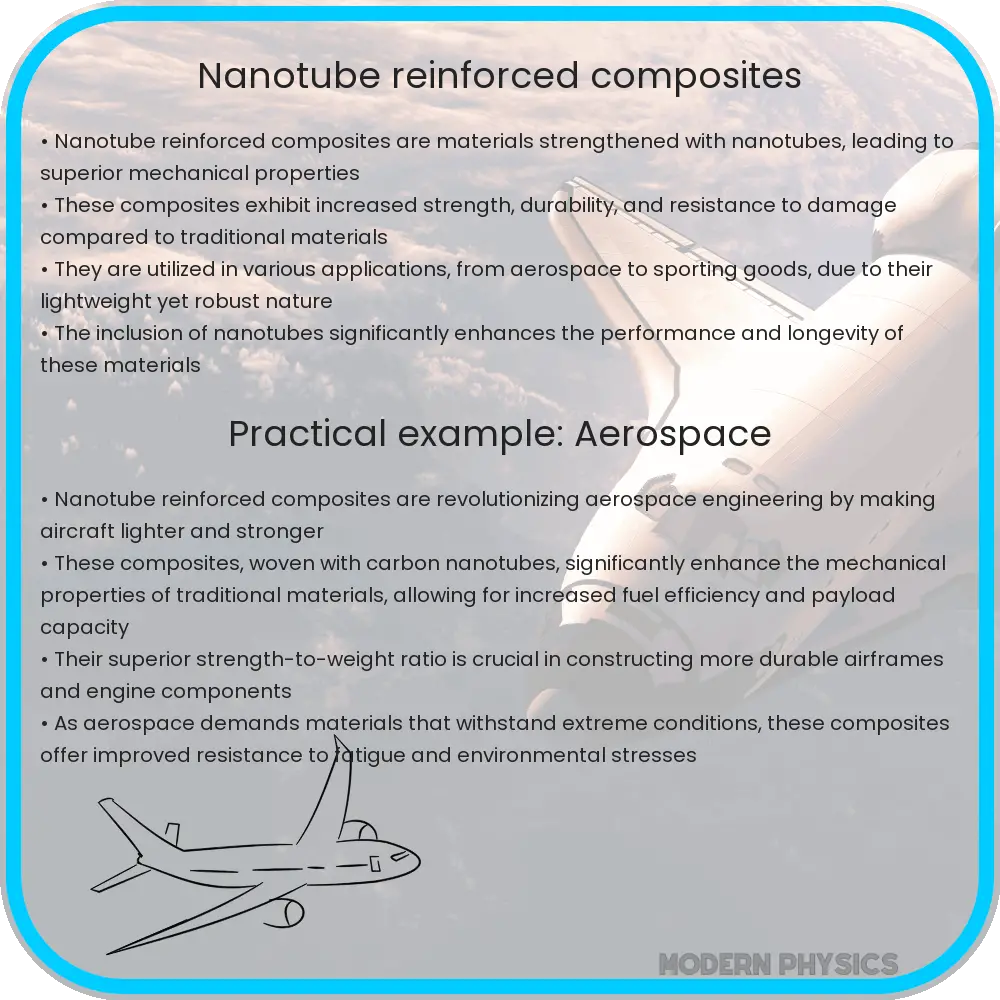
- Aerospace: NRCs are used in the manufacture of aircraft and spacecraft components, where their strength-to-weight ratio helps reduce overall weight and increase fuel efficiency.
- Automotive: In the automotive industry, NRCs contribute to lighter, stronger, and more durable components, which enhance vehicle performance and safety.
- Sports Equipment: The use of NRCs in sports equipment, like racquets and bicycles, results in gear that is both lighter and more durable, thus improving athletic performance.
- Building and Construction: NRCs are increasingly utilized in the construction sector for structural reinforcements that require minimal weight with maximum strength.
Future Prospects and Research Directions
Research continues to explore new ways to optimize and expand the applications of nanotube reinforced composites. Ongoing investigations focus on improving the matrix-nanotube bonding, developing more cost-effective production methods, and enhancing the environmental resistance of these composites. As technology evolves, it is expected that the use of NRCs will become even more widespread, potentially including new domains like biomedical devices and renewable energy systems.
Conclusion
Nanotube reinforced composites represent a significant advancement in material science, offering a combination of strength, lightness, and durability that is hard to match with traditional materials. From aerospace to sports, NRCs are already making a profound impact. With ongoing research aimed at overcoming current manufacturing challenges and discovering new applications, the future of NRCs looks incredibly promising. By continuously pushing the boundaries of what is possible with these materials, engineers and scientists are paving the way for innovations that could transform entire industries. The exploration of nanotube reinforced composites is not just about enhancing material properties—it is also about redefining the limits of engineering and design to create a more efficient and sustainable future.