
Explore the cutting-edge world of nanoscale optics and photonics, delving into its precision, speed, innovations, and future potential.
Introduction to Nanoscale Optics and Photonics
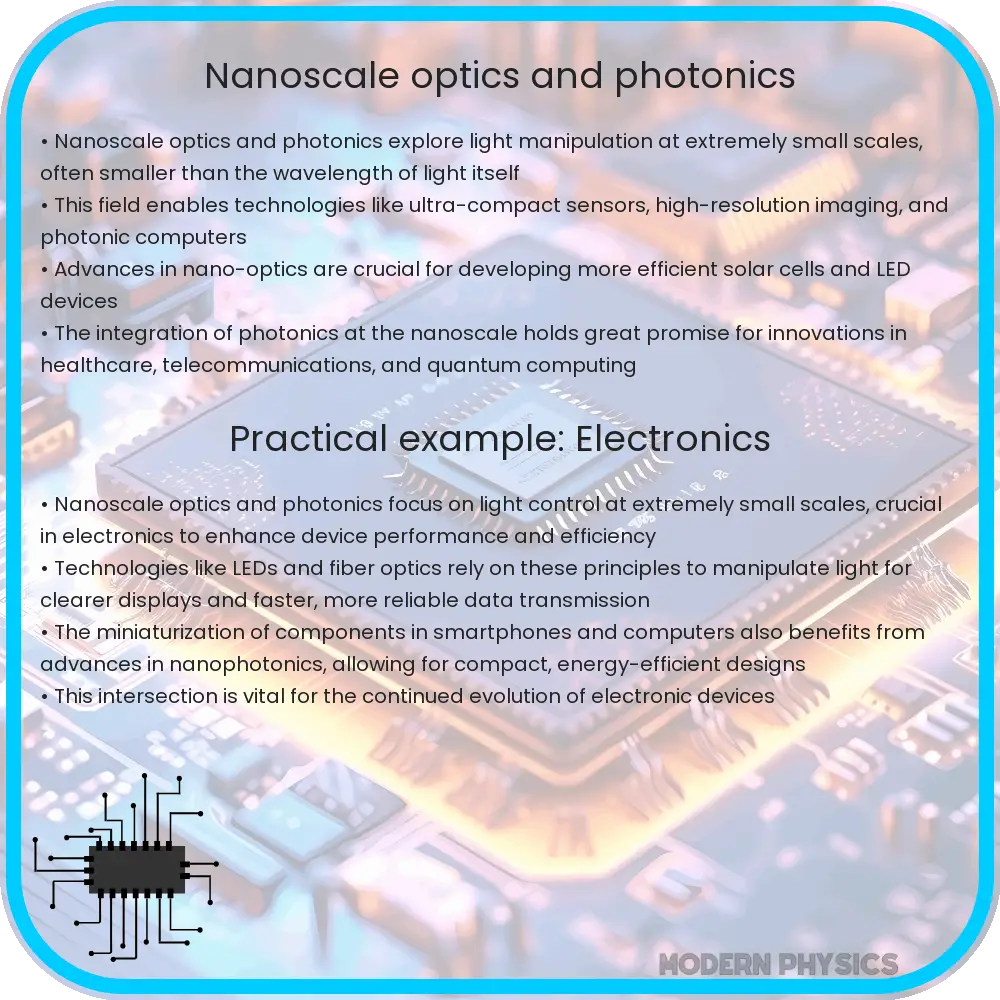
The burgeoning field of nanoscale optics and photonics stands at the forefront of modern technological advancements. This discipline revolves around the study and manipulation of light at the nanometer scale, a realm where classical optics and quantum mechanics converge. The implications of this field are vast, spanning from high-speed data transmission to revolutionary medical diagnostics.
The Essence of Nanoscale Precision
At the heart of nanoscale optics is the concept of precision. Manipulating light at scales smaller than the wavelength requires intricate designs and materials. This precision enables the creation of novel optical devices, such as metamaterials, capable of bending light in unconventional ways. Such materials are pivotal in developing super-lenses that surpass the diffraction limit of light, allowing us to see details at the atomic level.
Speed: Bridging Light and Electronics
Speed is a crucial aspect of photonics, especially at the nanoscale. The ability to control light signals rapidly opens up possibilities for ultra-fast optical computing. In this realm, photons can replace electrons in certain computing applications, leading to significantly faster data processing and transmission speeds. This is particularly relevant in the field of telecommunications, where the demand for high-speed data transfer is constantly increasing.
Innovations in Nanoscale Photonics
Nanoscale photonics is a breeding ground for innovation. One such breakthrough is the development of quantum dots, which are tiny semiconductor particles that exhibit quantum mechanical properties. These dots have become essential in various applications, from high-resolution displays to advanced solar cells. Another area of innovation is plasmonics, which explores the interaction between electromagnetic field and free electrons on a metal surface, paving the way for enhanced sensors and photonic circuits.
Moreover, the integration of nanophotonics with other fields, such as biology and chemistry, is leading to groundbreaking innovations. For instance, nanophotonic sensors are being developed for early disease detection by analyzing biomolecules at unprecedented sensitivities.
The synergy of nanoscale precision, speed, and innovation in optics and photonics is thus reshaping technology and opening new horizons in various scientific domains.
Challenges and Future Perspectives in Nanoscale Optics
Despite its promise, nanoscale optics and photonics face several challenges. Fabricating structures at the nanoscale with high precision is not only technologically demanding but also cost-intensive. Moreover, dealing with the quantum effects at this scale requires a deep understanding of quantum mechanics, posing a significant challenge for researchers and engineers. Additionally, integrating these nanoscale devices into existing systems, like optical fibers and electronic circuits, requires innovative approaches to overcome compatibility issues.
Environmental Impact and Sustainability
Another critical aspect to consider is the environmental impact of nanoscale photonic technologies. The production processes of nanomaterials and devices need to be sustainable and eco-friendly. Researchers are increasingly focusing on developing green photonics, which aims to minimize the ecological footprint of these technologies while maximizing their efficiency and utility.
Advancements in Computational Techniques
Advancements in computational techniques are playing a pivotal role in overcoming these challenges. Sophisticated simulation tools enable researchers to model and predict the behavior of light at the nanoscale, aiding in the design of efficient and innovative photonic structures. Machine learning algorithms are also being integrated to optimize the design and fabrication processes, potentially reducing costs and development time.
Conclusion: The Bright Future of Nanoscale Optics and Photonics
The field of nanoscale optics and photonics is at a pivotal point in its development, marked by groundbreaking innovations and challenges alike. Its impact on technology and science is profound, offering unprecedented precision and speed in manipulating light. As researchers continue to unravel the mysteries of light at the nanoscale and develop sustainable production methods, the future of this field appears bright and promising. The integration of advanced computational methods and the pursuit of green photonics principles are guiding the way towards a more sustainable and technologically advanced future. The potential applications are vast and varied, ranging from ultra-fast computing and telecommunications to revolutionary medical diagnostics and treatments. As the field continues to evolve, it will undoubtedly play a crucial role in shaping the technological landscape of the future.
Is this conversation helpful so far?