
Explore the cutting-edge realm of nanoscale heat transport, its efficiency, control mechanisms, and transformative applications in technology and energy.
Nanoscale Heat Transport: Paving the Way for Technological Innovation
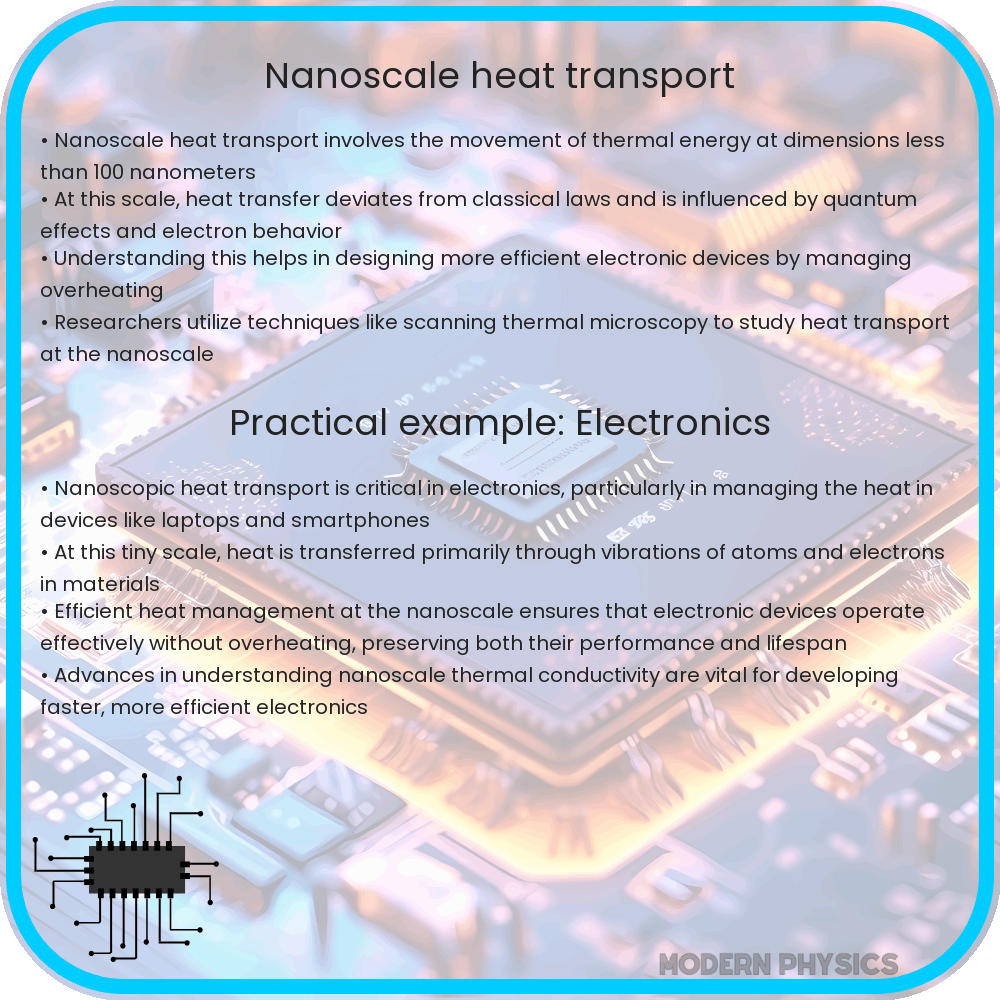
Understanding and controlling heat transport at the nanoscale level has emerged as a critical area of research, offering significant implications for a wide range of applications, from electronics to energy systems. At this scale, heat transfer deviates from classical laws, governed instead by quantum mechanics and the unique properties of materials at the atomic and molecular levels. This article delves into the efficiency, control mechanisms, and applications of nanoscale heat transport, shedding light on its potential to revolutionize various industries.
Efficiency of Nanoscale Heat Transport
At the nanoscale, thermal conductivity can exhibit unusual characteristics due to the quantum effects and increased surface-to-volume ratio. Materials like graphene and carbon nanotubes are prime examples, demonstrating exceptional thermal properties that surpass those of traditional materials. The efficiency of heat transport in these materials is influenced by phonon scattering, electron transport, and the interaction between different modes of heat transfer. Enhancing the efficiency of nanoscale heat transport involves engineering material structures at the atomic level to optimize these interactions.
Control of Heat at the Nanoscale
Controlling heat flow at the nanoscale is paramount for the development of next-generation thermal management systems. Techniques such as phononic engineering, which involves designing periodic structures that can manipulate phonons (the carriers of heat in insulating materials), offer a way to control thermal conductivity. By tailoring the geometry, size, and distribution of these structures, it’s possible to create materials with tailored thermal properties, including thermal insulators and conductors with unprecedented performance.
Applications of Nanoscale Heat Transport
The implications of advanced nanoscale heat transport are vast and varied. In electronics, efficient heat dissipation is crucial for the performance and longevity of devices. Nanomaterials with high thermal conductivity can lead to the development of smaller, faster, and more efficient electronic components. Moreover, in the field of renewable energy, enhancing the thermal management of photovoltaic cells can significantly improve their efficiency and durability. Additionally, the principles of nanoscale heat transport are being explored in the development of thermoelectric materials, which convert heat directly into electricity, offering a promising approach to waste heat recovery and energy conversion.
Challenges and Future Directions in Nanoscale Heat Transport
Despite the promising advancements in nanoscale heat transport, several challenges remain. One of the primary hurdles is the precise measurement and characterization of thermal properties at the nanoscale, which requires sophisticated techniques and equipment. Additionally, the integration of nanomaterials with existing technologies poses significant challenges, including scalability, stability, and compatibility issues. Future research is geared towards overcoming these obstacles, with a focus on developing new materials and structures that can further enhance the efficiency and control of heat transport at the nanoscale.
Innovative Research and Technological Breakthroughs
Emerging research is continuously pushing the boundaries of what’s possible with nanoscale heat transport. Innovations such as ultra-thin films and nanocomposites are being explored for their potential to offer superior thermal properties. Advances in simulation and modeling techniques also play a crucial role, enabling researchers to predict and optimize the behavior of nanoscale thermal systems before they are physically realized. These technological breakthroughs hold the promise of leading to more sustainable and efficient energy systems, advanced electronic devices, and novel materials with tailored thermal properties.
Conclusion
Nanoscale heat transport represents a frontier in the quest for more efficient, reliable, and sustainable technologies. Its applications span across critical sectors, including electronics, energy, and materials science, promising to usher in a new era of innovation. The ability to control and manipulate heat at such a diminutive scale opens up unprecedented opportunities for the development of devices and systems with enhanced performance and functionality. However, realizing the full potential of nanoscale heat transport requires overcoming significant challenges, particularly in measurement, characterization, and integration. As research progresses, the continued exploration of this fascinating field holds the key to unlocking transformative technological advancements that could redefine our approach to energy, electronics, and materials science.