
Unveiling the potential of nanorods in advanced technology, focusing on their unique properties and diverse applications in electronics, biotechnology, and material science.
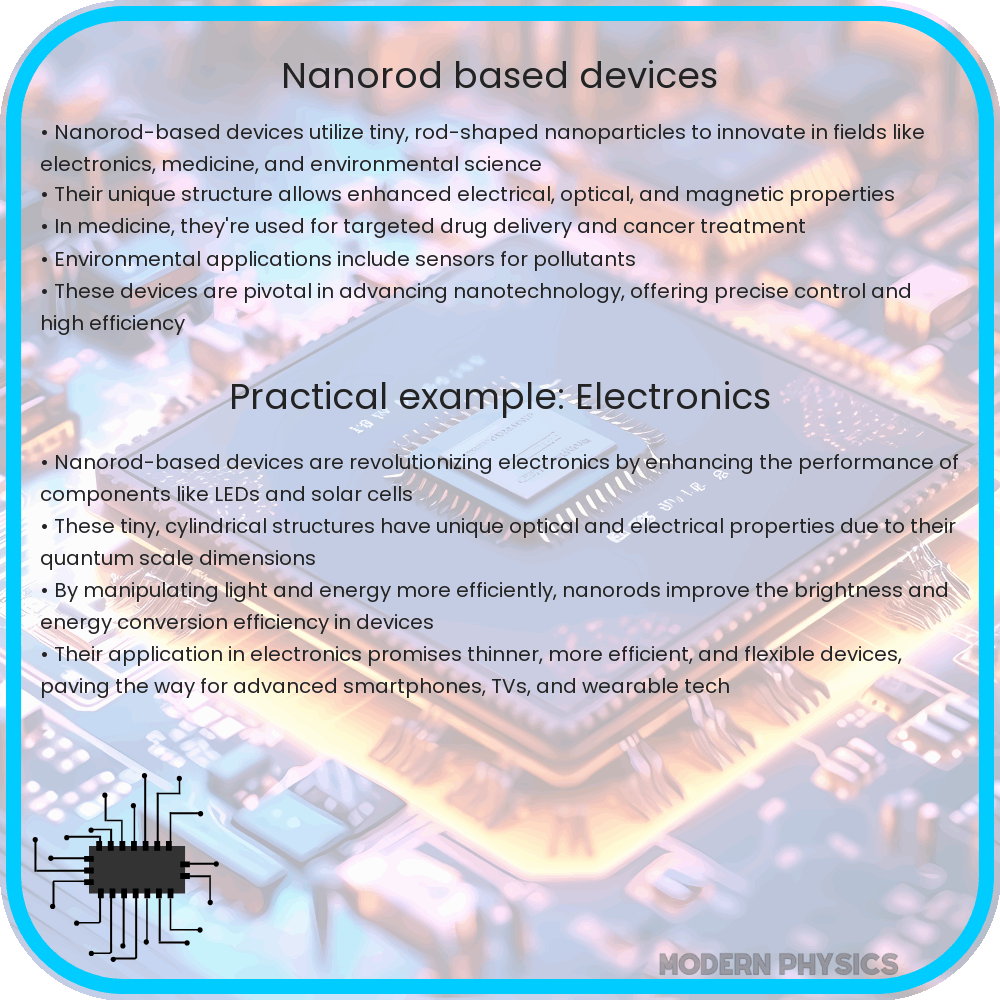
Introduction to Nanorod-Based Devices
As we delve into the realm of nanotechnology, nanorod-based devices emerge as a frontier of innovation in material science, with implications spreading throughout physics, electronics, and biotechnologies. Nanorods, which are cylindrical nanostructures with diameters in the range of nanometers (typically 1-100 nm), possess unique optical, electrical, and magnetic properties that make them suitable for a variety of applications.
Understanding Nanorods
Nanorods are typically fabricated from semiconducting materials such as gold, silver, silicon, or zinc oxide. The precise control over the size, shape, and composition of these nanorods allows scientists to tailor their properties to suit specific needs. This attribute is particularly crucial in enhancing the efficiency and performance of devices based on these nanostructures.
Efficiency of Nanorod-Based Devices
One of the most remarkable aspects of nanorod-based devices is their efficiency. The high surface area-to-volume ratio of nanorods facilitates better interaction of materials at the molecular level. For instance, in photovoltaic cells, this means more effective light absorption and conversion of solar energy into electricity. Nanorods can be oriented precisely to optimize the light absorption, significantly boosting the efficiency of solar cells.
- Photovoltaics: By embedding nanorods made from materials like titanium dioxide, researchers have been able to develop solar cells that convert sunlight to energy more efficiently than traditional flat-surface cells.
- Sensors: In sensor technology, the enhanced surface area of nanorods allows for greater sensitivity to chemical and biological agents, which is key for medical diagnostics and environmental monitoring.
Usability of Nanorod-Based Devices
The increasing usability of nanorod-based devices stems from their compatibility with existing manufacturing processes. Nanorods can be synthesized through relatively straightforward methods, such as vapor deposition and solution-based synthesis, making them easy to integrate into current production lines. Additionally, their mechanical robustness and stability under stress make nanorods ideal for use in rugged environments, further expanding their practical applications.
Innovation Driven by Nanorods
The field of nanorods is ripe with innovation, mainly because these structures offer so much potential across various domains. In medicine, for example, gold nanorods are being explored for use in hyperthermic treatments, where they can be used to precisely target cancer cells and convert light energy into heat, destroying malignant cells with minimal impact on surrounding healthy tissues.
- Drug Delivery: Nanorods can be engineered to attach to specific cell receptors and deliver drugs directly to targeted cells, thereby increasing the efficacy and reducing side effects of treatments.
- Optoelectronics: In the field of optoelectronics, nanorods are employed in the creation of light-emitting diodes (LEDs) and lasers that operate at energy levels and efficiencies unattainable with bulk materials.
Across these applications, the customizability of nanorods stands out. Their properties can be fine-tuned by altering their composition, size, and even the way they are arranged within a material. This versatility opens up new avenues for the development of next-generation electronic, photonic, and medical devices.
Environmental Impact and Sustainability
The implications of nanorod technology extend beyond just technical advancements; they also pose important questions about environmental impact and sustainability. For instance, while the high efficiency of nanorod-based devices could lead to reduced energy usage and fewer emissions, the manufacturing and disposal processes involve materials that may be harmful to the environment. It is crucial for ongoing research to not only focus on enhancing the capabilities of these devices but also on developing greener methods of production and recycling to mitigate any adverse environmental effects.
- Eco-Friendly Materials: Research is being directed towards using less toxic materials for nanorod production to decrease environmental degradation.
- Recycling Techniques: Advanced techniques are being developed to recycle nanorod-based devices safely and efficiently to ensure that these technologies are sustainable in the long run.
Challenges and Future Perspectives
Despite their numerous benefits, nanorod-based devices face several challenges. Among the key issues are manufacturability at scale and consistency in performance across different production batches. Moreover, integrating these nanostructures into existing systems without disrupting them poses a substantial technology transfer challenge.
Future research in nanorod technology will likely focus on overcoming these hurdles. With rapid advancements in nano-fabrication and characterization techniques, it is expected that nanorod-based applications will become more practical and widespread. This will further spur innovation in areas such as energy efficiency, medical therapies, and environmental monitoring, continually pushing the boundaries of what is possible in nanotechnology.
Conclusion
Nanorod-based devices represent a significant stride toward a new era of technological innovation that could transform an array of industries, from renewable energies to healthcare. Their unique properties enable enhanced performance and functionality that is unachievable with traditional materials. However, the drive towards widespread adoption of nanorods must also consider environmental impacts and scalability challenges. By addressing these issues, we can fully harness the potential of nanorods to not only innovate but also contribute positively towards sustainability and societal well-being. With the concerted efforts of scientists, engineers, and policymakers, the future of nanorod technology looks promising, offering exciting possibilities for addressing some of the most pressing challenges of our time.