
Explore the cutting-edge advancements in nanomagnetism, its applications in technology and medicine, and the theoretical backbone in solid state physics.
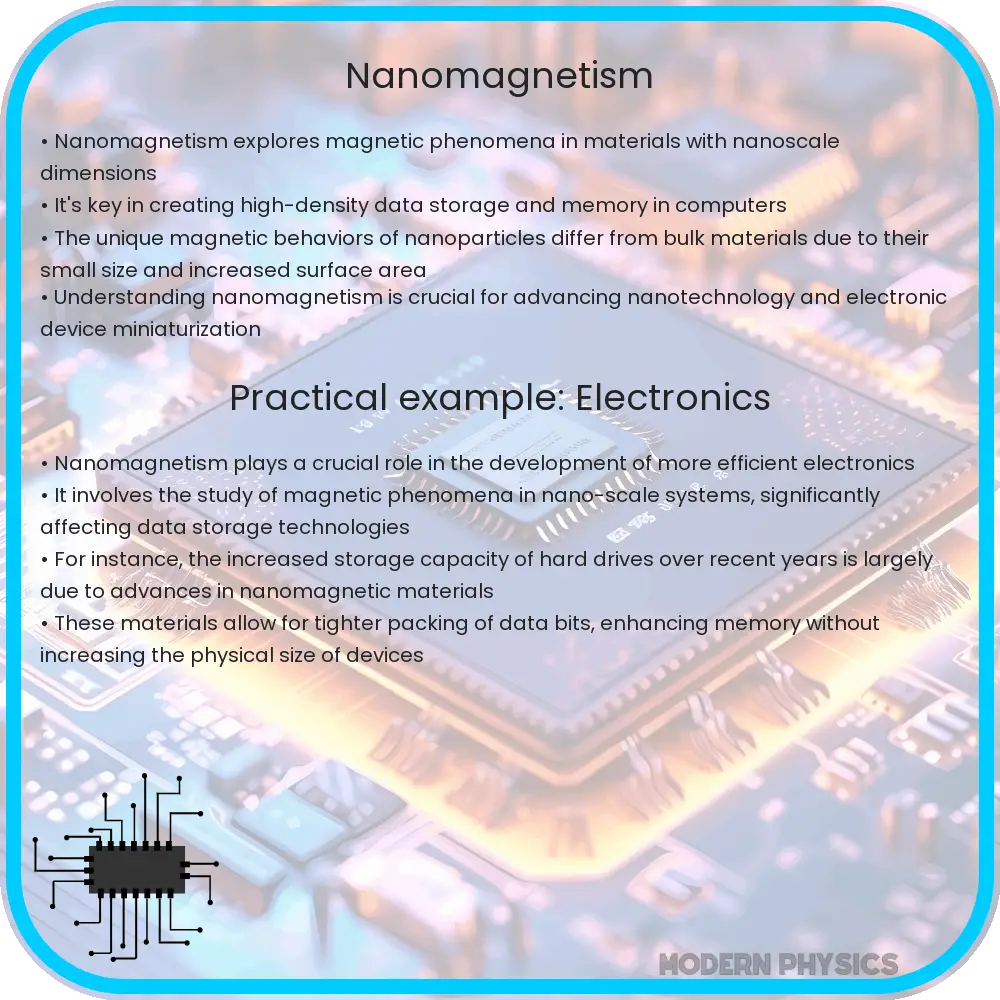
Nanomagnetism: Unveiling the Future of Technology
Nanomagnetism is a field of solid state physics that explores the magnetic behavior of systems at the nanoscale. This intriguing area of study has become increasingly significant due to its potential applications in various technologies, including data storage, medical diagnostics, and electronics. The advances in nanomagnetism are driving innovations that could redefine the landscape of current technologies, making devices more efficient, compact, and capable.
Advancements in Nanomagnetism
Recent advancements in nanomagnetism are largely attributed to the development of novel materials and fabrication techniques. For example, the synthesis of magnetic nanoparticles and thin films with precise control over size, shape, and composition has opened new avenues for research and applications. These materials exhibit unique magnetic properties that are not found in their bulk counterparts, such as superparamagnetism and quantum tunneling of magnetization. Additionally, the advent of spintronics, which utilizes the spin of electrons along with their charge, is revolutionizing the field of electronics by promising faster, more efficient devices.
Applications of Nanomagnetism
- Data Storage: Magnetic nanoparticles are used to enhance the density and efficiency of data storage devices. Techniques like magnetic recording on nanoparticle arrays have shown potential for significantly increasing storage capacity.
- Medical Diagnostics and Treatment: Nanomagnetic particles are employed in targeted drug delivery, magnetic resonance imaging (MRI) contrast agents, and hyperthermia treatment for cancer, showcasing the versatility of nanomagnetism in the medical field.
- Environmental Remediation: Magnetic nanoparticles facilitate the removal of contaminants from water, illustrating an eco-friendly application of nanomagnetism.
Theoretical Underpinnings of Nanomagnetism
The theoretical framework of nanomagnetism revolves around understanding the quantum and classical magnetic phenomena at the nanoscale. Key concepts include the exchange interaction, which is responsible for the alignment of magnetic moments in materials, and the anisotropy that dictates the preferred direction of these magnetic moments. The size and shape of nanoparticles also play a crucial role in their magnetic behavior, influencing properties like coercivity and saturation magnetization. Computational models and simulations are integral in predicting and analyzing these complex phenomena, guiding experimental efforts and the design of nanomagnetic devices.
Nanomagnetism: A Frontier in Solid State Physics
Nanomagnetism, a subfield of solid state physics, explores the magnetic behaviors of materials at the nanoscale. It is a discipline that bridges classical magnetism and quantum mechanics, revealing phenomena that are not observable in bulk materials. This field has seen significant advancements in recent years, driven by both theoretical developments and experimental breakthroughs. The applications of nanomagnetism are vast, ranging from data storage solutions to medical therapies, highlighting its importance in modern technology and research.
Advancements in Nanomagnetism
One of the key advancements in nanomagnetism is the manipulation of spintronics, where the spin of electrons, rather than their charge, is used for information processing. This has led to the development of more efficient, high-density memory devices. Additionally, the discovery of new magnetic materials at the nanoscale, such as single-molecule magnets (SMMs) and magnetic nanoparticles, has expanded the potential applications of nanomagnetic systems.
Another significant advancement is in the synthesis and characterization techniques, such as atomic layer deposition (ALD) and scanning tunneling microscopy (STM), which have enabled precise control over the magnetic properties of nanoscale materials. These techniques have opened new avenues for the study of quantum effects in magnetism and the engineering of magnetic nanostructures with tailored properties.
Applications of Nanomagnetism
The applications of nanomagnetism are diverse and impactful. In data storage, nanomagnetic materials are used to increase the density and efficiency of memory devices, such as hard drives and magnetic random access memory (MRAM). This is achieved through the development of nanoscale magnetic bits that can store information more compactly than traditional materials.
In the medical field, nanomagnetic particles are employed in diagnostic imaging and targeted drug delivery. For example, superparamagnetic iron oxide nanoparticles (SPIONs) are used as contrast agents in magnetic resonance imaging (MRI) to improve the visibility of internal structures. Moreover, magnetic nanoparticles can be directed to specific sites within the body using external magnetic fields, enabling precise delivery of therapeutic agents.
Theoretical Insights into Nanomagnetism
The theoretical understanding of nanomagnetism has also advanced, with quantum mechanics playing a crucial role in explaining the magnetic properties of nanoscale materials. Theories such as the quantum theory of magnetism and the Heisenberg model have been adapted to describe the complex interactions within magnetic nanoparticles and thin films. These theoretical frameworks help predict the behavior of nanomagnetic systems, guiding the design of new materials and devices.
Conclusion
Nanomagnetism stands at the intersection of classical physics and quantum mechanics, offering insights into the magnetic properties of materials at the nanoscale. The advancements in this field have not only deepened our understanding of fundamental physics but also paved the way for innovative applications in technology and medicine. As research continues, the potential of nanomagnetism is bound to expand, promising new solutions to contemporary challenges and contributing to the advancement of science and technology.