
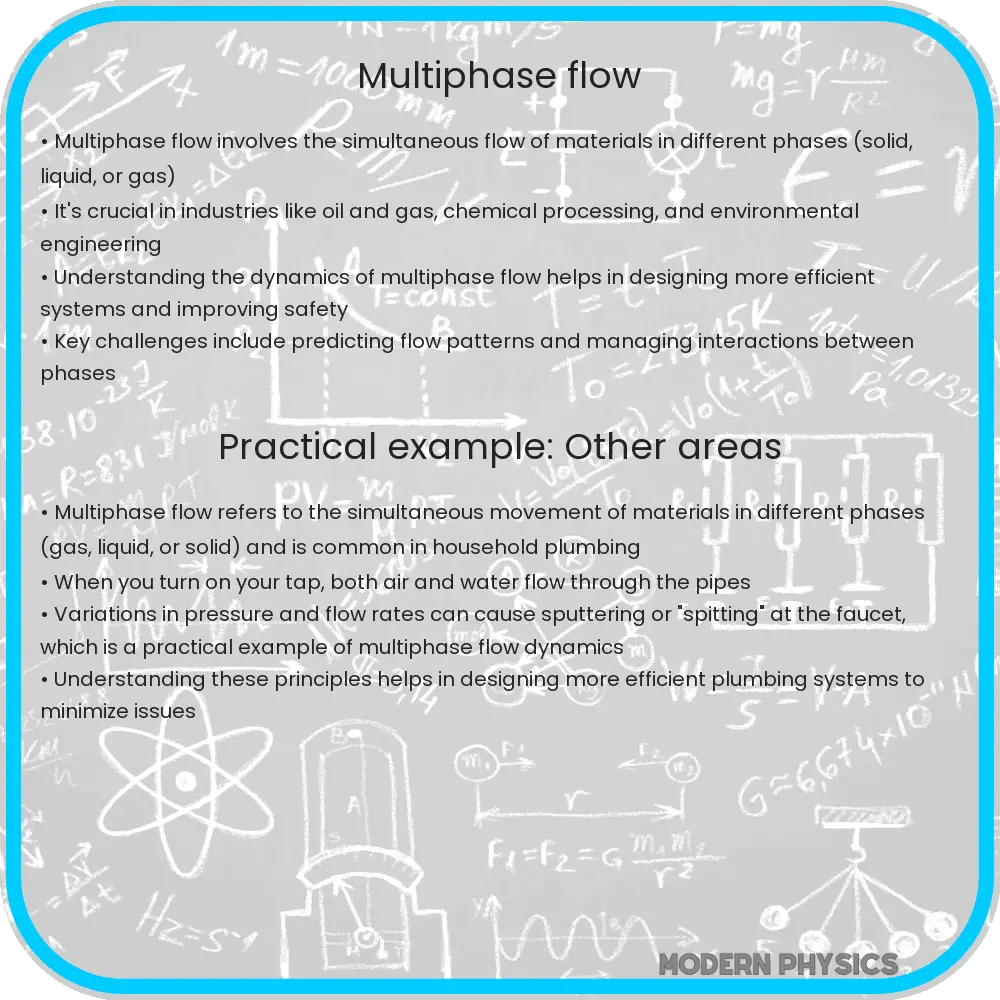
Multiphase flow involves the simultaneous movement of materials with different phases (solid, liquid, gas) within a single conduit, essential for optimizing industrial processes.
Understanding Multiphase Flow in Hydrodynamics
Multiphase flow refers to the simultaneous flow of materials with different phases (solid, liquid, or gas) or different chemical properties within the same conduit. In the field of hydrodynamics, this topic is particularly vital because it combines the complexities of fluid dynamics with the diverse behaviors of mixed materials. Understanding these flows is crucial for optimizing processes across various industries, including oil and gas, chemical manufacturing, and wastewater treatment.
Types of Multiphase Flow
There are several types of multiphase flow, primarily categorized by the state of the materials involved:
- Gas-Liquid: Such as gas bubbles in liquid.
- Liquid-Liquid: Different liquids that do not mix, like oil and water.
- Gas-Solid: Solid particles carried through a gas stream, often seen in pneumatic conveying systems.
- Liquid-Solid: Solid particles in a liquid, such as slurry flows in pipelines.
- Gas-Liquid-Solid: A combination of all three phases, which is common in chemical reactors.
Hydrodynamic Analysis of Multiphase Flow
The analysis of multiphase flow focuses on understanding how these different phases interact and influence each other’s movement and properties. Key aspects of analyzing these flows include:
- Flow Regimes: Depending on their relative velocities and concentrations, multiphase flows can exhibit different flow regimes, such as bubbly, slug, or annular flows.
- Pressure Drop: Changes in pressure along the flow path are more complex in multiphase systems due to the interactions between phases.
- Phase Distribution: The spatial distribution and temporal stability of phases impact the flow dynamics and need comprehensive understanding.
Mathematically, the multiphase flow can be modeled using various approaches, with the most common being the Eulerian and Lagrangian perspectives. The Eulerian approach treats each phase as a continuum and solves the Navier-Stokes equations for each phase separately. Alternatively, the Lagrangian approach models the dispersed phase not as a continuous fluid but in terms of discrete particles, bubbles, or droplets, tracking their interactions and trajectories.
Optimization of Multiphase Flow Systems
Enhancing the efficiency and efficacy of systems handling multiphase flows is essential. Optimization can be achieved by:
- Controlling Flow Rates: Adjusting the flow rates of different phases to stabilize the flow and minimize interactions that might cause blockages or equipment wear.
- Improved Piping Design: Designing pipe systems that accommodate changes in flow types (e.g., from slug flow to bubbly flow) can prevent structural failures and improve longevity.
- Advanced Monitoring Techniques: Using sensors and flow meters to continuously measure flow characteristics and adjust operational parameters in real time.
Efforts in optimization not only aim to reduce operating costs but also strive to enhance safety measures and minimize environmental impacts. These objectives drive ongoing research and innovations in the technology and methodologies applied to multiphase flow systems.
Next, we will delve deeper into the technical modeling approaches and real-world applications of multiphase flow analysis and optimization, highlighting the challenges and solutions identified in recent research.
Modeling Approaches in Multiphase Flow Analysis
Technical modeling of multiphase flow is a complex endeavor that employs a variety of computational techniques to predict and analyze flow behavior. The primary models include:
- Volume of Fluid (VOF): This method is used for tracking and locating the interface between two immiscible fluids. It provides a clear description of phase distribution and is particularly useful in simulating the merging and breaking of drops and bubbles.
- Mixture Model: Suitable for flows where phases are intimately mixed, this model treats the flow as a single continuous phase with properties that are a volume-averaged sum of the individual phases’ properties.
- Computational Fluid Dynamics (CFD): CFD simulations are extensively used in multiphase flow analysis to solve the Navier-Stokes equations numerically, offering detailed insights into flow dynamics, turbulence, and interaction of phases.
These models help engineers and scientists visualize complex flow patterns and optimize system performance under varied operational conditions.
Real-World Applications of Multiphase Flow
The practical applications of understanding and controlling multiphase flow are vast and impactful:
- Oil and Gas Industry: In the extraction and processing of oil, multiphase flow knowledge helps in designing efficient separators and pipelines, crucial for enhancing oil recovery and reducing malfunctions due to phase interactions.
- Chemical Engineering: Reactors and mixers in the chemical industry often handle multiple phases; understanding their dynamics can improve reaction rates and yield, leading to more efficient processes.
- Environmental Engineering: Treatment plants use multiphase flow principles to separate wastes and treat water, essential for maintaining environmentally safe discharge standards.
Moreover, advances in multiphase flow research continue to open new avenues in biomedical engineering, pharmaceuticals, and even space exploration, where fluid behavior in zero gravity poses unique challenges.
Conclusion
Multiphase flow is a critical component of modern engineering and technology that affects numerous industry sectors globally. From designing better oil recovery systems to more efficient chemical reactors, the insights gained from studying such flows lead to significant economical and environmental benefits. As technology continues to advance, the scope for innovation in this area expands, promising more sophisticated methods to handle and utilize the unique characteristics of multiphase systems.
By investing in research and development in the field of hydrodynamics, especially multiphase flow, engineers and scientists pave the way for more sustainable industrial practices and innovative solutions to technical challenges. This ongoing pursuit not only sharpens our understanding but also enhances our capacity to mold natural phenomena for beneficial outcomes.