
Explore Modulation Transfer Function (MTF) in optics: Learn about clarity, resolution, contrast in lenses and its practical applications.
Understanding MTF in Geometrical Optics: Clarity, Resolution, and Contrast
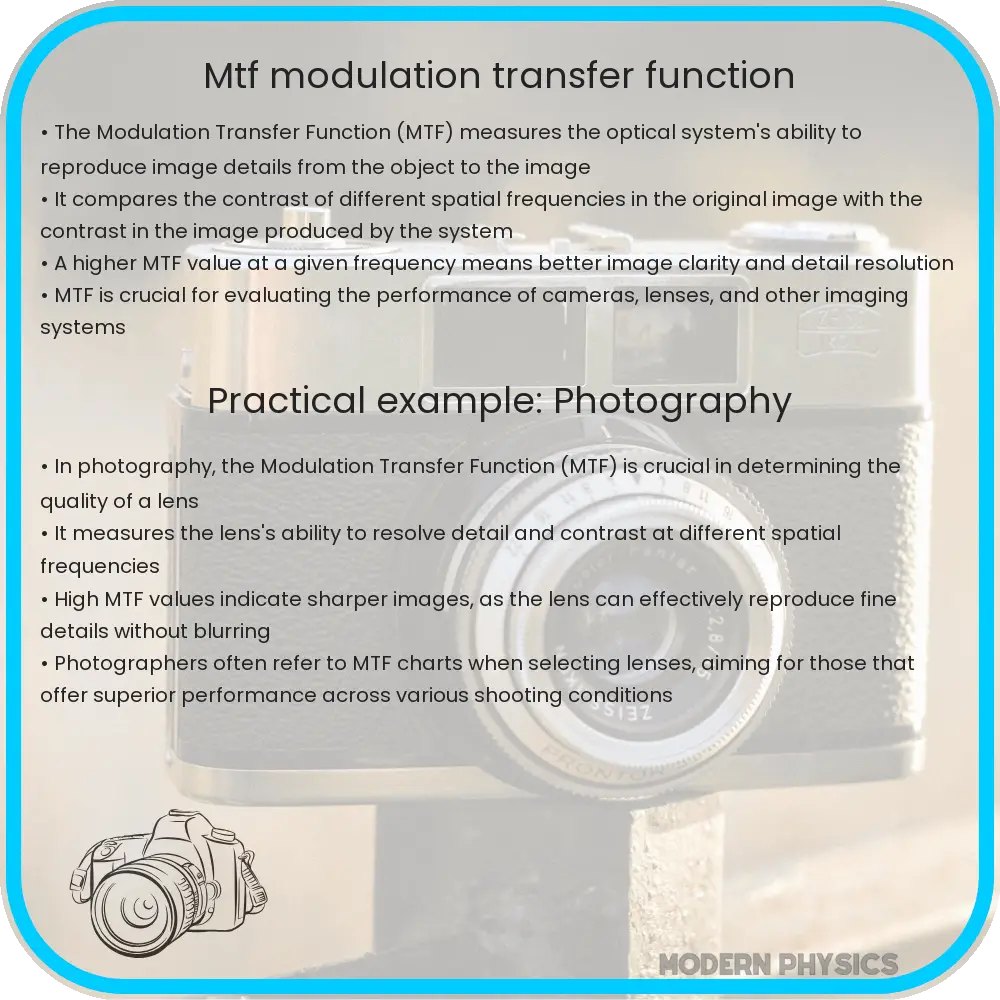
Modulation Transfer Function (MTF) is a critical concept in geometrical optics, playing a significant role in determining the clarity, resolution, and contrast of optical systems. It is a measure of an optical system’s ability to transfer contrast from the object to the image over a range of spatial frequencies. In simpler terms, MTF describes how well an optical system can reproduce various levels of detail from an object to an image.
Clarity and Resolution in Optical Systems
The clarity of an optical image is closely tied to its resolution, which refers to the optical system’s ability to distinguish between fine details in the object. Higher resolution implies that smaller details can be resolved. In the context of MTF, a higher value indicates better ability to reproduce finer details, leading to clearer images. MTF is typically represented as a curve, showing the contrast produced by the system at different spatial frequencies. The spatial frequency is measured in cycles or line pairs per millimeter (lp/mm), and it signifies the level of detail in the image.
Contrast: A Key Component of Image Quality
Contrast in optical terms is the difference in luminance or color that makes an object distinguishable from other objects and the background. In the MTF curve, the contrast is measured at various spatial frequencies. At low frequencies, where details are more extensive and less intricate, most optical systems can reproduce high contrast. However, as the frequency increases, representing finer details, the contrast typically decreases. This decrease in contrast at higher frequencies is a fundamental characteristic of all optical systems and is crucial in defining the system’s performance.
The Role of MTF in Lens Evaluation and Design
MTF is not only a tool for analyzing existing optical systems but also a vital parameter in lens design. It helps in quantifying how different lens designs, materials, and coatings affect the overall image quality. By understanding and manipulating the MTF, optical engineers can optimize lenses for specific applications, whether it’s for high-resolution photography, microscopy, or telescopic observations.
In conclusion, the MTF provides a comprehensive understanding of how well an optical system can preserve the clarity, resolution, and contrast of an image. Its importance in the design and evaluation of lenses and other optical components cannot be overstated, making it a cornerstone concept in the field of geometrical optics.
Factors Influencing MTF in Optical Systems
Several factors can influence the MTF of an optical system. These include the aperture size, aberrations, diffraction, and the quality of lens elements. A larger aperture generally allows more light and thus can potentially increase resolution but can also introduce aberrations. Lens aberrations, such as spherical and chromatic aberrations, degrade the MTF by causing image distortions. Furthermore, diffraction, which occurs when light waves encounter obstacles like the edges of a lens, limits the maximum resolution of an optical system.
MTF and Sensor Resolution
In digital imaging, the resolution of the sensor also plays a crucial role in the system’s MTF. The pixel size of the sensor determines the smallest detail that can be captured. An optical system with high MTF might still produce poor images if the sensor resolution is inadequate. Conversely, a high-resolution sensor cannot compensate for a lens with poor MTF. Therefore, a balance between the lens’s MTF and the sensor’s resolution is essential for optimal image quality.
Practical Applications of MTF Analysis
MTF analysis is extensively used in various fields. In photography, it helps in lens selection and camera settings optimization. In astronomy, MTF is crucial for telescope lenses to ensure clear celestial images. In medical imaging, such as MRI and CT scans, high MTF is vital for accurate diagnosis. The application of MTF in these areas shows its versatility and importance in practical scenarios.
Conclusion: The Significance of MTF in Geometrical Optics
In summary, the Modulation Transfer Function is an indispensable tool in geometrical optics, providing a quantitative measure of an optical system’s ability to reproduce clarity, resolution, and contrast. Understanding MTF allows for the evaluation and optimization of optical systems, ensuring that they meet the specific needs of various applications. Whether in photography, astronomy, or medical imaging, MTF plays a pivotal role in achieving high-quality images. As technology advances, the role of MTF in lens design and evaluation will continue to grow, further enhancing our ability to capture and analyze the visual world with greater precision and detail.